From an xChat Deep Dive We Thought Went Nowhere to Three Sleepless Nights at Grok Bot Galaxy
We once thought researching xChat was wasted effort—until Grok Bot flooded our social feeds. What is Grok Bot? We stayed up for all three days of Grok Bot Galaxy and break down, from a marketing team’s perspective, how it turns AI from a “copilot” into a “coworker,” and what that means for social media and CRM work.
 MarketingTeam

A slightly embarrassing confession first
What we originally spent our time researching was actually xChat.
Elon Musk’s standalone messaging app—pitched on end-to-end encryption, sign-up without a phone number, and disappearing messages—was dubbed the “Western WeChat” when it launched on iOS in April, and plenty of users in Taiwan loudly called for it to replace LINE. For a team like ours that lives inside the LINE ecosystem every day, it was obviously a must-study topic. We dug in, published an article, and concluded it was all thunder and no rain. Honestly, at the time it felt like wasted effort: after all that research, the messaging app didn’t seem to make much of a dent. After that, the name Grok went quiet.
Contents
- Silence, then a bombshell
- xChat vs. @grok vs. Grok Bot
- What is Grok Bot?
- What it really changes is AI’s “role” in your work
- What it means for us
- No effort is ever wasted
- FAQ
Silence, then a bombshell
The mood back then went something like this: ChatGPT and Claude kept shipping steady upgrades, while Gemini stumbled from one issue to the next and became a favorite source of social media memes. Grok? Barely a peep. Just as many people assumed it was quietly folding its hand, xAI dropped a bombshell: Grok Bot.
Before long, it was all over our feeds—practically everyone talking about AI or automation was sharing it and trying it out. Financial media even hailed it as “the next ChatGPT moment.” That’s when it clicked for us: the article we thought had gone nowhere was looking at X’s ambitions in messaging. What actually rewrote the rules was X’s ambitions in work.
Don’t mix them up: xChat, @grok, and Grok Bot are three different things
Before going further, let’s untangle the three names people confuse most—which is also why so many people couldn’t read the board at the time:
In a nutshell: the first two are tools; the third wants to be your coworker.
What is Grok Bot? Let’s find out at Grok Bot Galaxy
 Three people, 72 hours, a company built from scratch
Rather than rely on secondhand takes, we wanted to watch it actually work. So we followed Grok Bot Galaxy from start to finish.
It was a three-day xAI event held September 15–17 at The Howard in San Francisco, running 8:30 a.m. to 6:00 p.m. Pacific Time each day, with a parallel livestream open to viewers worldwide. In Taiwan time, that meant streaming from 11:30 p.m. until 9:00 a.m. the next morning. Reportedly, about 70,000 people had registered for the livestream before it even started.
The three days actually ran two tracks in parallel, which are easy to confuse at first. One was a set of role-based hands-on sessions, each using a practice demo company to show “how this role works with a Bot as a coworker.” The other—and the real crowd-pleaser—was the build-a-company-from-scratch-in-72-hours challenge. Keep the two apart, or you’ll end up mistaking a “teaching sandbox” for “real-world results.”
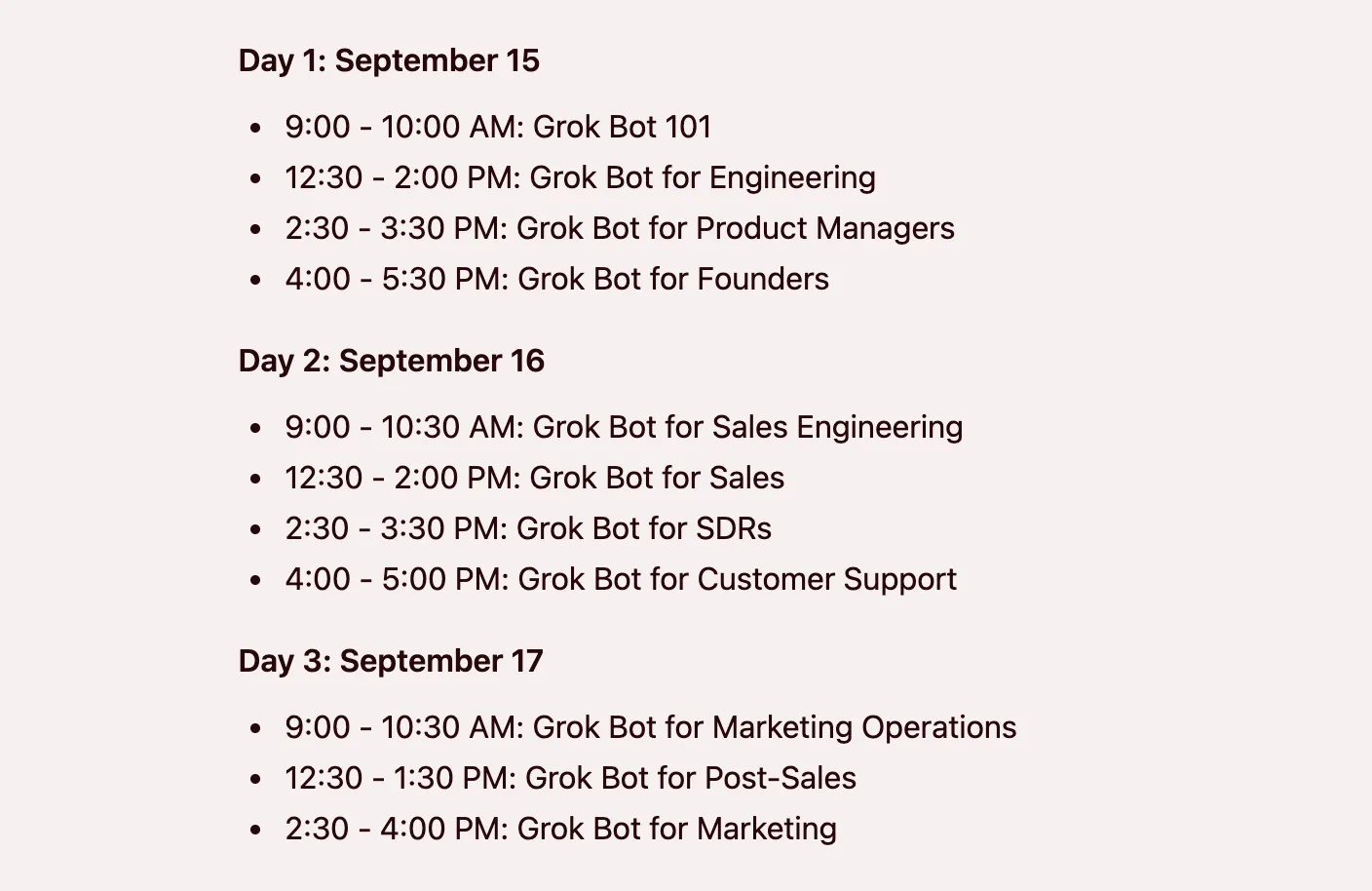 The agenda published on the event page
First, the hands-on sessions. The role-based lineup went like this: Day 1 covered the basics, engineering, product decisions, and the founder’s perspective; Day 2 shifted to the business side—presales, sales, SDRs, and customer support; Day 3 wrapped up with marketing operations, post-sale follow-up, and marketing. The point wasn’t how to write code—it was how the same method actually looks different when you’re writing a sales prospecting email versus debugging a backend. For those of us who handle content, lead lists, and customer service, the Day 3 sessions were essentially a breakdown of our daily work.
Now the challenge that stole the show: Lauren Tan, Matt Palmer, and Roshan Sadanani treated Grok Bot as their own staff. In their own words, they kicked off with “no name, no product, no idea yet,” and joked that if they couldn’t pull it off, they’d “turn into pizza.” This wasn’t an edited three-minute demo—it was three straight days of a real build by real people, live. By the end, they had actually launched a playable browser-based battle game, Thursday Arena (thursdayarena.com, where the site also recaps the three-day livestreamed build).
To be honest, though, what the challenge proved is that you can ship a working product in 72 hours—not that you can build a money-making business. When they wrapped, they had a playable version, but the first real dollar of revenue hadn’t come in yet. That distinction is exactly what we think deserves to be spelled out: don’t count “free trials” and “sign-ups” as money already earned.
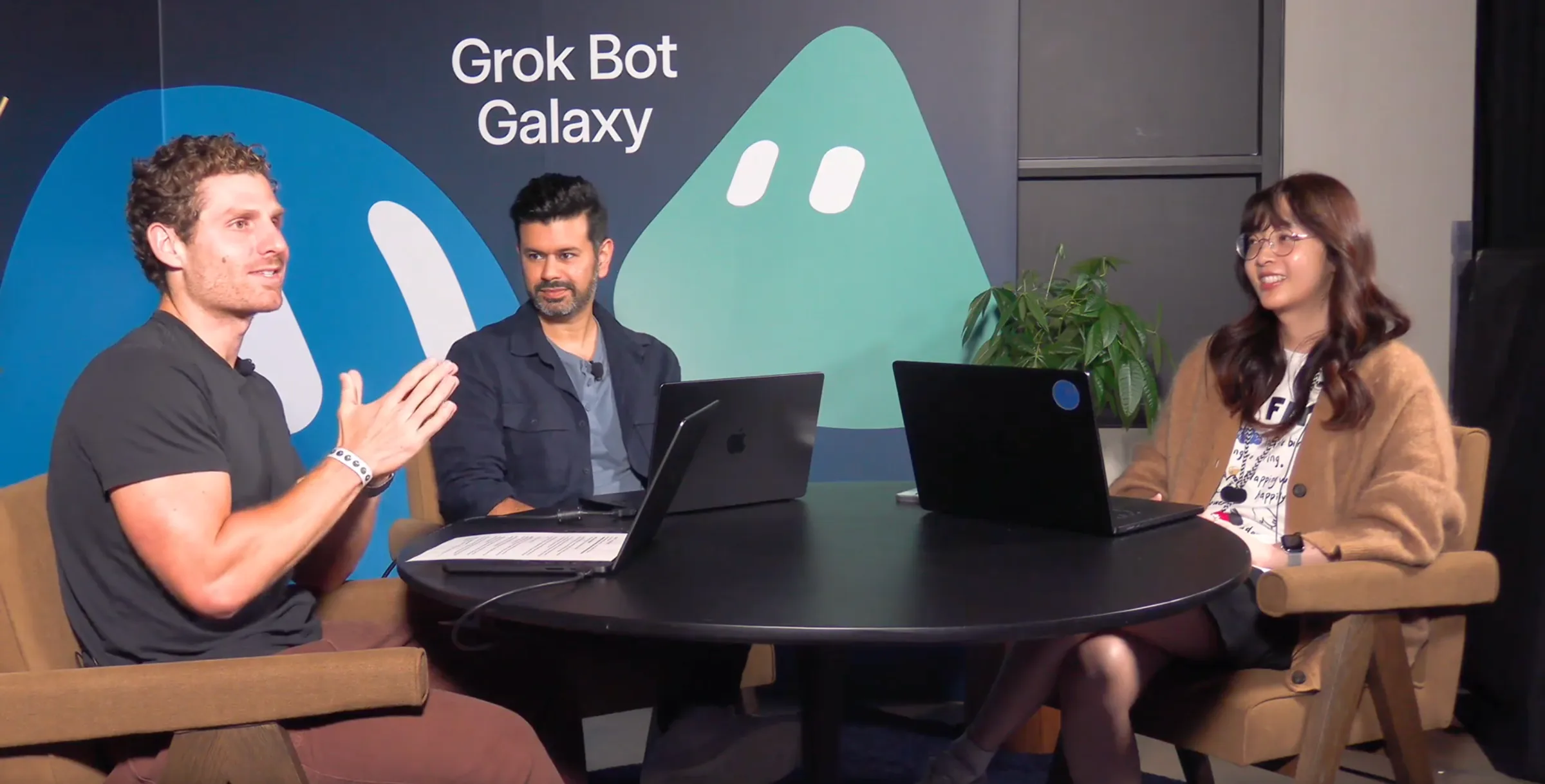 Screenshot from X’s public replay
What it really changes is AI’s “role” in your work
After three days of watching, our gut feeling is this: it isn’t yet another smarter chat box—it’s AI moving from “copilot” to “coworker.” The line we kept hearing on stage went roughly like this: the Bot is a coworker, one Bot per role, and the work gets finished; humans keep only a handful of things—setting direction, hitting send, merging code, and paying.
Tools like Claude Code and Codex are still, at heart, “give a command, get a response” copilots—reactive tools that act only once they receive a request. Grok Bot is solving a different problem: instead of firing questions at a single chat box, you lead a team with “one Bot per role.” In practice, you talk to just one “secretary/dispatcher Bot,” which hands tasks off to specialist Bots for research, coding, visual design, and so on, and keeps them on schedule. But it won’t spin up new Bots on its own—who joins the team and how much access they get is always a human decision.
Another principle that stuck with us: “The Bot says it’s done” doesn’t mean “it’s actually done.” Real completion is the moment a human reviews the evidence and clicks merge or send.
The permission design is worth marketers’ attention, too. You don’t hand the AI your main account password; it’s more like onboarding a new hire—connect one tool at a time, grant only the access that’s needed, and any “outward-facing” action (sending email, changing prices, issuing refunds) has to be cleared with a human first. In plain terms: you’re onboarding the AI, not tossing it your whole key ring.
What it means for those of us in social media and CRM
This is where it hit home for us. A social media manager, a freelancer, or a one-person business can lose half the day just replying to customer quote requests and handling repetitive questions. Everyone wants AI to help, but they worry it’ll give a wrong answer and cause irreversible damage. Grok Bot’s answer isn’t full automation—it keeps humans at the key checkpoints: when a new customer inquiry comes in, the Bot drafts a reply based on past data and pushes it to Slack, and only sends it after you approve.
That’s the same direction we’ve always believed in—AI pushes the work to “one step from done,” and humans take that crucial last step: approving, judging, and publishing externally. Honestly, “run my social media for me” sounds tempting, but it actually bundles five kinds of work: research, writing, publishing, replying, and crisis management. What truly takes root tends to be low-risk tasks where mistakes are easy to spot and stopping won’t directly touch external systems. That’s our advice to our team and our clients alike: start with automation you can verify and trace back, take on one or two low-risk tasks at a time, don’t raise a whole flock of Bots at once—and definitely don’t hand over your social accounts wholesale.
Here’s an interesting contrast: xChat wants to win the conversations in your life, while Grok Bot wants to win your work itself.
In today’s crowded AI race, no effort is ever wasted
That xChat article once made us feel we’d wasted our time. We put in the effort and didn’t seem to get much out of it. Looking back now, it wasn’t wasted at all: precisely because we’d done that research, when Grok Bot appeared we were the ones who understood right away what it was doing—and who were willing to stay up for three nights to follow Galaxy all the way through.
That’s our biggest takeaway: in today’s crowded AI race, no effort is ever wasted. Research that doesn’t make waves today often just hasn’t reached the day it pays off; the player who’s gone quiet may be gathering strength. The devil is in the details—and the details reveal themselves only to those who keep watching.
FAQ
Q: How is Grok Bot different from @grok?
@grok is a Q&A bot in X’s reply threads that “answers only when tagged,” and the exchange ends once it replies. Grok Bot is a standalone app that carries out tasks autonomously in the cloud and keeps running in the background even after you leave the page. The former is a tool; the latter is more like a coworker.
Q: What is Grok Bot Galaxy?
A three-day event hosted by xAI on September 15–17, 2026, at The Howard in San Francisco and livestreamed worldwide. It ran on two tracks: role-based hands-on sessions (engineering, product, sales, SDR, customer support, marketing, and more), and a challenge in which three people used Grok Bot as their staff to build a company from scratch in 72 hours—ending with the launch of a playable browser game, Thursday Arena.
Q: Is Grok Bot a good fit for marketing or social media work?
Yes, but we recommend starting with low-risk tasks. It can draft customer service replies and push them to Slack first, sending them only after you approve—keeping humans in the crucial step of approving, judging, and publishing externally.