The problem isn't weak content. It's sending the same message to developers and everyday consumers at once, so neither side ever finds it relevant. Segmentation is what makes everyone feel well looked after. After adopting OakMega Social CRM, KOHLER Taiwan grew its LINE friends by 42% and tagged 90% of them. Its showroom Booking Center passed 100 bookings in under two months, with a cancellation rate of just 7%.
Fitting out the bathrooms in a newly built home usually involves three very different people. The developer's site manager weighs specifications, timelines, and project quotes. The interior designer cares about design language and reference projects. The consumer wants to visit a showroom on the weekend, get a feel for the products, and ask about any limited-time offers.
All three might add KOHLER's LINE Official Account in the same week.
And then they all receive the same message.
The site manager sees a limited-time discount and shrugs. The consumer sees a spec sheet and can't make sense of it. Two days later, a few more blocks show up in the dashboard.
Defining “Gracious Living” through craftsmanship since 1873
Founded in the US in 1873, KOHLER is a century-old bathroom brand built on the philosophy of “Gracious Living,” blending artistic design, exceptional craftsmanship, and forward-looking technology. Starting with enameled cast-iron bathtubs, it has grown into a benchmark for bathrooms in top hotels and contemporary homes worldwide. In Taiwan, KOHLER runs brand showrooms in cities across the island, offering consumers an immersive product experience, while building deep partnerships with B2B partners such as developers and interior designers.
Because it serves both B2B and B2C customers, KOHLER Taiwan's LINE Official Account faced a challenge from day one that most brands don't: how do you make people with completely different needs all feel well served in the same account?
Why can't one broadcast satisfy developers, designers, and consumers at once?
KOHLER's LINE friends were a mix of developer procurement teams, interior designers, distributors, and everyday consumers. Without any way to segment them, broadcasts were practically the only way to communicate. Make a message too technical, and consumers couldn't follow it or simply weren't interested. Make it too casual, and B2B partners found it irrelevant and sometimes blocked the account outright.
A rapid rise in blocks was the most direct result of this broadcast-everything approach.
The sales side was even harder to fix. Each customer group could only be managed one-on-one by individual sales reps. Managers had no way to see in the dashboard which customer was at which stage of negotiation or what had been discussed before. Order visibility was close to zero, and every question meant going back to the sales rep for an answer.
Two pain points existed at the same time: externally, messages couldn't be targeted; internally, the process wasn't transparent.
Segmentation isn't about sorting people. It's about giving each of them their own service experience
When KOHLER came to OakMega, its core need was clear: give customers with different roles a tailored experience inside the same LINE account.
Behind that need was a more fundamental insight. All three groups added KOHLER on LINE because they were interested in KOHLER, just in completely different ways. Developers want efficiency and specs, designers want inspiration and resources, and consumers want experiences and offers. Identify “who you are” right away, and every message after that can be truly relevant.
The answer wasn't “make better content.” It was “get the right content to the right people.”
How does a LINE account sort friends by role in 30 seconds?
Welcome survey: friends identify themselves from the very first step
As soon as someone adds KOHLER's LINE account, it sends a welcome message and a short survey. In under 30 seconds, friends answer questions about their role and preferences. The moment they submit, the system does two things automatically: it writes a complete set of profile tags in the dashboard and switches them to the rich menu designed for their role.
Three roles, three completely different entry points:
| Role | Key rich menu features |
|---|---|
| Consumers | Popular products, contact a specialist, latest product catalog |
| Interior designers | Join the designer community, curated styles, star products, featured projects, contact a specialist |
| Developers | Book a showroom visit, popular products, follow now, purchasing information, warranty service, FAQ |
Developers see the information that matters most for project procurement. Designers see project inspiration and community resources. Consumers see star products and a gateway to offers. Nobody has to filter anything themselves; the system has already done it.
Don't just push products. Get friends to tap in on their own
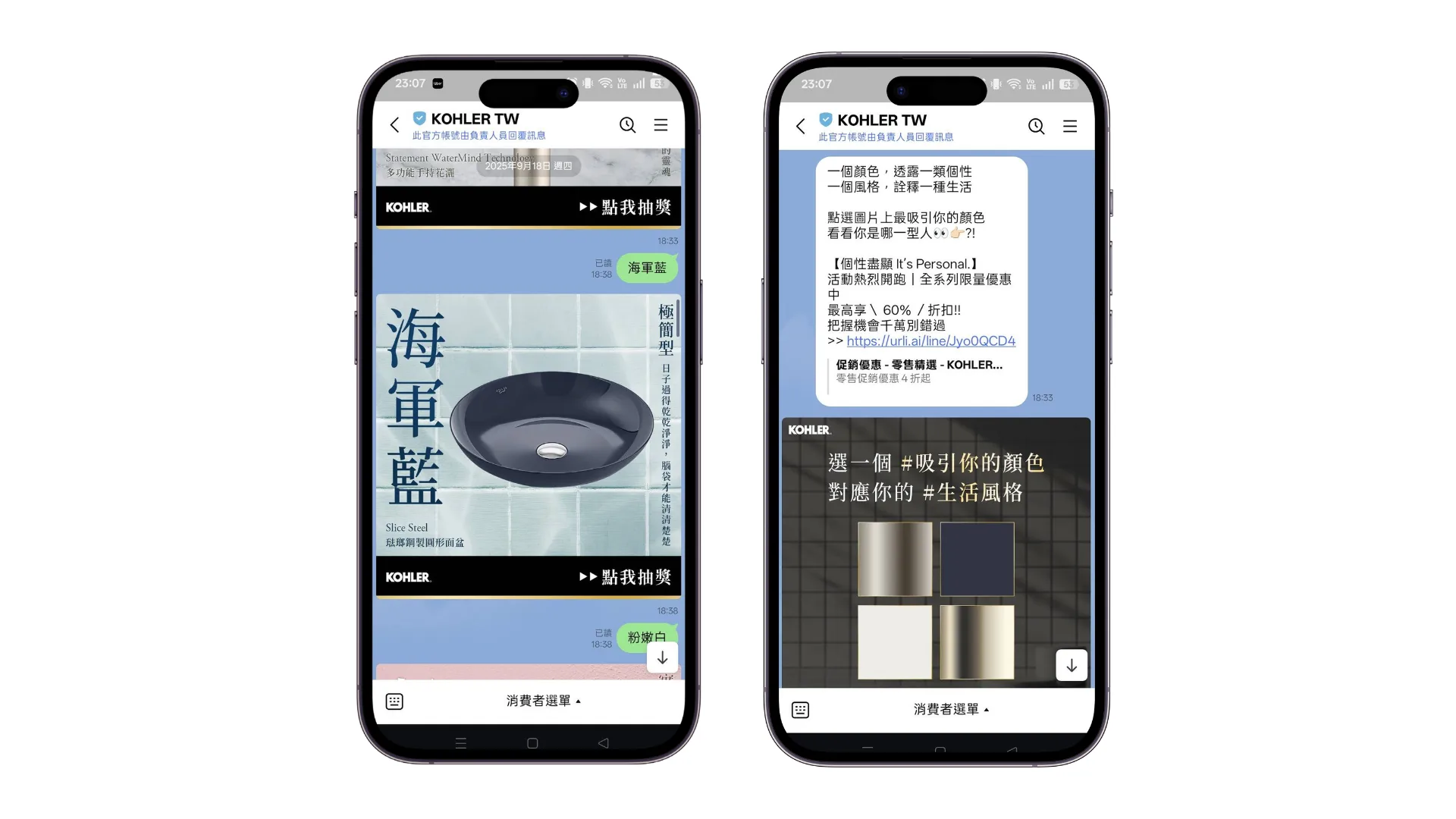
KOHLER's premium products deserve a showcase that makes people stop and take notice. Using OakMega's multi-panel rich messages, KOHLER created the “It's Personal.” interactive series. Friends simply tap an image to choose the color or style that appeals to them most, get matched with a new KOHLER product, and enter a prize draw and sharing campaign at the same time.
This one design does three jobs at once: an effortless interaction reawakens dormant friends, a result card deepens the impression of the new products, and a sharing mechanism brings in new customers. Paired with a limited-time offer across the full collection, the interaction connects directly to purchase intent.
Booking Center: turning showroom bookings into a service, not a process
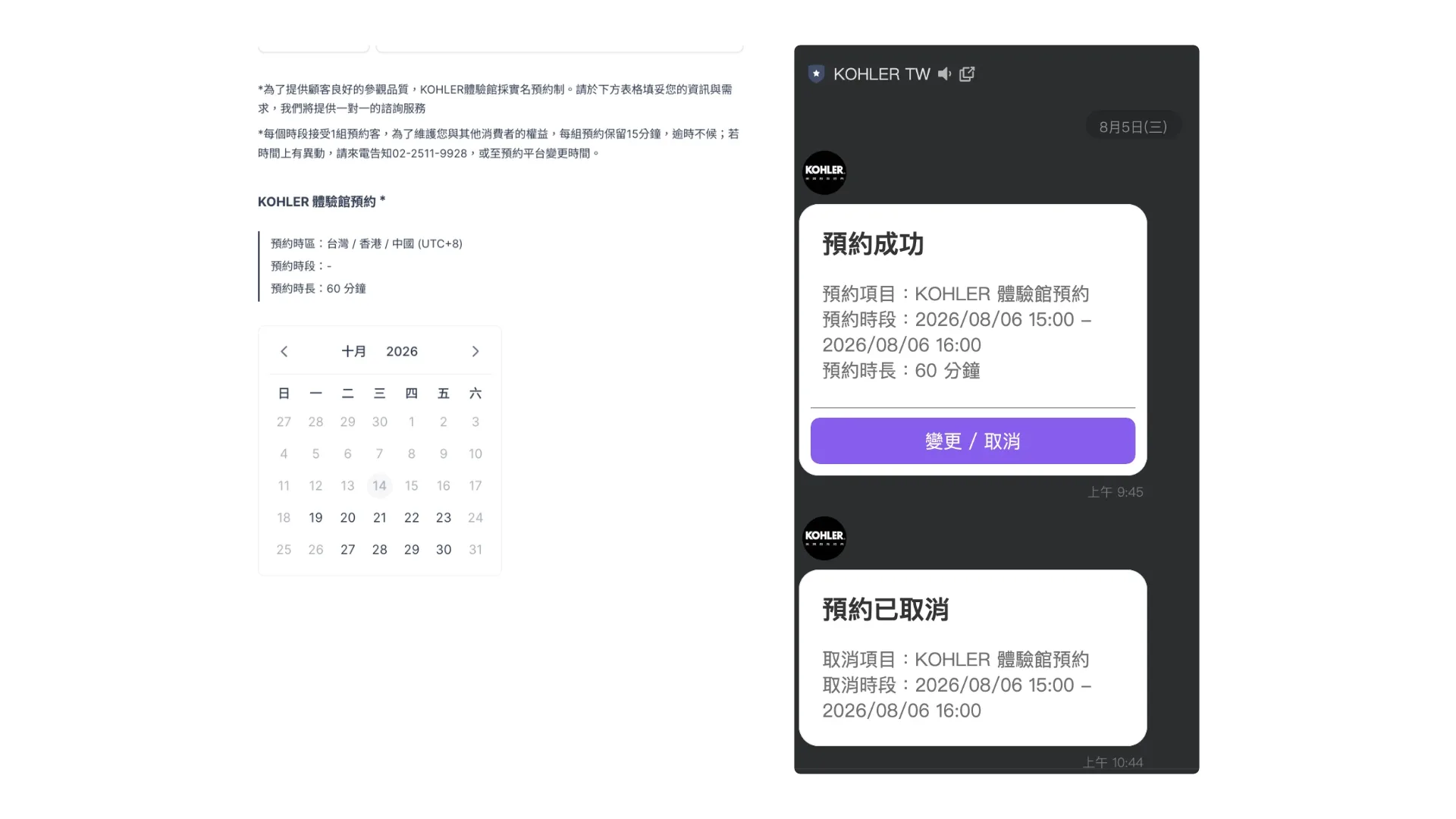
KOHLER's brand showrooms are a key step in selling high-ticket products. Consumers and designers need to see and touch the products in person to truly understand the difference KOHLER's craftsmanship makes. Bookings used to be handled by phone or email, and no-show rates commonly ran between 15% and 25%. Every empty slot was a cost.
The OakMega Booking Center keeps the entire flow inside LINE. Friends pick any open showroom time slot, the system confirms instantly and adds the booking to the calendar, and the LINE Official Account sends a reminder before the appointment. If friends need to reschedule, they can do it right in LINE without picking up the phone.
The result: the post-booking cancellation rate fell from the industry average of 15–25% to 7%. Booked slots are no longer just names on a list; real people actually show up.
One year later, the account looks completely different
| Metric | Data | What it means |
|---|---|---|
| Friend growth | +42% (3,800+ → 5,500+ friends) |
Precise segmentation cuts blocks, so net growth keeps building |
| Tagging rate | 90% | Nine in ten friends have identified their role, giving a clear profile |
| 100+ bookings via the Booking Center | In under two months after launch | Friends are willing to book directly in LINE |
| Showroom booking cancellation rate | 7% | Less than half the industry average of 15–25% |
What does a 90% tagging rate mean? It means KOHLER's dashboard now holds profiles for more than 5,000 friends: who is a designer, who is a developer, who is an everyday consumer, and who is interested in which product line. The next broadcast won't be a blast to everyone. It will reach exactly the right people.
“With OakMega's services, we offer dedicated service to customers in different roles, which has greatly improved our sales efficiency.” — KOHLER Taiwan
Behind the 7% cancellation rate is a mechanism that looks simple: proactive reminders. After confirming a booking, consumers no longer get just a cold confirmation email. Instead, they receive a friendly reminder on LINE before the appointment. That difference turns a booking from “a plan I can cancel anytime” into “an appointment I'm actually going to keep.”
What can brands that mix B2B and B2C borrow from this?
KOHLER's story offers three design principles that any brand serving both B2B and B2C customers, or audiences with very different profiles, can put to work right away.
First: the moment someone adds you is the best chance to segment them. Friends are most willing to engage right after they join. Use that window for a 30-second survey that identifies their role, tags them automatically, and switches them to the right menu. It creates far less friction than adding tags later, and far more people complete it.
Second: interactive games aren't just entertainment; they're the most effective way into product awareness. KOHLER's multi-panel rich messages let consumers actively “choose their own style,” and that act of choosing is itself a brand touchpoint. It's lower-friction and more memorable than pushing product images, and more likely to get shared.
Third: no-shows are a problem you can design away. An industry no-show rate of 15–25% isn't inevitable; it's the result of an incomplete booking flow. A complete reminder mechanism, from confirmation through countdown, with changes handled right inside LINE, can significantly raise show-up rates and make sure every showroom slot is truly put to use.