


A prospective owner walks into the showroom, looks at a Defender, chats with a sales consultant for a while, leaves a phone number, and heads out.
The consultant goes back to the desk and starts typing that customer’s details into the system, field by field. It takes about 40 seconds per person. On a busy weekend, those seconds pile up until well after closing time.
Meanwhile, headquarters has just signed off on a new model announcement for every dealer in Taiwan. The message has to reach each location first, where it gets forwarded, adjusted, and proofread separately. By the time it actually reaches an owner, both the content and the timing may have changed.
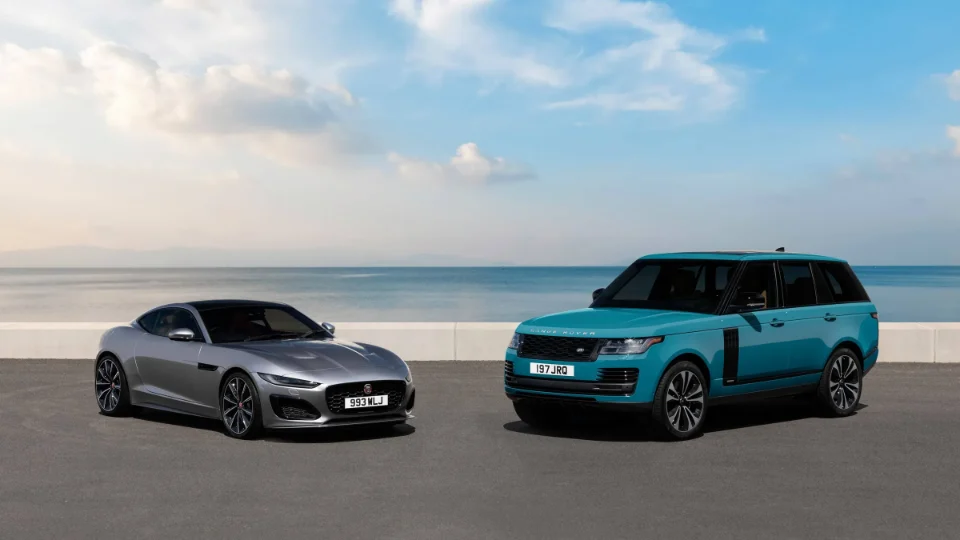
Jaguar Land Rover is the UK’s largest carmaker, and its two brands have very different personalities: Jaguar stands for agile performance and striking design, while Land Rover is the benchmark for all-terrain SUVs. In Taiwan, the company has a local branch, but the people who meet owners face to face work at its authorized dealers.
Headquarters could see the brand, but not the customer. How do you close that gap?
Offline touchpoints never made it into any system
What sets luxury car brands apart from mass-market models is that sales are built on brand loyalty. An owner’s value lies not only in the first purchase but in every service visit, upgrade, and referral that follows. That makes it especially important that every touchpoint is properly remembered.
The problems came from three places.
First, the existing CRM couldn’t reach offline. Jaguar Land Rover already used Salesforce, but the system didn’t cover data from offline sales. What a customer said in the showroom and which car caught their eye mostly stayed in the consultant’s memory and handwritten notes.
Second, there was a gap between headquarters and dealers. The journey from winning a new prospect to becoming an owner spans headquarters and many dealers. Information was passed along through the dealer network, messages arrived in pieces, and headquarters couldn’t communicate with every dealer at the same time.
Third, two brands meant two sets of content. Jaguar and Land Rover need very different broadcasts. Every release required its own coordination and proofreading, which was labor-intensive and often left different versions of the same message in circulation.
The result: communication with prospective owners was poorly targeted. And as other carmakers rolled out online showrooms and digital test drive bookings, standing still meant handing the earliest touchpoints to someone else.
Dealers aren’t the end of the line; they’re nodes that need to be connected
Most brands’ instinct with a dealer network is to hand communication over to the dealers: headquarters sets the direction and dealers execute on their own. For a brand that cares about a consistent experience, that puts the most critical part of the journey in a black box.
Jaguar Land Rover saw it differently: dealers and headquarters actually need the same data and the same flow. As long as the details a customer leaves at first contact flow back into the system right away, headquarters gets the full picture and dealers avoid duplicate work.
The question was never who owns communication. It was whether data could flow between everyone involved.
Connecting Salesforce and LINE with an automotive Social CRM
A Social CRM is a customer relationship management system built around social messaging channels such as LINE. It turns customers’ social interactions, form responses, and behavior into data in real time, so brands can talk to customers based on where they are in their journey. For car brands that rely on dealers, its value is that touchpoints happening offline can also flow back into the same system.
Jaguar Land Rover uses its LINE Official Account as the main channel for engaging owners, and connected its existing Salesforce database with OakMega Social CRM. The account now has more than 10,500 friends.
The approach has three parts:
| Problem to solve | Features used | How it works |
|---|---|---|
| Manual data entry by consultants took too long | Membership forms, survey forms, customer service forms | Separate forms for owners and non-owners, synced to Salesforce automatically on submission |
| Headquarters and dealer messages were out of sync | A dedicated headquarters account, message template sync | Headquarters syncs message templates to every dealer account in one click |
| Customers couldn’t find the right information at each stage | Member center, segmented rich menus, multi-panel rich messages | Separate brand and owner sections, covering everything from browsing to servicing |
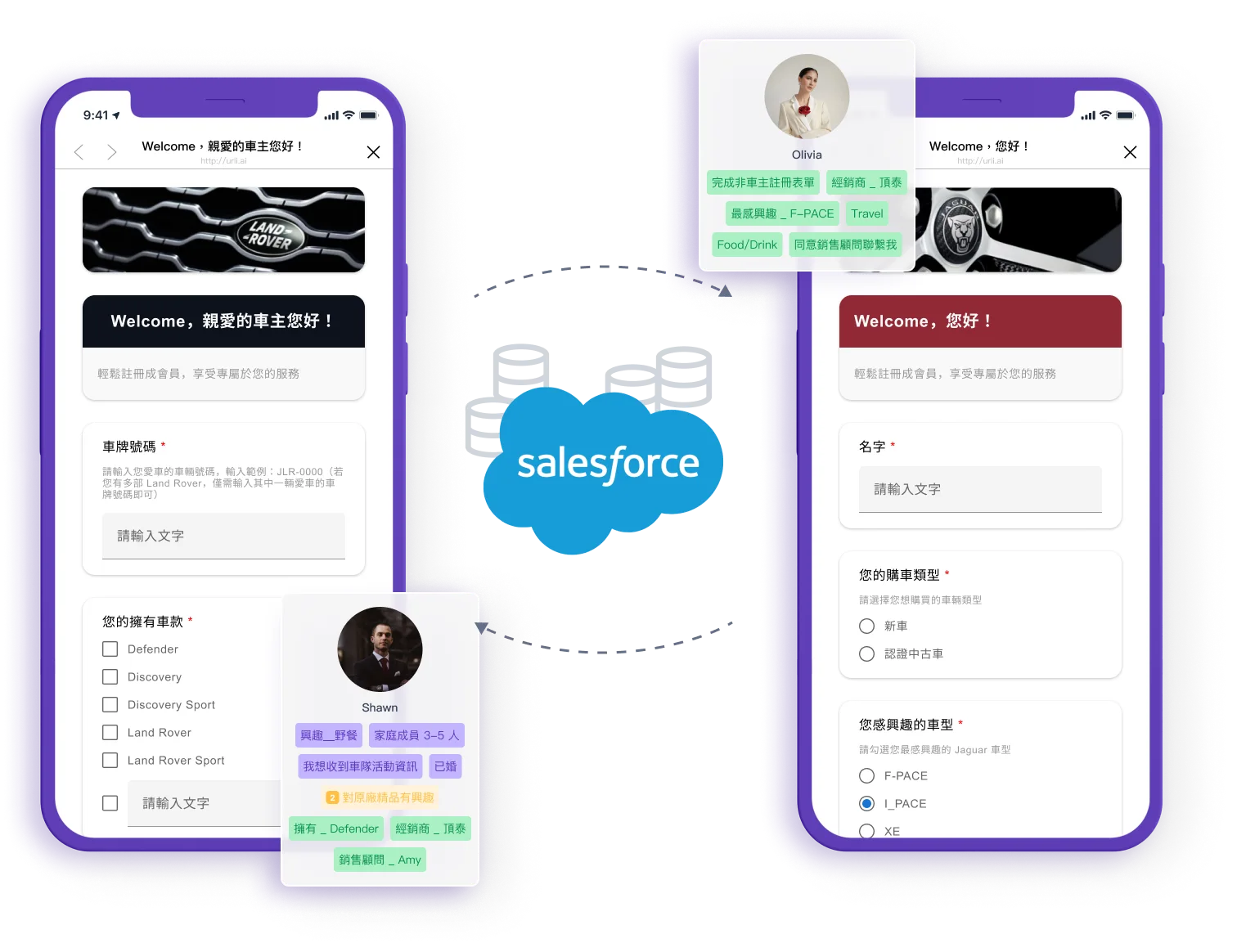
1. Segmented forms replace manual entry. Owners and non-owners fill in different membership forms. The data is recorded in the OakMega Social CRM dashboard and synced to Salesforce in real time. Each customer used to take a sales consultant about 40 seconds to log by hand; now there’s no wait, and the system handles identification and record-keeping on its own. On submission, the system also tags each customer automatically based on their answers, so later broadcasts can be split by buying stage.
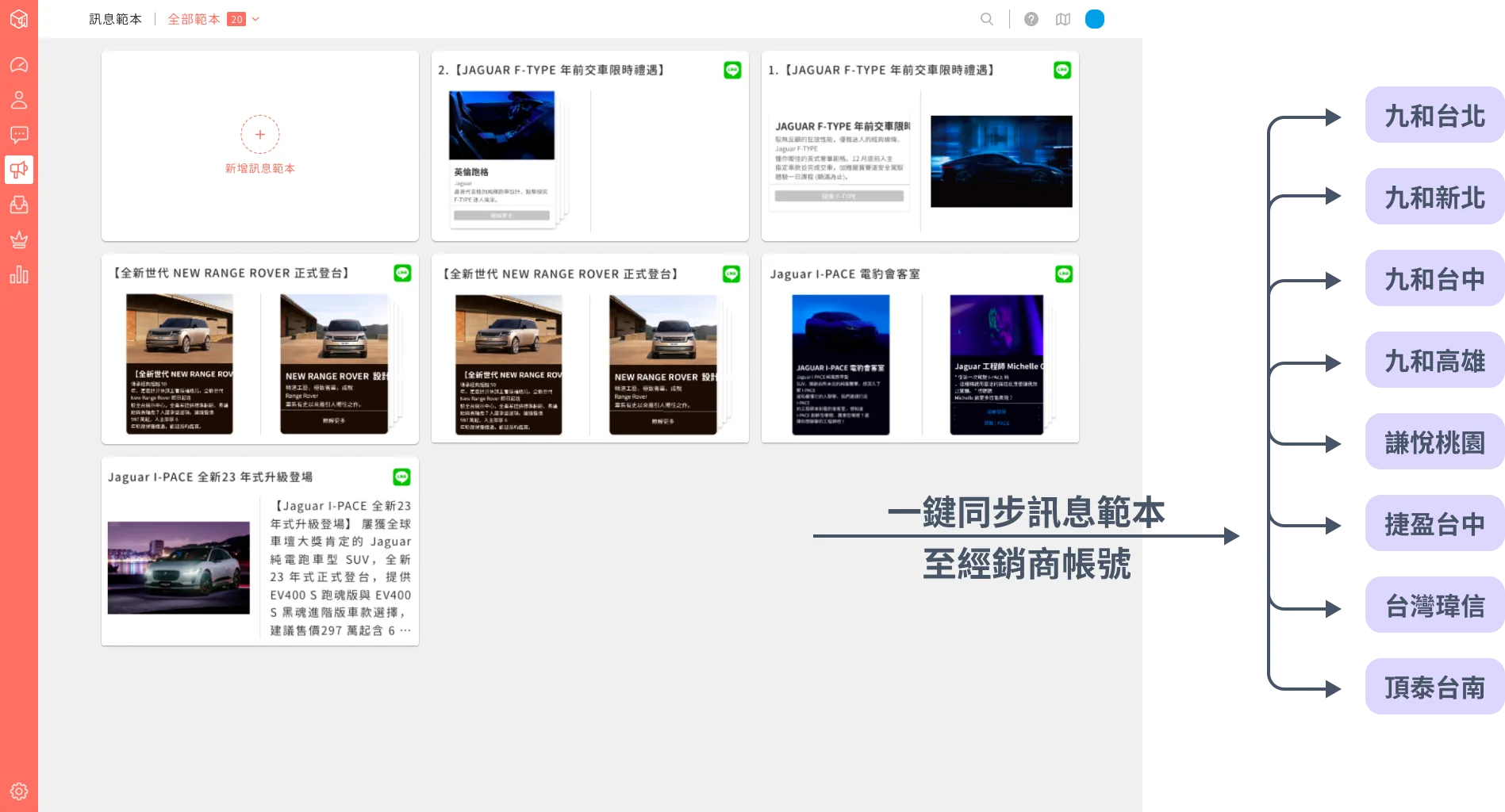
2. A dedicated headquarters account manages dealer broadcasts centrally. Headquarters set up its own official account to see how every dealer is engaging customers. When there’s new model news to share, headquarters syncs the message template to every dealer account in one click. Dealers only need to publish it at the set time, with no extra back-and-forth or proofreading.
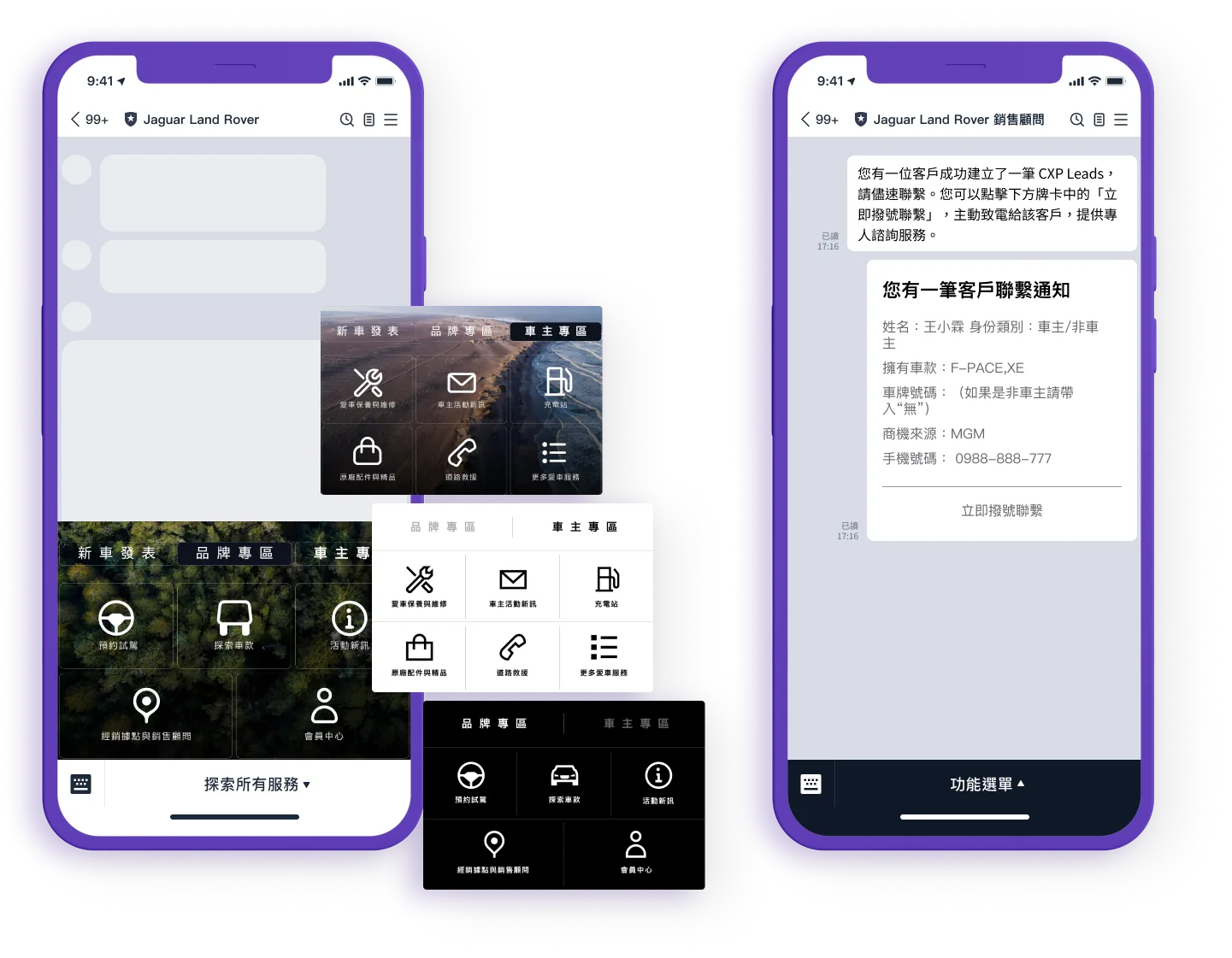
3. Rich menus tie the whole buying journey together. The official account is split into a brand section and an owner section, covering pre-sale and after-sale services: online showrooms, test drive bookings, a charging station map, and servicing and repairs. When customers browse or test-drive at a dealership, they scan their sales consultant’s personal QR code. From then on, whenever they tap a model page on LINE, that consultant is notified instantly and knows exactly what the customer is looking at.
What the numbers say
Communication between headquarters and dealers became 75% more efficient.
| Metric | Before | After | Change |
|---|---|---|---|
| Data entry per customer | Typed in by consultants, about 40 seconds each | Forms sync to Salesforce automatically | About 90% less time spent on manual entry |
| Headquarters–dealer communication efficiency | One-by-one coordination and proofreading | One-click message template sync | 75% better |
| Customer data completeness | — | 98% | — |
| Owner forms completed | — | 2,500+ | — |
| Test drives booked through segmented broadcasts | — | 100+ prospects | — |
The 75% gain didn’t come from cutting a single step. It came from removing the whole “headquarters drafts, dealers forward, everyone proofreads” chain. Dealers no longer check content one by one, and mismatched versions disappeared along with it.
The 98% data completeness came from no longer relying on manual transcription. Customers fill in the forms themselves on LINE, so fields are complete and consistently formatted, and the data is ready to use as soon as it lands in Salesforce.
The 100+ prospects who booked test drives are the result of the first two: with complete, tagged data, broadcasts can target owners at each stage and tell them what they actually want to hear.
Social CRM has effectively reduced the friction in Jaguar Land Rover’s digital transformation and made rolling out digital services much smoother. LINE’s two-way interaction encourages customers to tell us what they need, so we get first-hand data right away and can create broadcasts tailored to each owner.
If you’re facing the same problems
Let customers enter their own data instead of having staff copy it for them. Manual entry doesn’t just take time; it also caps the quality of your data. Start by finding the form your team retypes most often and turn it into one customers can complete on LINE.
Treat dealers as nodes to connect, not just recipients of instructions. One template from headquarters, published on time by every location, takes less effort than each one rewriting it, and it’s more consistent. Try the unified template flow first with a single new product launch.
Let offline actions trigger online notifications. A QR code plus a tag is enough to show a consultant what a customer is looking at after leaving the showroom. Start with your most common touchpoint.
Jaguar Land Rover put these ideas into practice with OakMega’s automotive Social CRM, but the principles apply to any brand that relies on dealers or franchisees. For more automotive use cases, see OakMega’s automotive solutions.