






People in Taiwan do care about the environment. According to a 2023 sustainable behavior survey by Taiwan’s Environmental Protection Administration, 78% of people said they understand the issue of climate change, yet only 18% had ever actively taken part in a sustainability action.
They know, but they don’t act.
This gap isn’t caused by too little promotion. Each of us already receives more than 5,000 messages a day (source: Dentsu Aegis Network, Digital Society Report, 2022), so one more environmental message is just one more piece of noise. Even more striking, a 2024 study by the College of Communication at National Chengchi University found that while over 60% of people feel they already act green, 85% don’t know whether what they do “actually works, or is even noticed.”
The problem facing the Ministry of Environment wasn’t public apathy. It was that the existing communication channels gave action no visible outlet and no visible reward.
The Ministry’s challenge: policies went out, but rarely made it into people’s lives
The Ministry of Environment is the central government agency that coordinates and enforces environmental policy in Taiwan, leading long-term work on air pollution control, the circular economy, and climate change response. Its official LINE account is one of its main digital channels for policy communication. Until recently, it worked as a one-way broadcast: announcements, news, and event notices went out, with no way of knowing whether anyone cared.
Three core problems pushed that model to its limit:
First, messages were “visible” but didn’t “connect” to daily life. Policy messaging lacked a concrete point where it turned into action in people’s routines. Knowing today’s AQI is bad is one thing; knowing where to find the nearest green restaurant, or getting a reminder that your vehicle inspection is due next month, is another. The first is information. The second is a service.
Second, people “wanted to take part” but “couldn’t find” a practical way to do it. It’s not that nobody wants to go green. Within the existing communication framework, “going green” was simply too abstract: no tasks, no feedback, and no reason to come back next time.
Third, actions “happened” but “left no record.” Even when people joined an event or did something good for the environment, the government couldn’t see it, and people themselves forgot it right away. Without accumulation there’s no habit; without recognition there’s no motivation to keep going.
Key insight: the problem wasn’t too little promotion, but participation designed with no reward
When the Ministry of Environment approached OakMega, the core question was clear: how do you move policy communication from “we sent it out” to “something actually happened”?
Working through it, every answer pointed the same way: make every interaction visible, recordable, and cumulative.
People get hooked on games not because the games are inherently fun, but because games show every step of what you’ve done: your level, your achievements, the missions you completed today, and what you’ll unlock next time. What sustainability participation was missing wasn’t more promotion. It was this design logic.
What they did: three phases that build green actions into everyday conversations
OakMega and the Ministry of Environment rolled out the program on three levels: building identity and motivation in the short term, deepening immersion in the medium term, and becoming an integrated hub for action and services in the long term.
Short term: a personalized membership system, combining character binding and game mechanics
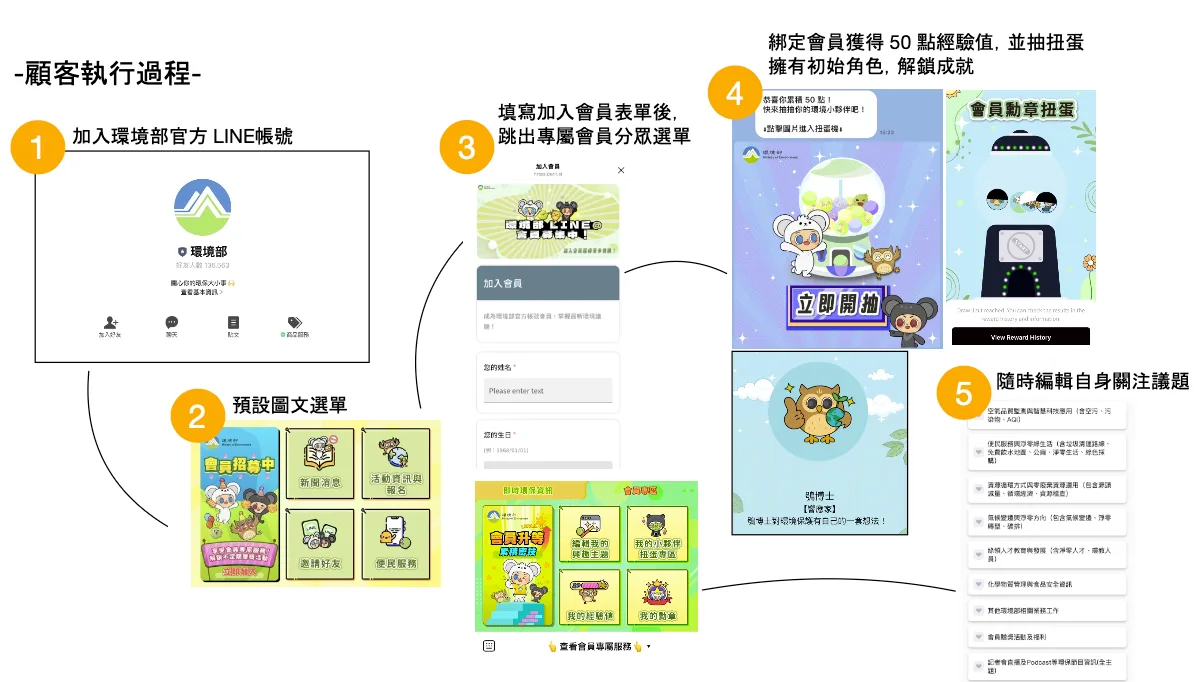
When new friends join, the system guides them through a member survey to set up their profile and topic preferences (they can subscribe to air quality, public services, resource recycling, climate change, and more), and immediately assigns the matching segmented rich menu.
The moment they finish binding their account, people receive 50 starting experience points and unlock their first gacha spin. The machine holds badges of environmental characters (Dr. Ride, Heibao, a sea turtle, a leopard cat, and more), sparking the intrinsic motivation to collect achievements from day one.
Every interaction after that keeps adding up: +1 for clicking a post, +5 for sharing a message, +10 for joining a designated event. Hit the threshold and the character levels up, titles unlock (from “Supporter” to “Explorer”), and new achievement pages are waiting to be explored. Every contact with the Ministry of Environment is no longer just “seeing a notification,” but “taking another step today.”
Medium term: OMO event design, combining online interaction and offline action
At the ministry’s past in-person events, people took part and that was it; their behavior data vanished into the crowd. OakMega’s OMO design turns every physical event into a trackable mission journey on LINE.
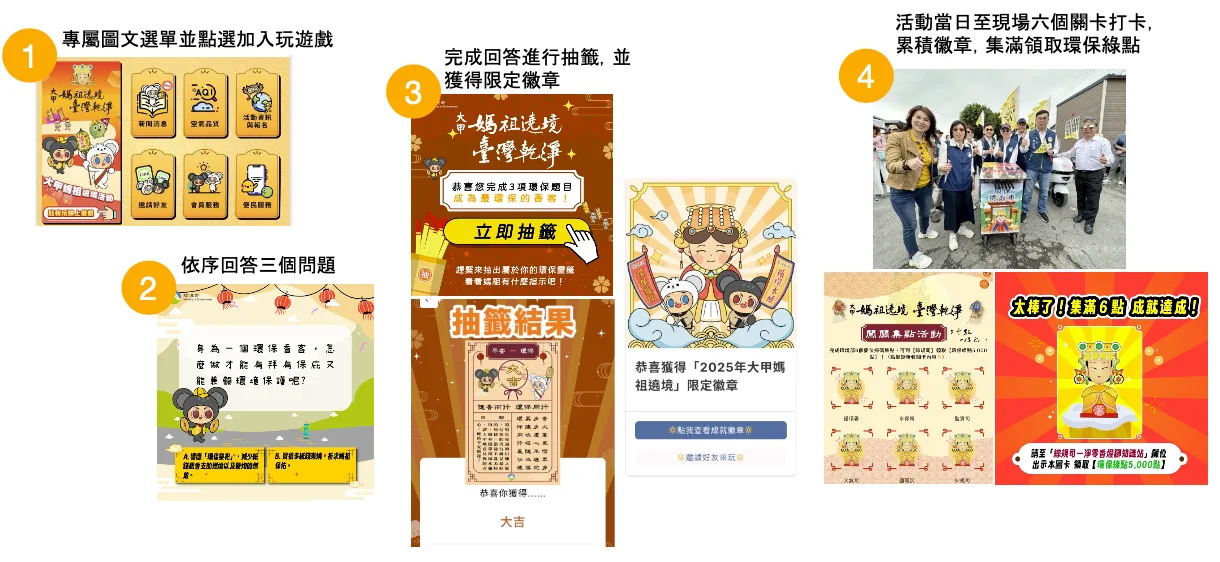
Dajia Mazu event (April 2025): Under the theme “Dajia Mazu Pilgrimage, Clean Taiwan,” people answered three environmental quiz questions on LINE, then drew a lot to receive a limited-edition Mazu badge. On the day of the event, they checked in at six on-site stations to collect points, and a full card could be redeemed for 5,000 Green Points. Online learning and offline action came together in a single journey, using the cultural pull of the Mazu pilgrimage to bring sustainable action into one of Taiwan’s biggest annual festivals.
World Environment Day plastic-reduction event (June 2025)
Visitors scanned a QR code on site to open the official LINE event page, picked up an online stamp card, and earned stamps by answering plastic-reduction quiz questions in order. Nine stamps earned a scratch card draw. From scan to prize, every step happened inside LINE, and every action was captured as data. On-site activity at the family fair became a trackable behavioral history.
After the event, participants’ preferences, engagement hotspots, and demographic traits all flowed back into the Social CRM dashboard, laying the groundwork for the next targeted broadcast.
Long term: two-way data integration, connecting public services and the LINE membership system
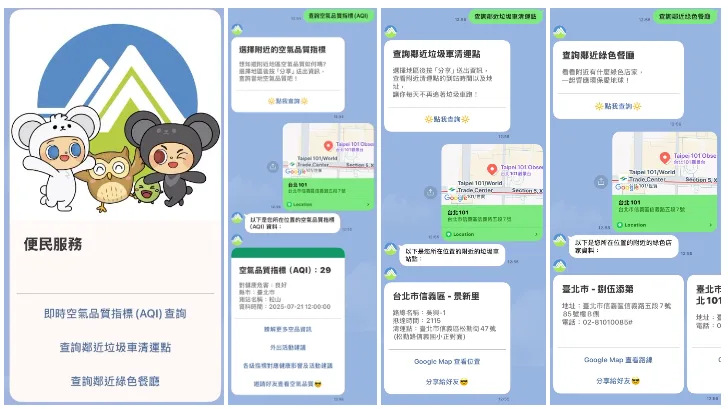
The third level brought static information scattered across the ministry’s website together into a sustainable living service center that people can use instantly inside LINE.
People share their location and instantly get the local AQI (with health advice), nearby garbage collection times and addresses, and a list of green restaurants close by. This information existed before, but people had to open a browser, find the ministry’s website, and then find the right page. Every extra hurdle pushed usage toward zero. Now it’s within three taps of opening LINE.
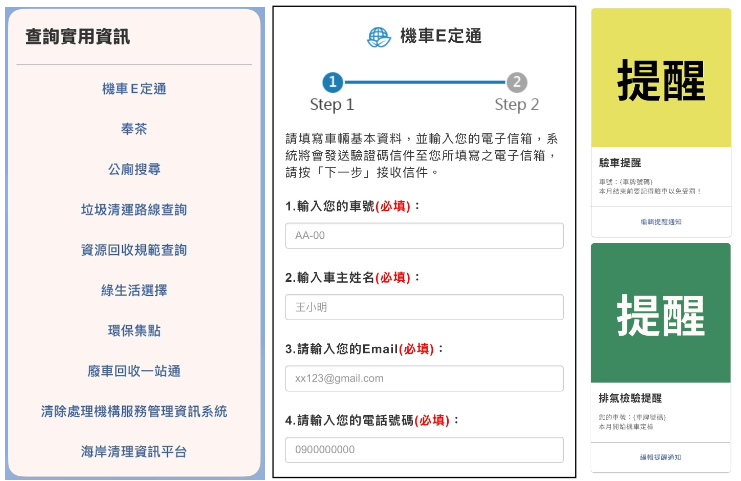
E-Dingtong, the scooter inspection reminder service, turns something that frustrates riders every year, the periodic vehicle inspection, into a proactive LINE reminder. Riders enter their plate number and email, and the system automatically sends a notification before the inspection is due. Set it once and get reminded for life, with no dates to remember and no more fines.
| Module | Core problem solved |
|---|---|
| Gamified membership system | Turns every interaction into cumulative progress and builds lasting motivation to take part |
| Topic subscription and segmented menus | People choose the topics they follow, keeping broadcast noise to a minimum |
| OMO event points | Offline actions leave a record on LINE, and behavior data is tied to each member |
| Location-based AQI lookup | Environmental information goes from static lookup to an instant, personalized service |
| E-Dingtong scooter reminders | Public services reach people proactively, building everyday stickiness |
Results: what nearly 250,000 actions in 113 days really mean
The service officially launched on March 12, 2025. After 113 days, the numbers speak for themselves.
| Metric | Result | What it means |
|---|---|---|
| Friend growth rate | +44.5% | Gamified design fueled word-of-mouth growth |
| Monthly active users | 14,587 | The account delivers real everyday value to the public |
| Average monthly interactions | 4.5 | Each active user comes back more than four times a month |
| Member binding rate | 47.5% | Nearly half of all friends set up a profile and were segmented |
| Event interaction open rate | 74% | Gamified mission design significantly boosted participation |
| Public satisfaction | 81% | 84% of respondents said the broadcast frequency was just right |
| Public service usage | 6,830 uses / 4,300 people | Static services became part of everyday routines |
| Total usage records | Nearly 250,000 | 20,000 people joined, 30,000 engaged |
Behind the 74% event interaction open rate is an OMO mission design that gives people “something to take away” every time they take part. Of the 81% who were satisfied, 53% said they would recommend the account to others “because it keeps them informed about policy.” That means the Ministry of Environment’s LINE account has evolved from a one-way announcement tool into a living service platform people actively want to share with those around them.
“From passive notifications to active engagement, we made going green playable, recordable, and doable.” — OakMega × Ministry of Environment
If you’re facing the same challenge
The Ministry of Environment case offers three principles that any organization driving public participation can borrow directly, whether it’s a government agency, a charity, an association, or an NPO.
First: make every interaction leave a trace.
When people can see their participation (experience points, badges, achievement pages), their willingness to come back rises significantly. Which of your organization’s public interactions disappear the moment they’re done? Designing them into a cumulative record is the lowest-cost way to build stickiness.
Second: put your services where people already are.
The ministry’s AQI lookup wasn’t a new feature, and the scooter inspection reminder wasn’t new information. What pushed usage to 6,830 was moving these services from a website people had to go looking for into LINE, which people open every day. How many of your services “exist, but nobody goes looking for them”?
Third: design events as “trackable journeys,” not “one-off happenings.”
The Dajia Mazu event was designed so that every on-site check-in left behavior data in the LINE back end. The strategy for the next event is built on that real data, not on the organizers’ gut feeling. Any organization that runs events can ask itself: once this event is over, how much more do I know about the participants than before it started?