A LINE OA gamification case study: how PTS Kids turned 6,500 families from watching a show into actually cutting carbon
The biggest challenge in sustainability education isn’t that kids don’t care. It’s that the inspiration stays in front of the TV and the action never happens.
- 6,504 families joined a 21-day RPG quest
- 68.5% conversion rate at the Arctic stage
- 3,138 people went outside, photographed their low-carbon commute, and sent the photos back
The key to getting an educational show to change everyday family habits was designing carbon reduction as something rewarding and social, with a next level to look forward to.
| Item | Details |
|---|---|
| Client | Public Television Service Foundation (PTS Kids) |
| Core challenges | Sustainability messages rarely turned into action, viewers drifted away after each episode, and LINE broadcasts carried a high block rate |
| Solution | OakMega Social CRM: a 21-day RPG mission map, a badge achievement module, segmented journeys, and Playground prize draws |
| Key results | 6,504 participants, a 68.5% conversion rate at the Arctic stage, and 3,138 people uploading low-carbon photos (48.2%) |
| Campaign period | May 26 to August 2, 2025 (about 10 weeks) |
| Award | LINE Biz-Solutions Awards 2025: Best Creative Content Award |
The episode ends. Then what?
The biggest challenge in sustainability education isn’t that kids don’t care. It’s that they’re moved in front of the TV, but the action never follows.
When the episode ends, three minutes of empathy don’t add up to a single real-world choice. PTS Kids faced exactly this problem when it launched the Global Warming series of its show Hua Lu Mi. The series took nine students from different countries to the Arctic, Norway, and Palau to witness the climate crisis firsthand. The story was there, the production was excellent, but one question remained: once the show is over, how do families keep going?
They decided to turn carbon reduction into an RPG quest that kids would want to finish. In the end, 6,504 families played, and 3,138 of them went outside and sent back photos of their own low-carbon commutes.
Here’s how it happened.
Meet PTS Kids: a channel that has grown up with Taiwan’s children for 20 years
Hua Lu Mi first aired in 2001 and has been running for more than 20 years, making it one of Taiwan’s longest-running exploration shows for school-age children. It uses the camera to help kids discover the wonders of the world and broaden their horizons.
This time, facing climate change, the defining issue of this generation, PTS Kids wanted more than a great show. It wanted the show to be a starting point, so that kids and families wouldn’t just watch passively but would take part and actually change the choices they make every day.
The partnership with OakMega had a single goal: turn a one-time viewing experience into long-term family engagement and sustainable habits.
Why awareness campaigns alone have never been enough
The problem isn’t that kids don’t care. It’s that nobody gave them a way to act.
Traditional sustainability campaigns follow a simple logic: explain why it matters, then hope people act on their own.
That logic has three gaps.
First, too many messages, nothing memorable. Families today receive far more information than they can absorb. A reminder to use fewer plastic bags disappears in three seconds in the algorithmic flood.
Second, knowing isn’t doing. Kids know polar bears are losing their habitat, but they don’t know what they can do today. Nobody has built them a bridge from knowledge to action.
Third, one-time participation doesn’t stick. The campaign ends and users leave. With no follow-up and no ongoing motivation, yesterday’s inspiration is forgotten today.
According to a survey by LINE, more than 90% of consumers say that too many promotional messages from a LINE Official Account make them less likely to click, or even lead them to block the account. For a children’s channel, that number is especially sensitive: its audience is parents, and parents’ attention is the scarcest resource there is.
While helping PTS Kids plan the campaign, we noticed that the most common mistake in sustainability education campaigns is treating awareness as the finish line. The information gets delivered and the job is considered done. The real challenge is getting people to still remember it, and still want to keep going, on day two, day seven, and day twenty-one.
The key insight: design carbon reduction as a game kids want to finish
Sustainability education has never lacked knowledge. What it lacks is a design structure that actually gets people moving.
When OakMega and PTS Kids designed the Pocket Kids 21-Day Carbon Action, there was only one core question: how can every episode become the starting point for the next action?
The turning point was one central design decision: instead of using the show to promote a campaign, let the campaign extend the show.
The answer came down to three design modules:
| Design module | Problem solved | Key mechanism |
|---|---|---|
| Map-based quest | Knowing → no path to action | Each episode airing unlocks a new stage |
| Badge achievement system | One-time participation → no lasting motivation | The visual pull of a complete collection, plus a sense of identity |
| Sharing × subscription | One person joins → no spread | Spreading knowledge = inviting friends |
How they did it: putting OakMega Social CRM to work, step by step
Map quest: a sense of mission turns sustainability into an adventure
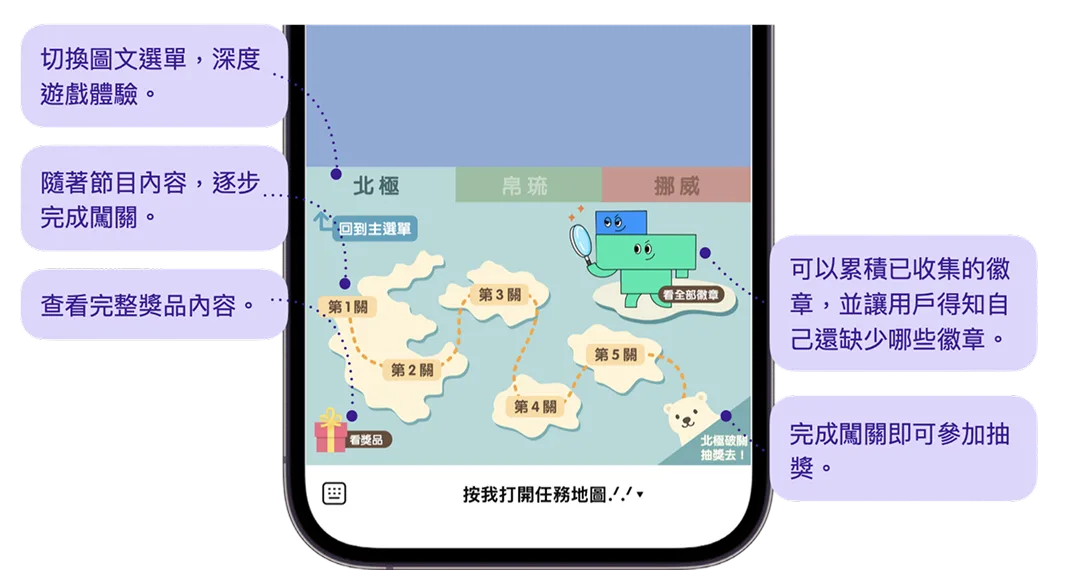
When friends enter the LINE OA, they see a mission map covering three countries. New stages unlock as the series airs: once the Arctic episode is out, the matching quiz appears.
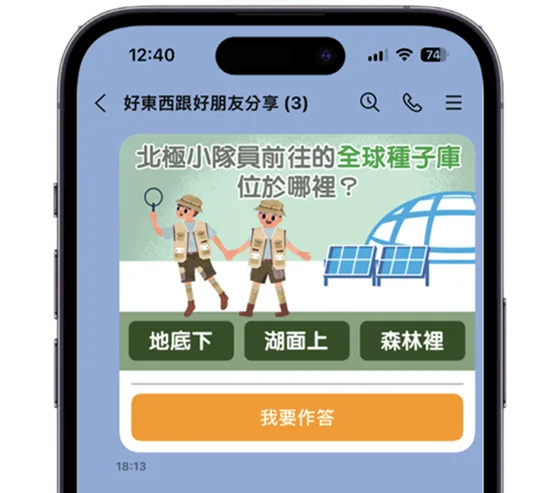
The questions were deliberately kept light. Instead of fill-in-the-blank memorization, they were fun, scenario-based multiple-choice questions such as “Where do you think the Global Seed Vault is?” A lower barrier meant family members of all ages could play together.
Badge achievements: giving kids an eco identity
Each completed stage automatically earns a dedicated badge: Arctic Good Neighbor, Carbon Cutting Champion, Earth Guardian, and more. These aren’t just points. They’re identity markers kids can take pride in.
With OakMega’s member achievement module, earned badges light up while the rest stay grayed out. That design creates an “almost got the full set” pull that makes people want to keep going.
Sharing × subscription: one person’s participation becomes many people joining
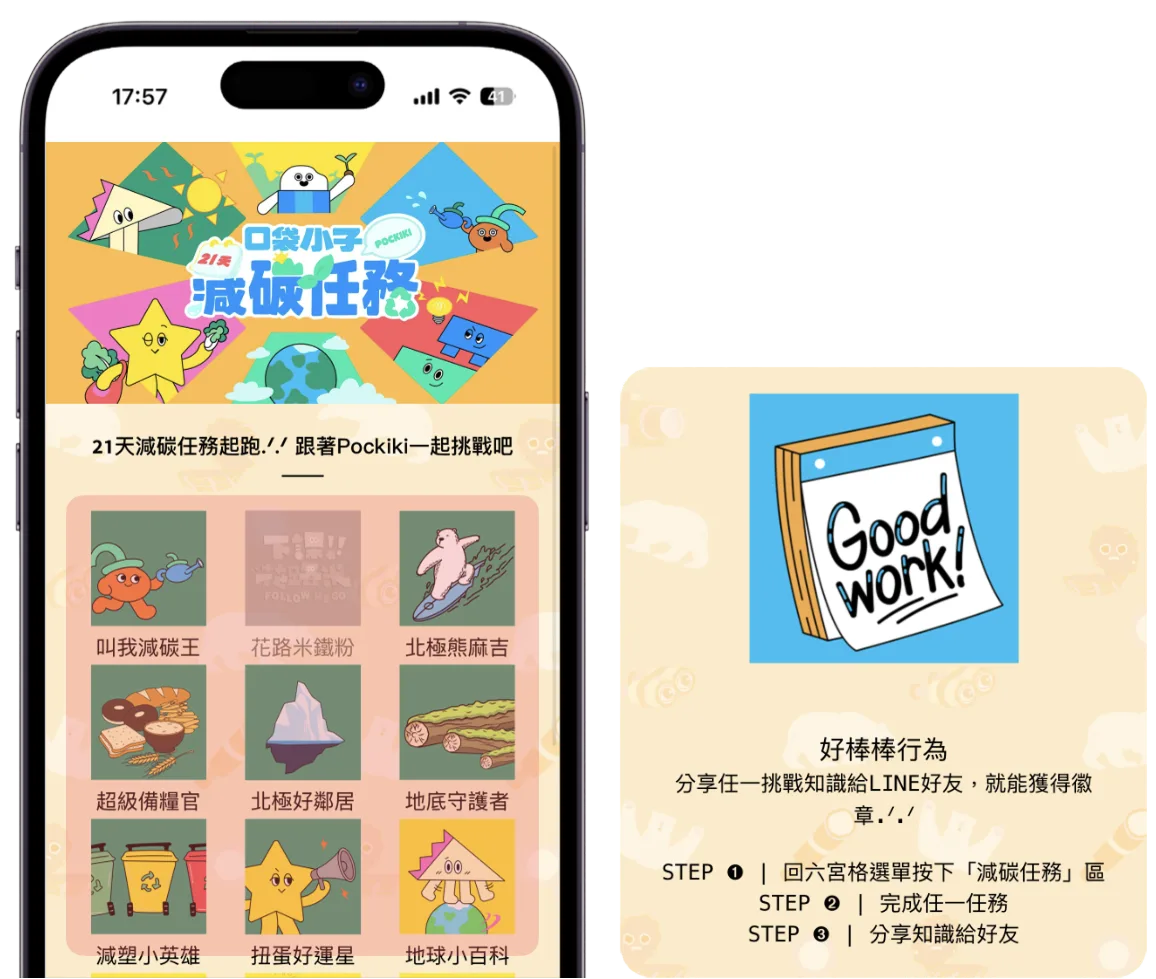
Friends can share climate quiz cards with others. When a friend taps the card, they land directly in the PTS Kids LINE OA to answer it. This is more than social reach: it’s a design that turns spreading knowledge and inviting friends into the same action.
Subscribing to the YouTube channel and watching the show also earned a bonus badge, linking the online show and LINE engagement into one complete path.
The results: one thing before the numbers
What surprised us most wasn’t that participation broke 6,000. It was this ratio: 3,138 people actually went out, photographed themselves taking the MRT or riding a bike, and uploaded the photos.
When we designed this mission, we expected it to have the highest drop-off. It required people to go outside, take a photo, and send it back, and every step added friction. Yet 48.2% of participants did it. That confirmed something for us: a high barrier isn’t the problem. What matters is whether people have a reason they can’t ignore.
| Metric | Result | What it means |
|---|---|---|
| Total participants | 6,504 | The entry point offered enough incentive |
| Mission shares | 5,500+ | The quiz content gave people a reason to share |
| Completed the Arctic stage and entered the draw | 4,454 | A 68.5% conversion rate shows strong mission appeal |
| Uploaded low-carbon commute photos | 3,138 | 48.2% of all participants, turning online engagement into offline action |
A 68.5% stage completion rate is exceptionally high for a content engagement campaign. It means more than two-thirds of the people who entered the campaign finished the entire flow.
Beyond the numbers, OakMega’s tagging and tracking give PTS Kids a clear view of each friend’s participation path, interests, and progress. That data will become the foundation for precise remarketing and future program planning.
According to Salesforce’s State of the Connected Customer report, consumers increasingly expect brands to offer meaningful interactions, not a barrage of messages. For children’s media, the trend is even stronger: any content parents choose for their kids has to deliver value beyond the screen.
The Pocket Kids 21-Day Carbon Action won the Best Creative Content Award at the LINE Biz-Solutions Awards 2025 precisely because it achieved something hard: an educational show truly changed the daily habits of real families.
It didn’t just help kids know more. It got kids to do something different.
If you’re facing the same challenge
Many brands, nonprofits, and media organizations share the same frustration: great content and great ideas, but engagement won’t budge and users vanish as soon as the campaign ends.
This campaign offers three principles you can reuse:
1. Build external triggers into the design. PTS Kids didn’t ask users to log in every day on their own. It gave them a way to go further at the very moment they were already watching the show. What are your users already doing that could become the starting point for action?
2. Give people an identity, not just a task. A badge isn’t a prize. It’s how kids define themselves. When being eco-friendly becomes an identity people embrace, action stops being an obligation and becomes a choice.
3. Give high-barrier tasks a reason people can’t ignore. Uploading a low-carbon commute photo was the toughest mission in the campaign, yet nearly half of participants completed it, because it carried clear social meaning and instant feedback. Do your high-barrier tasks give people a strong enough “why”?
The answer isn’t more content. It’s designing a structure that gives people a reason to keep going.