Every week, she’s a different mom
Picture a mom who is 32 weeks pregnant. She’s working through her hospital bag checklist, wondering how many diapers she’ll need for the first week after birth. Then a brand message pops up on her phone, recommending training pants.
She doesn’t reply. She just taps Block.
For Huggies, a global leader in baby care, moments like this could happen on LINE every day. The brand’s official account had more than 190,000 friends, most of them expecting moms and new parents. Their needs are extremely specific, and they change fast: a mom at 34 weeks of pregnancy and a mom two weeks after giving birth care about completely different things.
The friend count was growing. But did the brand really know who each friend was, or what stage she had reached?
Data scattered everywhere, so every message said the same thing to everyone
The maternity and baby category has a trait few other industries share: customer needs come with a countdown. From pregnancy through a baby’s first two years, the questions and the products a family needs change every few weeks.
In maternity and baby, customer needs run on a countdown. Miss the week, and the message loses its meaning.
The challenge Huggies faced came in three layers:
First, identities were fragmented. The same mom might be a LINE friend, have a member record in Salesforce, and shop in physical stores. None of these identities recognized each other, so the brand saw three strangers instead of one customer who was 32 weeks pregnant.
Second, offline purchases were invisible. Most diapers and baby products sell through hypermarkets and drugstores, where the purchase records stay with the retailer. The brand had no way to know who bought what, or what to recommend next.
Third, manual work couldn’t sustain precise messaging. Segmenting broadcasts by week of pregnancy with hand-applied tags and manual scheduling was costly and error-prone. Teams often fell back on mass broadcasts, and the block rate climbed.
Without a change, 190,000 friends would slowly turn into 190,000 chat windows nobody opened anymore.
A baby’s age in weeks is the best segment there is
The turning point for Huggies was realizing it held a piece of data most brands struggle to get: the due date.
A due date tells you how many weeks old the baby is right now, what the mom will face next week, and what products she’ll need next month. That’s more precise than any demographic tag. The question was never “how many messages should we send?” It was “can we say the right thing in the right week?”
The same principle applies to any industry where customer needs move forward over time: when you know where a customer is on the journey, your messages stop being a sales pitch and start being support.
Designing LINE CRM member journeys for a maternity and baby brand
Huggies worked on two tracks: first connect the scattered identities and data, then use that data to power automated member journeys.
Step 1: Connect Salesforce and build a first-party data platform
Using a dedicated OakMega Social CRM API, Huggies connected its LINE Official Account and its existing Salesforce customer platform in both directions. Customers’ digital behavior on LINE becomes history tags that sync back to Salesforce, and Salesforce data flows back to LINE to schedule broadcasts automatically. Segmentation that once required manual upkeep now runs on its own.
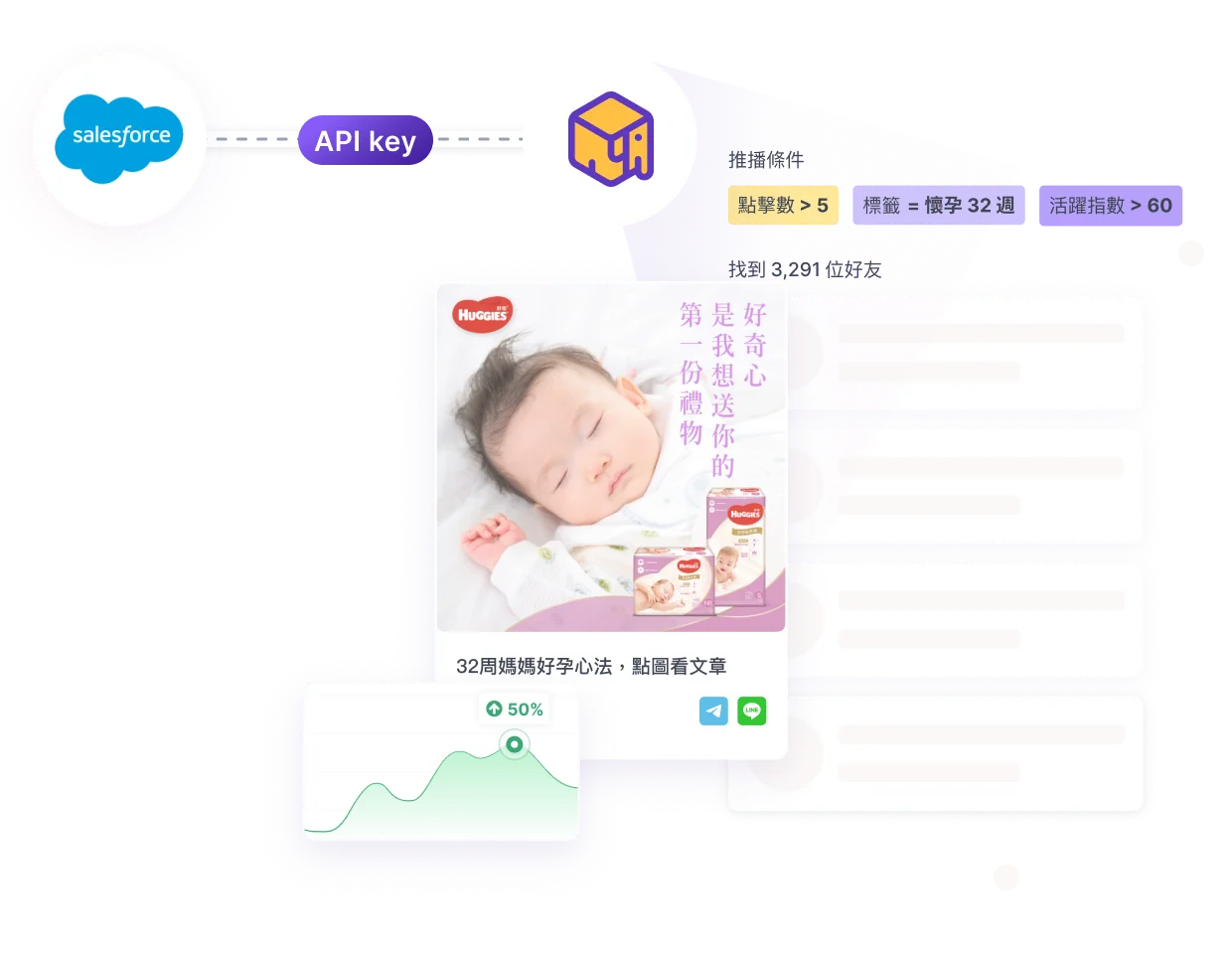
Step 2: Let the due date drive 13 member journeys
A member journey is an automated sequence of messages and interactions arranged around a customer’s stage or behavior. In the Huggies design, once a mom enters her basic details and due date in the LINE Official Account, the system works out her baby’s development timeline and routes her into one of 13 customer journeys. At 32 weeks, 34 weeks, 37 weeks, two weeks postpartum, and beyond, every milestone comes with matching product recommendations and parenting tips, and the system adjusts the next message based on how she engages.
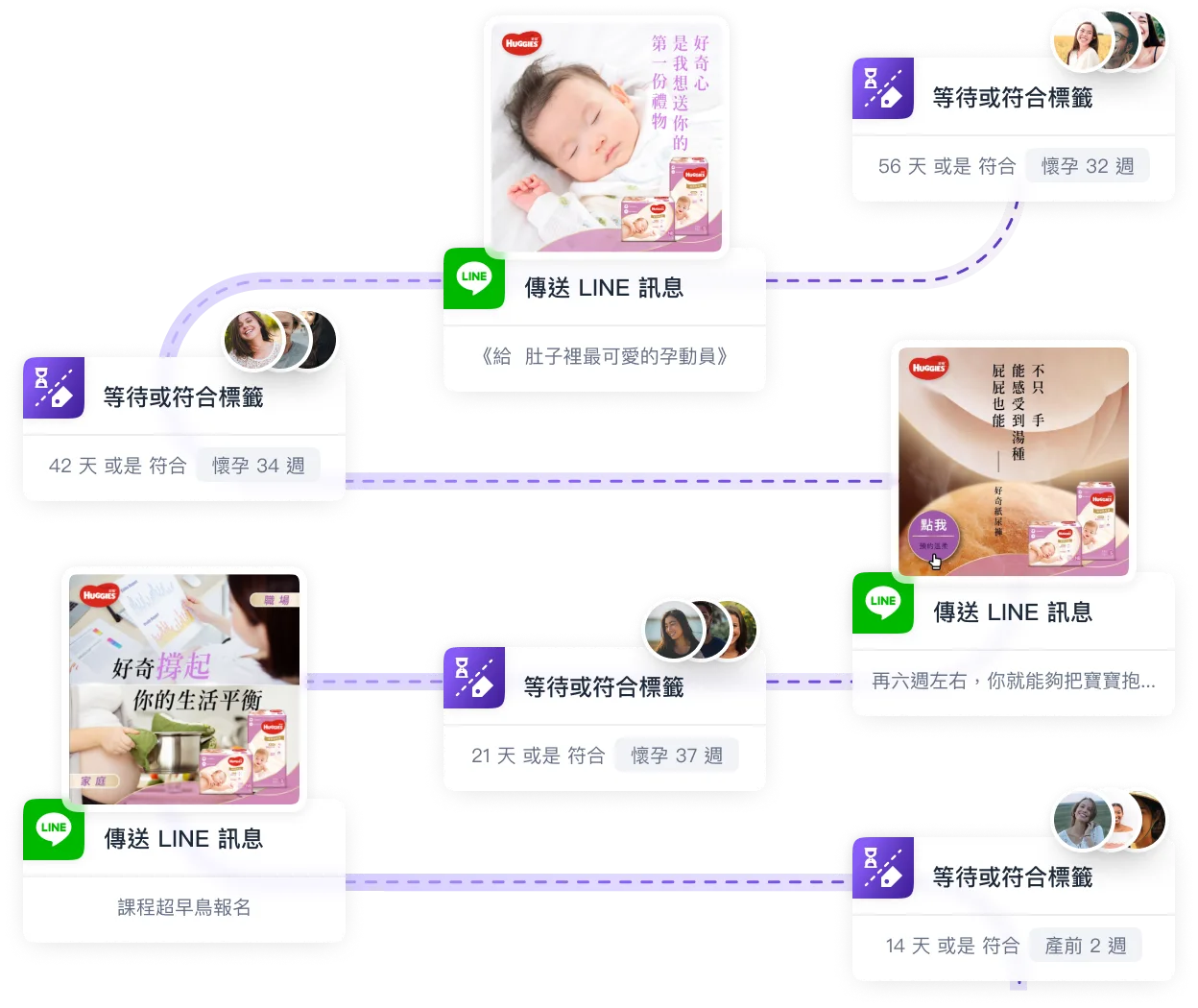
Step 3: Fill the data gaps with interactive modules
Huggies paired several OakMega Module Store features so that every interaction leaves behind usable data:
| Problem to solve | Feature used | How it works | Data or impact |
|---|---|---|---|
| Boosting first and repeat purchases | Coupon center | First-purchase offers, campaign coupons, and birthday credits, redeemable online and in physical stores | Automatic tagging on use triggers follow-up content |
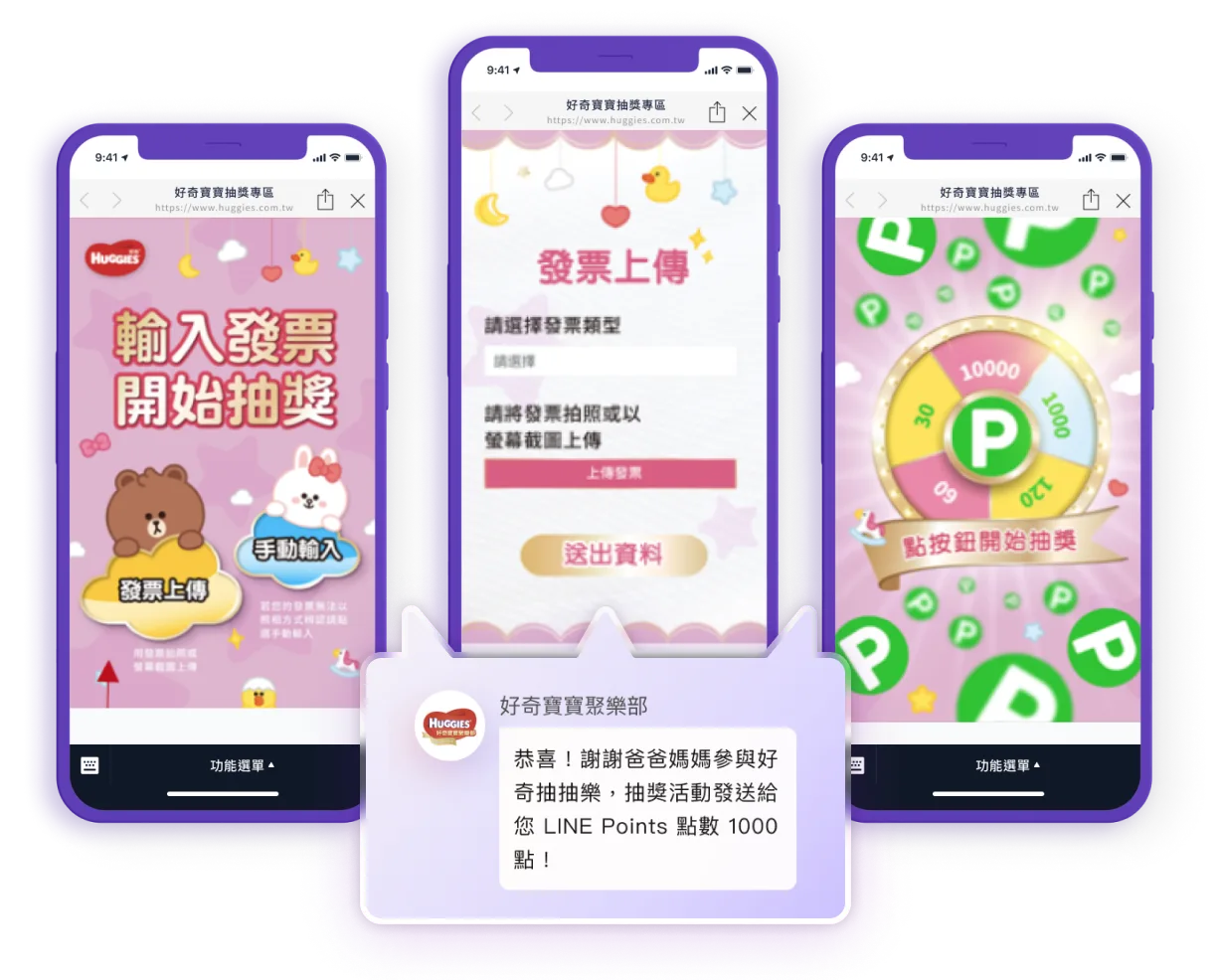
| No visibility into offline purchases | Receipt upload prize draw + OCR | Moms upload receipts to enter prize draws (such as 1,000 LINE Points); OCR reads the purchased items and tags them automatically | Offline purchase records flow back, enabling related product broadcasts and wider basket coverage |
| No real feedback from users | Member forms | A “money back if not satisfied” guarantee paired with a feedback form; completing it enters a prize draw | Genuine product feedback that also sparks online buzz |
| A purely transactional relationship | Custom greeting cards | Special campaigns for occasions like Mother’s Day let moms create personal cards to send each other | Deeper emotional ties between the brand and the parenting community |
What the numbers showed
The block rate fell by 20% while membership grew by 200%.
More friends and fewer blocks: that’s what real growth in LINE membership looks like.
| Metric | Change |
|---|---|
| Member growth rate | ↑ 200% |
| Member linking rate | ↑ 70% |
| Campaign coupon redemption rate | ↑ 70% |
| Block rate | ↓ 20% |
| Monthly active users (MAU) | ↑ 30% |
| Customer lifetime value (LTV) | 1.5x |
The member linking rate is the share of LINE friends who have linked their membership details. Its 70% rise came from moms choosing to share their due date and basic details, because they knew they’d get content that truly fit their stage. The lower block rate and higher MAU are two sides of the same coin: when messages match their needs, moms keep opening them.
The 1.5x LTV reflects the long-term value of journey design. By staying with moms from pregnancy through the postpartum months, the brand no longer just sells a pack of diapers. It offers the next product she needs at every stage, and average order value and brand share rise along with it.
If you face the same challenge
Find your customers’ “timeline data.” A due date is to a baby brand what a purchase date is to a carmaker, or an enrollment year to an education provider. Start by taking stock: which point in time lets you predict what your customers will need next?
Connect your data before you automate. Automated broadcasts are only as good as the data behind them. Matching identities between LINE and your existing CRM delivers more than rushing to design complex journeys.
Make every interaction earn a piece of data. Coupons, prize draws, and forms are more than promotional tools. When you design a campaign, ask first: what will this interaction teach us about our customers?
The key to lowering block rates isn’t sending fewer messages. It’s making every message fit where the customer is right now. Huggies put this LINE CRM approach for maternity and baby brands into practice with OakMega Social CRM, but the principles aren’t tied to any particular tool.