



After adopting OakMega Social CRM, Kikawa Pump's LINE Official Account reached a 37.04% monthly active rate, while its block rate dropped to just 4.58%.
- Monthly active rate (MAU, the share of friends who open the account at least once a month): 37.04%, far above what manufacturing accounts typically see
- Official account block rate: 4.58% (most brands sit at 10%–20%)
- Identity verification rate: 54%
Key insight: the digital gap in traditional manufacturing isn't a technology problem. It's a channel design problem: the brand was never given a way to know the people who actually use its products.
Key takeaways
| Problem | Solution | Result |
|---|---|---|
| The brand knew nothing about the technicians installing its products | Identity routing on the LINE OA + warranty registration by QR scan | 54% of friends verified their identity |
| Irrelevant broadcasts drove up the block rate | Segmented broadcasts based on identity tags | Block rate of just 4.58% |
| Technician loyalty depended on the channel | A points program tied directly to technicians | MAU reached 37.04% |
Another order landed at Kikawa Pump's headquarters that day: a batch for a building-supply dealer, delivery in three days, shipment on payment.
The invoice listed the items, the quantities, and the amount. What it didn't say was where those pumps would end up. Boosting water pressure in an old apartment block in Taipei's Neihu district? Running a cooling loop at a factory in Tainan? Who installed them, how many Kikawa units had that technician fitted over a career, and which brand was he planning to install next?
The same scene had repeated itself at Kikawa for decades. The numbers looked good year after year, but behind them, the brand knew almost nothing about its most important customers: the plumbing and electrical technicians who decide on site which brand gets installed.
More importantly, Kikawa isn't an exception. Nearly every manufacturer that sells through distributors runs on the same model, and knows just as little about the customers who matter most.
Kikawa Pump's challenge: a structural gap between brand and user in a B2B2C channel
Kikawa Pump (KIKAWA), a leader in Taiwan's booster pump market, has served the country for decades and enjoys strong brand recognition among plumbing contractors and in the residential pressure-pump market. But because it sells through a B2B2C model rather than directly, Kikawa faced a structural problem: once a product left the factory, it disappeared into a data black box.
Products flowed from the factory to building-supply dealers and wholesalers, who then sold them to technicians or homeowners. At the end of that chain, headquarters was practically invisible. The pain points came down to three things:
First, there was almost no connection with frontline technicians. Technicians are the ones who decide which brand gets installed on site, yet all Kikawa knew about them came from shipment figures. It had no view of installation locations or field feedback, and couldn't even say which technician had installed how many units in which county or city.
Second, the traditional master-apprentice model was losing its power to spread the brand. A younger generation of technicians no longer simply follows the brand their mentor prefers. When they hit a technical problem, they look up setup videos on YouTube or ask peers in online communities. A manufacturer that doesn't show up in those digital spaces hands its technical authority to someone else.
Third, loyalty was impossible to build, leaving the brand exposed to price undercutting. Without a direct reward mechanism, technicians could easily switch brands over a small discount from the channel. Decades of brand equity looked fragile against a price gap of a few hundred NT dollars.
Key insight: the problem wasn't marketing. The channel was never designed to let the brand know its users.
When Kikawa came to OakMega, the question seemed to be "How do we do LINE marketing well?" Both sides soon realized the real task was more fundamental: how to reach past layer after layer of the channel so headquarters could, for the first time, truly get to know the technicians choosing products on site every day.
The breakthrough wasn't wider reach. It was giving the people already using Kikawa products their first real reason to talk to the brand. That insight changed the whole design direction: the LINE OA would no longer be a container for ads, but a tool technicians genuinely need to open on the job.
What they did: turning the LINE OA from an ad container into a technician's toolbox
The rollout moved in three phases: first, lay the groundwork for identity (routing + warranty registration); next, connect enterprise systems (Salesforce API); finally, launch the loyalty program (points redemption). The core features of phase one went live within three months.
Automatic identity routing: know who you're talking to from the first step
During the early assessment for this project, we kept running into the same problem: technicians and homeowners joined the same account and received exactly the same messages. Technicians didn't need promotions, and homeowners didn't need setup manuals, so both felt the account had nothing to do with them.
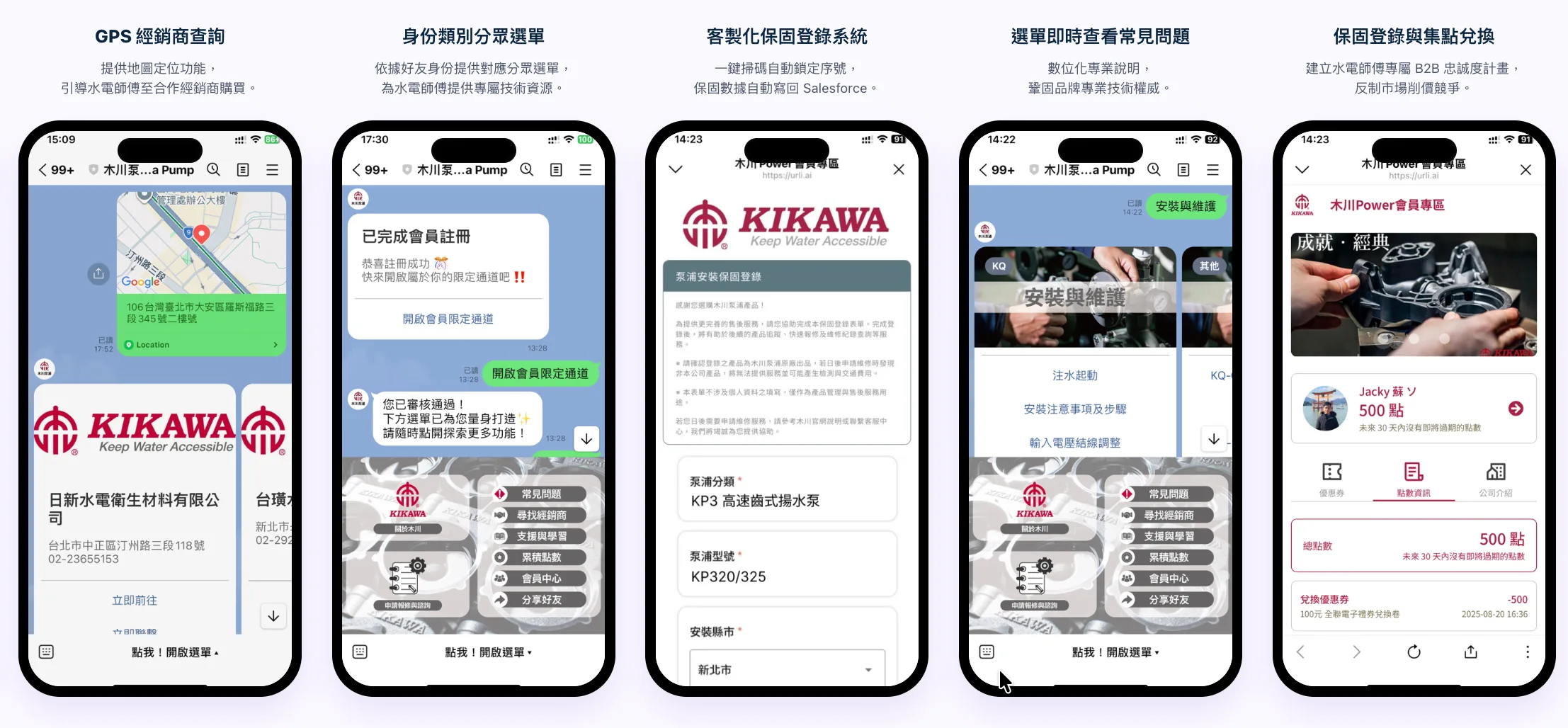
The answer wasn't two accounts. It was routing at a single entry point. When a new friend joins the LINE OA, the system immediately triggers a routing card that leads them through a quick form, automatically identifies them as a "plumbing technician" or a "homeowner," and assigns each group its own system permissions and follow-up journey. Technicians see professional tools; homeowners see lookup services. Each group stays on the right track without getting in the other's way.
On-site warranty registration by QR scan: turning paper warranty cards into digital assets
Once an installation is finished, the technician scans the QR code on the pump with LINE. The system automatically fills in the encrypted serial number and locks it, so all the technician has to do is select the installation district to complete the warranty registration. This one design solves three things at once: headquarters gets end-installation data, the technician completes the warranty paperwork, and the warranty information is written back to the Salesforce CRM in real time.
On security, OakMega uses high-strength encrypted QR codes and a Zero Retention architecture. The server never stores a full list of serial numbers. Each scan is verified individually against Kikawa's Salesforce through a real-time API, and the next steps only trigger once the serial is confirmed as valid, eliminating the risk of a data leak at the source.
Segmented rich menus: different roles, different menus
Once a technician is verified, their LINE menu automatically switches to a technician-only version, with one-tap access to the points area, technical packs, and troubleshooting manuals. Homeowners keep the basic warranty lookup and GPS directions to nearby dealers. The menus update in real time based on member tags in the OakMega dashboard, with no manual work required.
Troubleshooting chatbot: an on-site assistant available 24/7
The old paper manual became a conversation. The questions technicians run into most often on site, such as "priming and start-up steps for the KQ series" or "how to adjust voltage wiring," are all handled in chat, making the official account genuinely useful on the job site.
Bonus points: giving technicians a reason to recommend Kikawa first
Every warranty a technician registers earns exclusive bonus points. Technicians can check their balance right in LINE and redeem points for official Kikawa polo work shirts or tools. At its core, the program means choosing Kikawa effectively subsidizes a technician's operating costs, shifting the buying decision from "which channel is cheapest" to "which brand earns me more."
| Feature module | Core problem solved |
|---|---|
| Automatic identity routing | Builds a clear user profile from the very first touchpoint |
| QR code warranty registration | Opens the channel black box and captures end-installation data |
| Segmented rich menus | Segmented broadcasts that cut noise and lower the block rate |
| Troubleshooting chatbot | Restores the manufacturer's technical authority with younger technicians |
| Bonus points program | Counters competitors' price cuts with direct rewards and builds brand loyalty |
| Salesforce API write-back | Feeds warranty, points, and installation data back into enterprise systems in real time |
Results: behind the numbers is a database that never existed before
A 37.04% monthly active rate is the headline number in this story. What matters more is what it represents: a manufacturer that once knew little about its end users now has a database of its core audience, with names, roles, and regions, after adopting Social CRM.
| Metric | Result | Industry context |
|---|---|---|
| LINE OA monthly active rate (MAU) | 37.04% | Above the norm for manufacturing accounts |
| Official account block rate | 4.58% | Typical brands: 10%–20%※ |
| Identity verification rate | 54% | High share of core roles |
※ Based on LINE for Business average figures for business accounts in Taiwan
A 37% monthly active rate, far above the norm for manufacturing accounts, confirms the core logic of the "make it a tool" strategy: when the account is genuinely useful to technicians, they come back on their own, no broadcasts required.
The 4.58% block rate is direct proof that segmented broadcasting works. Technicians receive technical support and points updates, homeowners receive service information, and no one gets flooded with irrelevant messages, so there's no reason to block.
The 54% verification rate means Kikawa can now put a name and a role to more than half of its core friends. Among them are the plumbing technicians who hold the real buying power on site. Before Kikawa built this system, that asset simply didn't exist.
If you're facing the same problem
Kikawa's story offers three principles any B2B2C manufacturer can put to work.
First: make the account useful before you market with it. Kikawa's breakthrough didn't come from pushing more promotions. It came from giving technicians what they actually need on the job: setup manuals, warranty registration, and troubleshooting. Start by asking your team: "Does our LINE account give users a reason to open it when there's no promotion running?"
Second: the warranty process is the most underrated data source you have. Almost every manufacturer needs warranty registration, yet for most brands the warranty card is a slip of paper that vanishes once it's filled in. Digitize the warranty process and connect it to your CRM, and you get user data collection, identity verification, and automated journey triggers in one go, building your data foundation at almost no extra cost.
Third: aim your loyalty program at the people who actually choose the product. Many brands design points programs for end consumers, but in a B2B2C model the real decision-makers are often technicians, installation crews, and engineers. Putting the rewards directly in their hands is what actually shapes on-site buying decisions, instead of fighting an awareness battle with consumers that has nothing to stand on.
All three principles share one premise: a brand has to give users a reason to come back before the data will flow in on its own. The tool might be LINE, a QR code, or a points system, but the design logic is the same: make your users genuinely need you on the job.