






After rolling out OakMega Social CRM, FPAT brought more than 2,400 professional certificants together on LINE, with a monthly active rate above 20% and a block rate under 6%.
- Linked certificants: 2,400+ (precisely segmented into CFP® and AFP)
- Monthly active rate (MAU): > 20%, block rate < 6%
- TCPSI professional survey: takes 1 minute to complete, 1,000+ responses in two weeks
Key insight: Members weren’t unwilling to engage. There just used to be no place that made engaging easy.
Every two years, CFP® certificants have to renew their certification: submit their CPD hours, confirm they’ve met the requirement, and fill in the application. None of that is complicated on its own. But at FPAT before 2024, it often sent certificants across several systems: the website for the rules, the learning platform for their hours, their inbox for the renewal notice. Every step meant logging in and checking all over again.
For financial professionals who spend their days helping clients bring order to their finances, that fragmentation was especially ironic.
FPAT knew the problem was there, and it knew it wanted to fix it.
FPAT’s challenge: scattered information made a professional service feel like red tape
The Financial Planning Association of Taiwan (FPAT) was founded in 2003 and is the only professional body in Taiwan responsible for training, examining, and certifying CFP® (CERTIFIED FINANCIAL PLANNER™) and AFP (Associate Financial Planner) professionals. It formally joined the Financial Planning Standards Board (FPSB) in 2004. FPAT has long championed putting investors’ interests first, helping people build sound lifelong financial plans with the help of professional advisors.
But as the number of certificants kept growing, the cracks in how information reached them became harder to ignore. Three core pain points emerged:
First, information was scattered and hard to find. Course details lived on one platform, CPD hours in another system, renewal notices went out by email, and event sign-ups jumped to yet another page. Every time certificants wanted to check something, they had to switch between systems. It was inefficient and frustrating, and over time many simply stopped checking.
Second, events happened, but the data didn’t. FPAT has long hosted forums, seminars, and certificant meetups, mostly promoted through announcements on its website. Members saw an announcement and clicked a link, and then what? The association had no easy way to track who was genuinely interested, who registered and then canceled, or which topics drew which groups. Once an event ended, the data went back to zero.
Third, CFP® and AFP certificants have very different needs but received the same messages. The two groups have different renewal rules, different continuing education requirements, and different course preferences. Broadcasting one set of messages to everyone wasn’t just inefficient; it was an inconvenience for certificants, too.
Key insight: members weren’t disengaged; the existing systems made engaging too much work
When FPAT came to OakMega, the problem it wanted to solve looked like “how do we increase member engagement?” But once we dug in, the real issue was simpler: every service entry point asked members to clear one more hurdle.
Checking hours meant logging in. Reading an announcement meant digging through email. Filling in a survey meant opening another window. No single hurdle was high, but stacked together they were enough to make most people think, “I’ll do it when I have time.”
The fix was just as direct: remove the hurdles, and put the right information where members already look every day.
What they did: turning LINE into a digital service hub for certificants
The core strategy FPAT and OakMega built together was to bring member services scattered across platforms into a single LINE Official Account, then segment members precisely by certification status.
| Module | Core problem it solves |
|---|---|
| Certificant account linking | Precise segmentation, so CFP® and AFP certificants each see the services meant for them |
| CPD hours lookup | Makes lookups easier for certificants and cuts the administrative load |
| Event engagement tracking | Turns one-way notices into trackable, two-way interaction |
| Segmented broadcasts | The right message to the right people, for higher open rates |
| Restricted-access surveys | Ensures research data comes from active certificants, improving response quality |
Certificant account linking: knowing exactly who’s who from the first step
When new friends join, the system guides them through linking their account and automatically identifies CFP® certificants, AFP certificants, and general students, then assigns the matching service permissions and rich menu. CFP® certificants see CFP® renewal rules and courses; AFP certificants see AFP hour requirements. Neither group has to filter information on their own.
One-tap CPD hours lookup: turning the most common question into the simplest action
Certificants can check their accumulated CPD hours, progress on FPAT-accredited courses, and the status of required courses right inside LINE. This information used to require logging in to the learning platform; now it’s there the moment they open LINE. More than 2,400 certificants have already linked their accounts, and administrative inquiries have dropped noticeably.
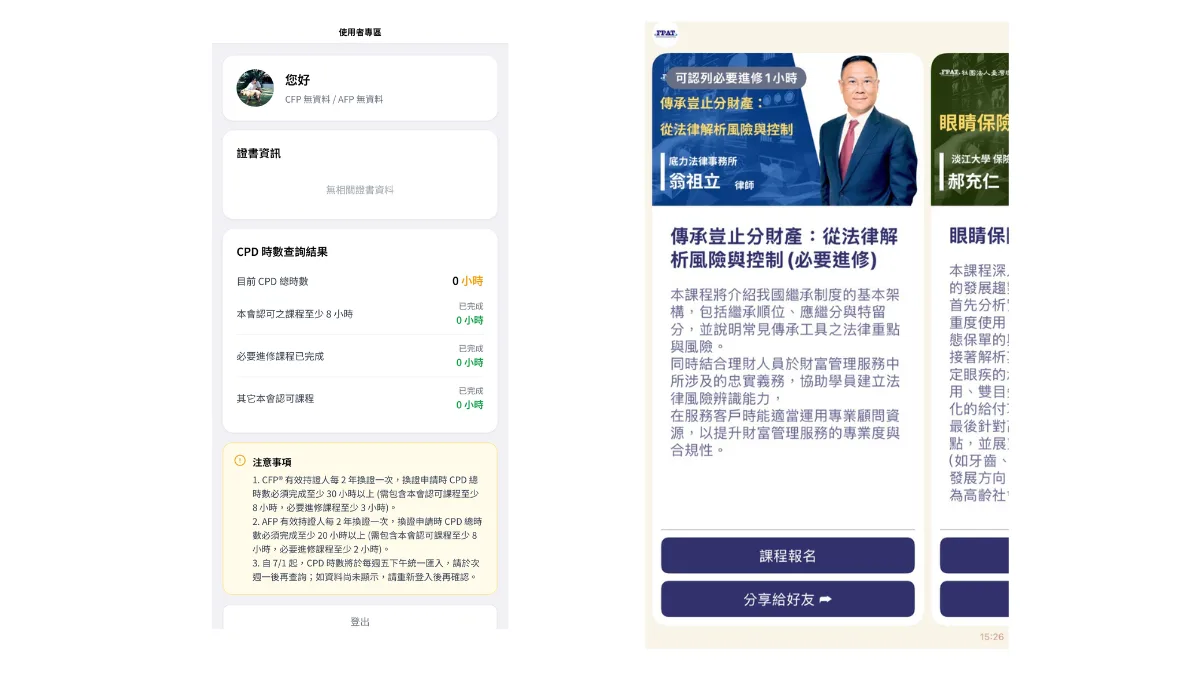
Left: certification details at a glance / Right: easy lookup and sharing of course information
Event engagement tracking: data on every registration and share
Broadcasts for certificant meetups, forums, and seminars come with two built-in action buttons: “Register” and “Share with friends.” Every click is fully logged in the back office. The association can see who is interested in which topics and which messages get shared more, so the next event is planned on real data instead of gut feeling.
TCPSI professional survey: segmented responses, 1,000+ in two weeks
To study trends in Taiwan’s financial planning industry in depth, FPAT launched the TCPSI survey using OakMega forms, with access restricted to active CFP® and AFP certificants and a limit of one response per person. The survey interface is clean and takes just one minute to complete. Paired with a prize-draw incentive, it collected more than 1,000 high-quality responses in two weeks, which went straight into academic research as baseline data.
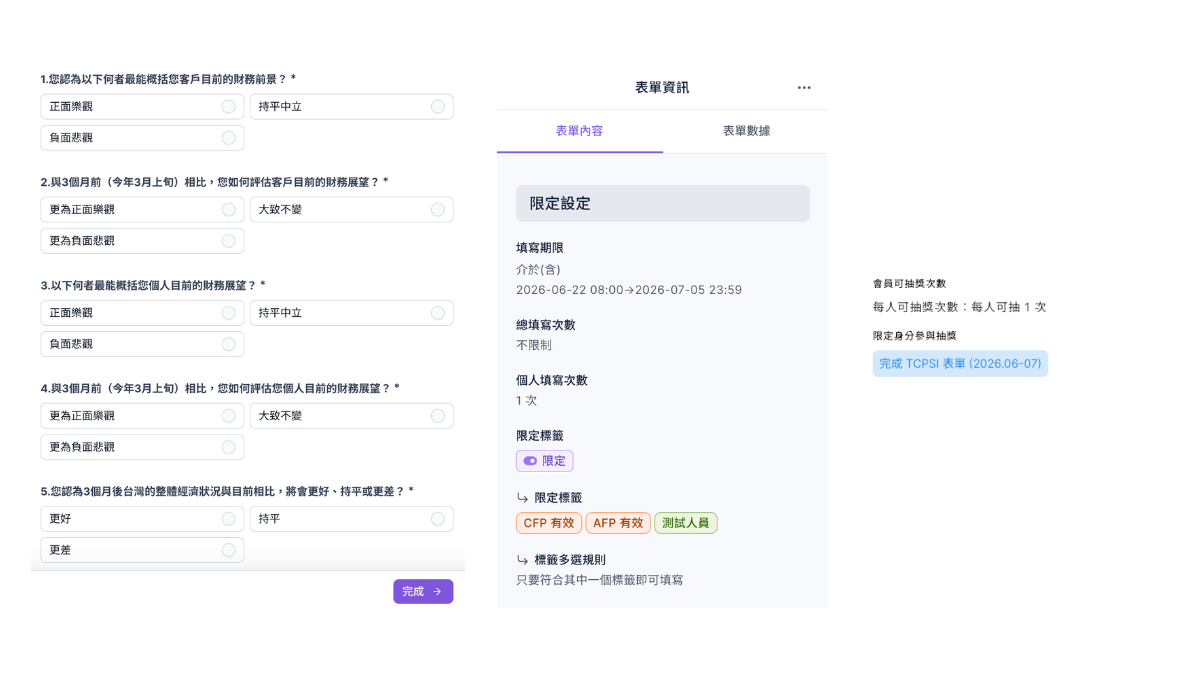
Left: an easy-to-complete interface / Center: only active certificants can fill in the survey / Right: participation restrictions
Results: behind the numbers, a member base that can truly be nurtured
More than 1,000 professional survey responses in two weeks. In an ordinary survey, that number wouldn’t stand out. But with access limited to active certificants, one response per person, and an academic research purpose, it shows that trust between FPAT and its certificants runs deep, deep enough that they’re willing to spend a minute of their workday answering a formal research survey.
| Metric | Result | What it means |
|---|---|---|
| Linked certificants | 2,400+ | Clear segmentation of CFP® and AFP certificants |
| Monthly active rate (MAU) | > 20% | The account delivers real, practical value to certificants |
| Block rate | < 6% | Segmented broadcasts effectively cut information overload |
| TCPSI survey responses (two weeks) | > 1,000 | High-quality research samples that directly support academic work |
A block rate under 6% is the result of segmented broadcasts doing their job. CFP® certificants aren’t bothered by AFP messages, AFP certificants don’t get renewal reminders that don’t apply to them, and general students aren’t flooded with research surveys. Everyone receives only what is relevant to them.
If you face the same challenge
FPAT’s story offers three principles worth borrowing for any association, trade body, or organization that manages professional members.
First: move your most common requests to the place with the lowest barrier. Checking CPD hours at FPAT used to require logging in to the learning platform; now it’s one tap away in LINE. What questions do your members ask every single year? Turn them into a LINE feature, and your support calls can drop by half.
Second: event messages aren’t just notices; they’re a chance to collect data. Every “Register” and “Share” button records member behavior. Your team can use that engagement data to gradually map out the preferences of different member groups, so your next content plan no longer relies on intuition.
Third: survey response rates depend on how easy the survey is, not how big the prize is. The key to 1,000 TCPSI responses in two weeks was a clean interface that takes a minute to complete, sent to certificants who already feel a sense of belonging to the association. The lighter the survey and the more precise the audience, the better the responses. That logic applies to member surveys at any organization.