Your Company Runs 10 AI Agents. Who Tells Them Who the Customer Is? | CEO Insights
When a business runs several AI agents at once, the risk isn't a weak model. It's that each agent reads a different version of who the customer is. Drawing on recent moves by HubSpot, OpenAI, and Salesforce, OakMega's CEO looks at customer context and customer relationship ownership in the AI agent era, and the two questions every business owner should ask.
 Porsche TsaiCEO
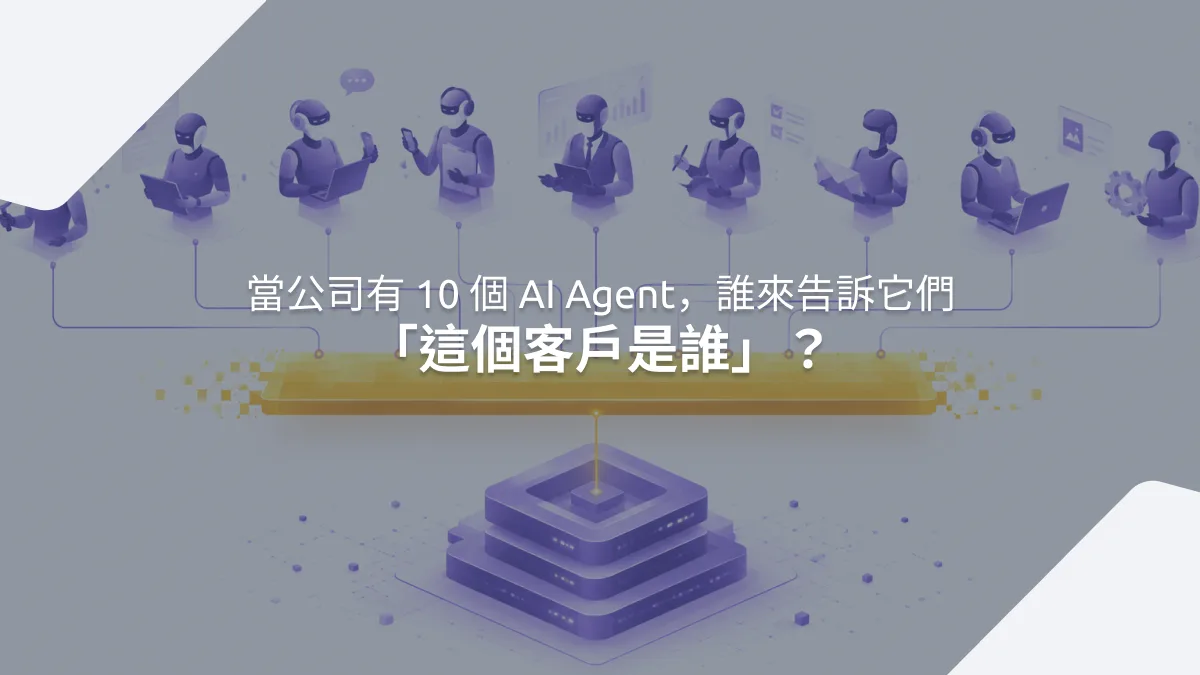
When a company runs multiple AI agents at once, what matters isn't how strong the models are. It's whether they all read the same Customer Context. If each agent holds its own fragment of customer data, one customer gets treated as several different people. That's exactly the lesson HubSpot, OpenAI, and Salesforce have all been scrambling to catch up on lately.
Contents
- One AI agent is great. Ten is where things break
- Even the big three are catching up on Customer Context
- Being smaller means you hit the wall sooner, with less to absorb it
- Two questions you can start asking today
- FAQ
One AI agent is great. Ten is where things break
Picture this.
You've rolled out AI. Sales has an agent that tracks deals and drafts outreach emails. Marketing has one that schedules posts and watches performance. Customer service has one that auto-answers common questions. Taken one at a time, they're all great, and the boss is happy.
The trouble starts when these agents deal with the same customer.
The sales agent is enthusiastically chasing a deal, unaware the customer blew up at support three days ago. The support agent politely works a ticket, unaware this is a VIP on a three-year contract. And the marketing agent is still pushing a new-customer discount at him.
Three agents, three versions of who this customer is. From the customer's side, he isn't dealing with a company that uses AI. He's dealing with a company that seems to have a split personality.
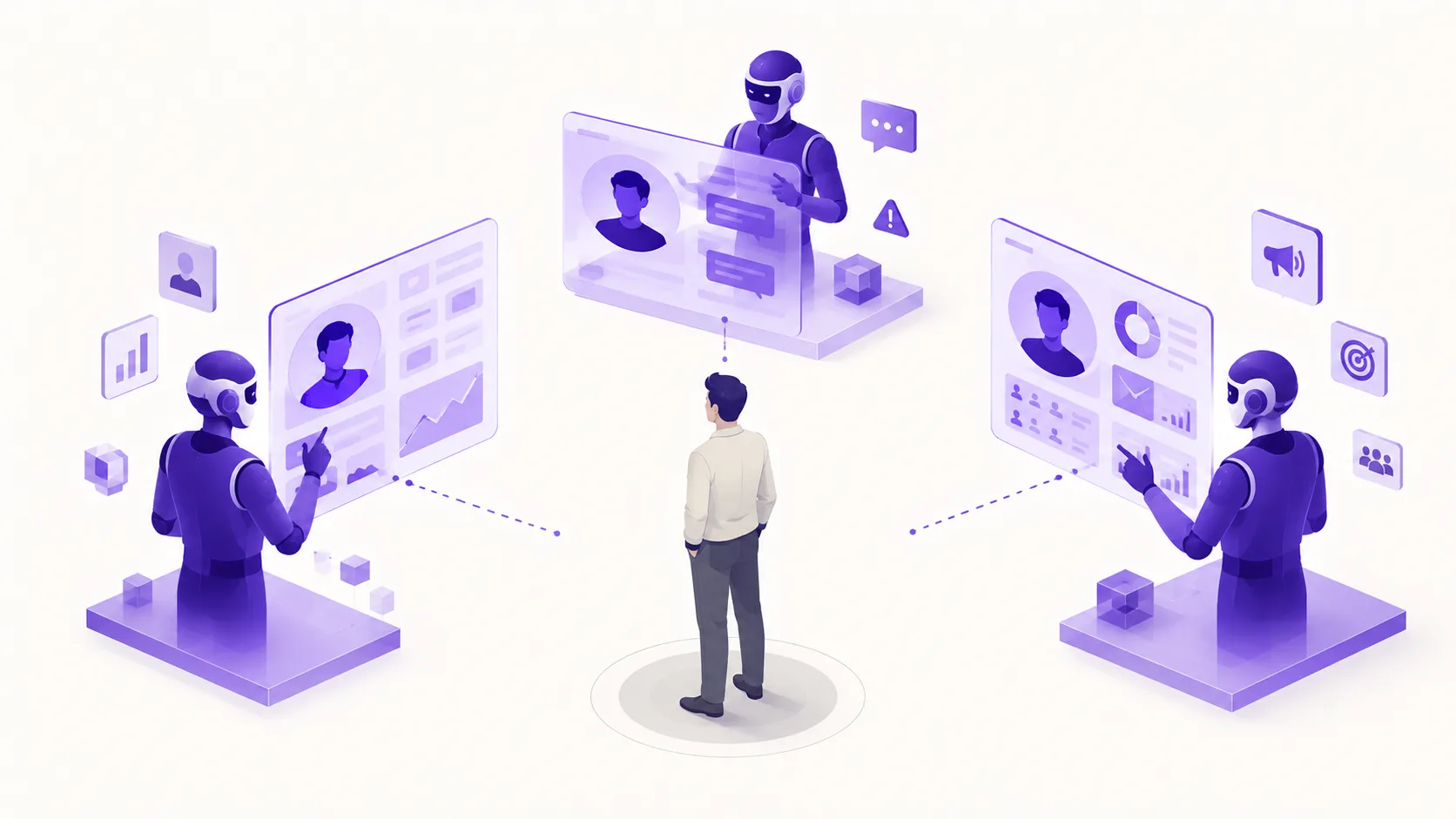
This isn't an efficiency problem. At worst, an efficiency problem slows you down. This is a perception problem: your company has turned one customer into three different people.
Even the big three are catching up on Customer Context
If you think siloed AI agents are only a small-company problem, look at the past month. OpenAI, HubSpot, and Salesforce launched new products almost simultaneously, all aimed at the same problem: companies keep plugging in more agents, and those agents don't talk to each other.
OpenAI launched Presence, a platform for deploying AI agents into real customer service operations. It draws boundaries for each agent: which policies to follow, what permissions it has, and when to hand a conversation back to a human.
HubSpot launched Agent Hub, a control layer for managing every agent in one place. HubSpot calls the mess “Agent Sprawl”: agents across the company each working from incomplete, unsynced data. Agent Hub pulls them together under one roof.
Salesforce launched Agent Fabric, a switchboard for agents. It automatically inventories agents scattered across platforms so you can see at a glance which ones are running and what each is doing.
Three different approaches, but at the core they all answer two questions:
First: when each agent asks “who is this customer,” is it reading the same data?
Second: where is the line drawn on what each agent is allowed to do?
The first is Customer Context. The second is governance. Customer Context is a single, cross-department record of the customer: who they are, what interactions they've had with the company, what contracts they've signed, and whether any issues are still open. Whoever looks, person or agent, sees the same version. Salesforce's 2026 Connectivity Benchmark Report found that enterprises run an average of 12 AI agents, and half of them are isolated: disconnected from each other and not centrally managed. These agents usually aren't planned by the boss. People build them on their own to get work done. Marketing thinks posting takes too long, so they hook one up. Sales hates writing outreach emails, so they set one up too. A colleague gets curious over the weekend and wires up another. Everyone means well, and each decision makes sense on its own. Then one day the boss asks a question, gets a different stock answer from each agent, and realizes the data was splintered long ago.
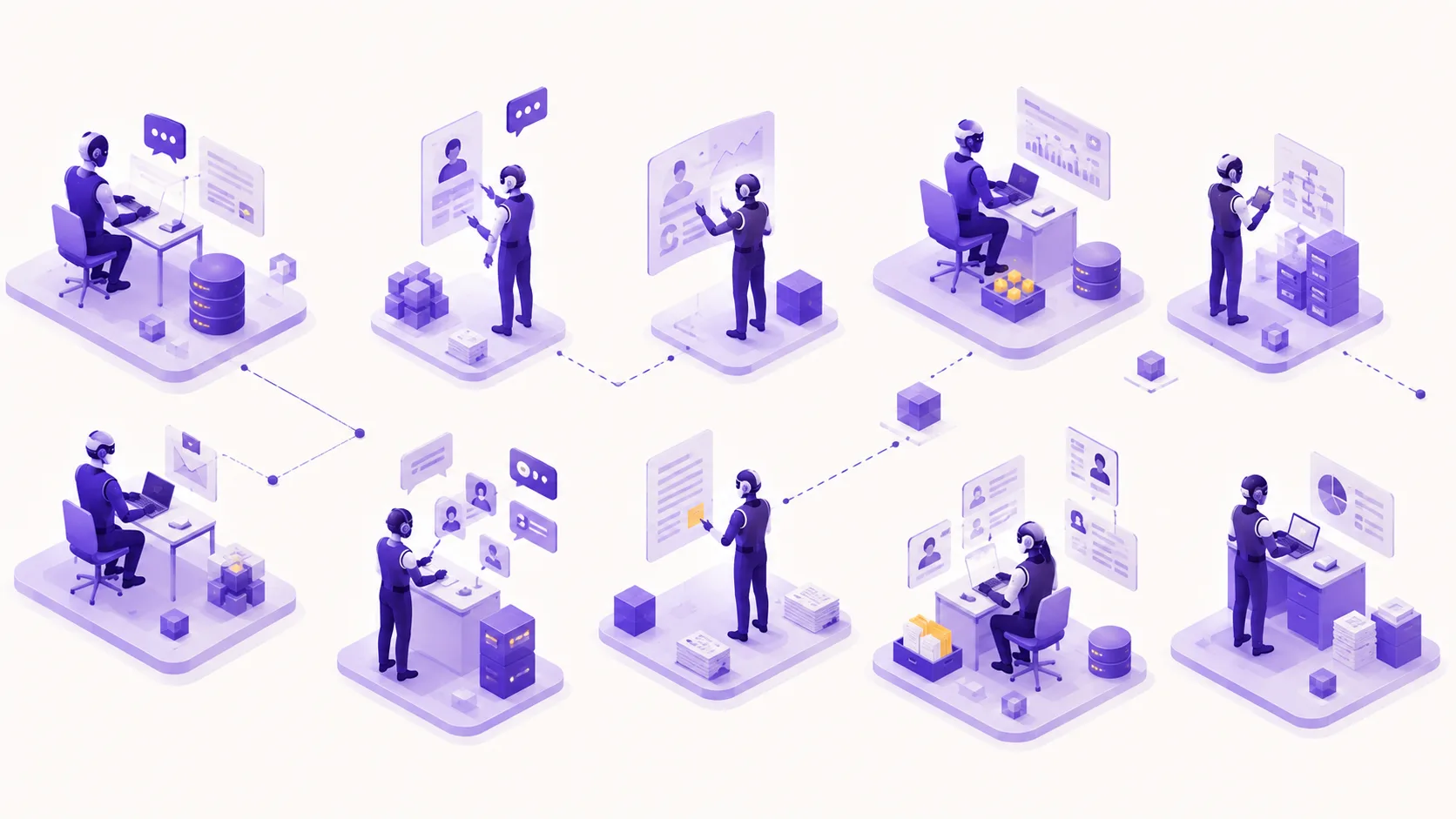
We all know the saying: “A brilliant model fed bad data will just give you the wrong answer, with total confidence.” Most people think AI is won or lost on the model. Anyone who has actually fought this battle inside a company knows it's won or lost on what the model can read.
Being smaller means you hit the wall sooner, with less to absorb it
At this point, SME owners in Taiwan might breathe a sigh of relief: that's a big-company headache. A business my size doesn't have that many agents.
Don't relax just yet. The big companies' problem is “too many,” so many they've lost count. Your problem is “too soon.”
You won't have hundreds of agents, but you will have a third one. And the day that third agent goes live, you'll hit exactly the same wall. The wall is just smaller, and you'll notice it later. The difference: when a big company hits the wall, a whole IT department cleans up afterward. When you hit it, you're the one cleaning up, and often you only discover the wall after you've already lost a customer.
So the real question isn't “Should I buy a few more agents?” It's something more fundamental: where does your company's record of who the customer is live right now? Is it scattered across sales' Excel sheets, support's chat logs, and marketing's lists? Or is there one place that everyone, including every agent, treats as the single source of truth?
This is what I keep calling “customer relationship ownership.”
We used to talk about ownership as a question of whether customers belong to the company or to the salesperson who takes them along when they leave. In the agent era, the question just has a new subject: is the customer relationship a shared set of facts in your hands, or is it scattered across ten agents' separate interpretations?
Ownership has never been a technical data-management problem. It's a question of control. Whoever holds the customer relationship that every agent reads from holds the results of AI.
And the right order is the exact opposite of what most people do. Most buy agents first and only rethink their data after hitting the wall. The right order is to establish that shared customer record first, then connect agents to it one by one. Build the context layer first. Don't patch it in later.
Two questions you can start asking today
We hold ourselves to this first.
At OakMega, we use agents internally to make plenty of tedious work run smoother. But we've deliberately held off on packaging them into products with catchy names. More than adding another agent, we care about one thing: whatever we try internally, it has to read customer data from the same place. We'd rather move a step slower than let every tool grow its own version of who the customer is. That's not caution. It's discipline.
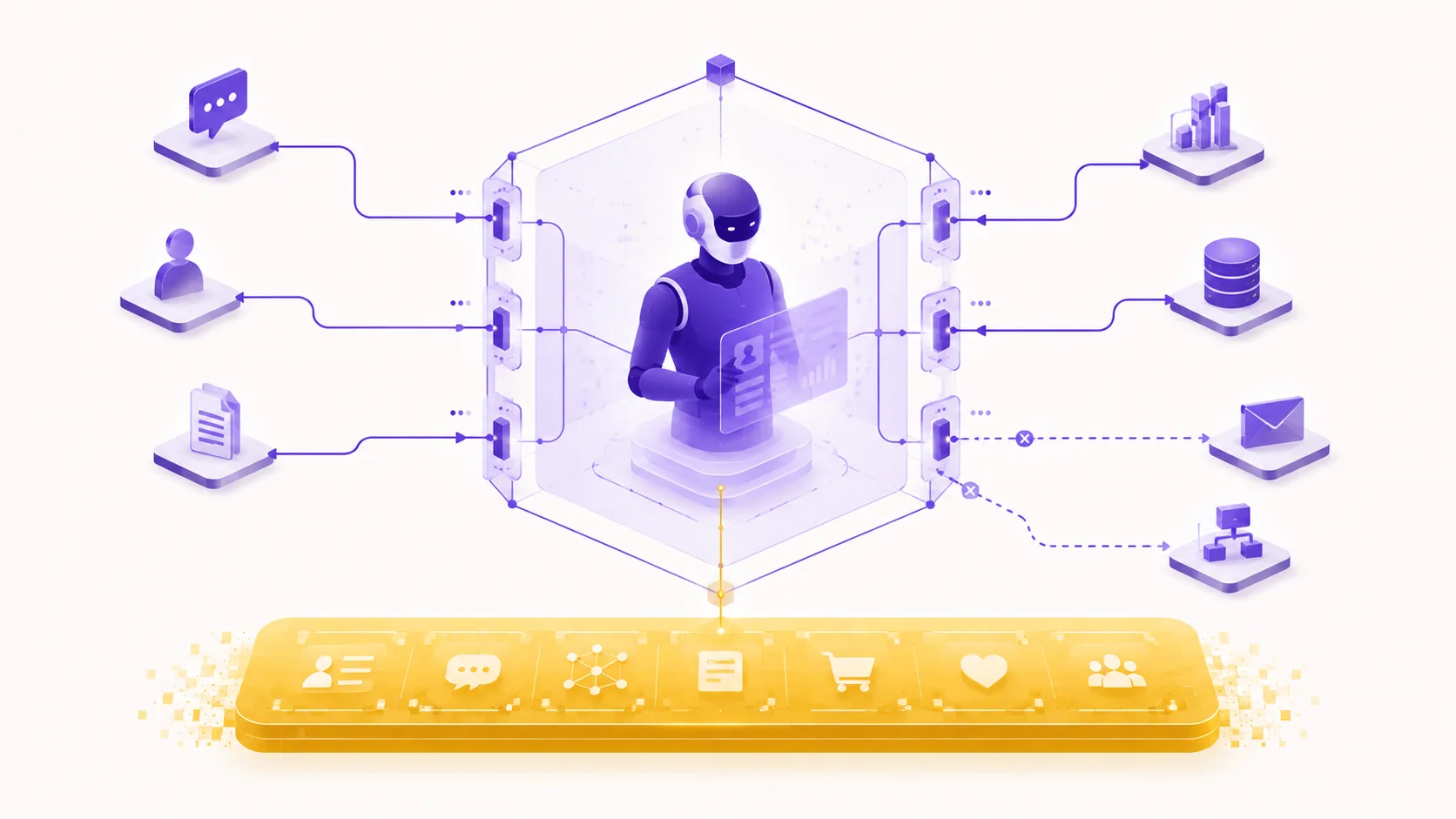
Because I know this for certain: features can be added back later. A customer relationship split ten ways can't be put back together.
So if you're being chased by pitches for every kind of AI and every kind of agent, here are two questions. Next time anyone presents to you, ask these first:
- Whose Customer Context does it read? Its own copy, or the one everyone in my company agrees on?
- What is it allowed to do, and what is it not allowed to do? And who drew that line?
Models will get stronger with every generation. Neither of us needs to worry about that; plenty of people are racing on it. But who holds the record of who the customer is, and who draws the line on what agents can do? Nobody will think those through for you, and nobody can decide them for you.
That said, you don't have to carry it alone. OakMega's FDE team isn't here to install more agents for you. We work with you to first build the shared customer record that every person and every agent reads from, draw clear lines on what each agent can do, and then connect AI one piece at a time. From scoping to development to getting your team up and running, you work with one point of contact throughout. Lay the foundation first; choosing the model later is no problem.
That's the homework that truly belongs to the business owner in the agent era.
If your AI is stuck at implementation, or you've spent the money without really putting it to use, let OakMega FDE help you build that record of who your customer is. From scoping to adoption, one point of contact throughout 👉 Contact us
FAQ
Q: What is Customer Context, and why does it matter for AI agents?
Customer Context is a single, cross-department set of facts about the customer, covering their identity, interaction history, contracts, and service status. Only when multiple AI agents read the same context can they make consistent decisions about the same customer. Without it, each agent is left guessing, which leads to contradictions and a broken customer experience.
Q: Why should SMEs care about this even more than large enterprises?
Large enterprises may have more agents, but they usually have IT teams to clean up afterward. SMEs often hit the wall by their third agent, frequently only after losing a customer, and have far fewer resources to recover.
Q: What should we do before adopting AI agents?
First establish a single set of customer facts that everyone (and every agent) reads from, then connect agents one by one. Doing it in reverse, buying agents first and patching data later, is the main reason most deployments fail.