The 2026 AI CRM Buyer's Guide: Adobe, HubSpot, or the LINE Ecosystem — Which Should Taiwanese Businesses Choose?
In 2026, CRM has entered the era of autonomous AI agents. This guide breaks down Adobe AICX, HubSpot Breeze's outcome-based pricing, and how OakMega's LINE-native CRM differs, with a decision framework for businesses in Taiwan.
 MarketingTeam
You might assume the hardest part of choosing a CRM for a Taiwanese business is deciding whether it has enough features.
In reality, the most common trap is this: companies pay top dollar for a world-class CRM, only to discover it can't see 70% of their customer interaction data. Why? Because those interactions happen on LINE, not over email or web forms.
That problem matters even more in 2026. With HubSpot redefining CRM value through outcome-based pricing and Adobe cementing its hold on the high end with enterprise-grade AI orchestration, brands in Taiwan aren't just asking "Which tool is easier to use?" They're asking "Which AI CRM architecture can actually reach the places where my customers live?"
Table of Contents
- Why 2026 Is Year One for AI Agent CRM
- A Pricing Revolution: What HubSpot's Outcome-Based Pricing Changes
- Adobe CX Enterprise: An AI Brain for Large Enterprises, at a Steep Cost in Taiwan
- The Owned-Channel Advantage of the LINE Ecosystem: How OakMega Stands Apart
- Mapping the Three Approaches: Which One Fits You?
- Our Take
- FAQ
Why 2026 Is Year One for AI Agent CRM
In a 2023 research report, Gartner predicted that by the end of 2025, 80% of customer service and support organizations would be applying generative AI in some form to improve agent productivity and customer experience. Going further, Gartner predicted in 2025 that by 2029, agentic AI will autonomously resolve 80% of common customer service issues without human intervention, cutting operating costs by an estimated 30%. Behind these two numbers lies a fundamental shift in the role of CRM: from a system of record to an agent that takes action.
CRM used to be valuable because of data completeness: capture every call, every order, and every tag, then let people read it, judge it, and act on it. The AI agent CRM of 2026 turns that logic upside down. When a prospect asks about product specs on LINE, the AI doesn't just log the conversation. It scores purchase intent in real time, triggers a personalized follow-up sequence, and delivers a lead-quality assessment to the sales manager within 12 hours.
For businesses in Taiwan, this shift cuts two ways. On one hand, autonomous AI CRM is rapidly blurring the line between marketing and sales. On the other, customer interactions in Taiwan are heavily concentrated in owned LINE channels, which means AI CRMs built on Western architectures run into a data gap that's almost impossible to ignore when they're deployed locally.
The ultimate form of CRM isn't a bigger database. It's a smarter business partner: a digital agent that knows when to make the first move.
A Pricing Revolution: What HubSpot's Outcome-Based Pricing Changes
In April 2026, HubSpot moved two flagship Breeze agents to outcome-based pricing, effective April 14, 2026. The pricing runs on two tracks. Prospecting Agent now charges US$1.00 for each qualified lead it recommends for follow-up. Customer Agent shifts from $1.00 per conversation to US$0.50 per customer service conversation it successfully resolves. In other words, if the AI doesn't solve the problem, you don't pay. It looks like a minor pricing tweak, but it captures a paradigm shift across the entire CRM industry.
Traditional subscriptions boil down to "you pay to use the tool." Whether or not the AI produces real business value, the monthly fee stays the same, and the brand carries all the risk. The core promise of outcome-based pricing: the vendor and the brand share the risk, and if the AI delivers nothing, you pay nothing. That shift moves the CRM evaluation criteria from "How many features does it have?" straight to "How many measurable results can it deliver in my business?" According to HubSpot, Breeze Customer Agent currently achieves a 65% resolution rate across more than 8,000 customers and cuts resolution time by 39%.
HubSpot Breeze: Core Strengths and Limits
HubSpot Breeze Agent sets a high bar for AI CRM in the mid-market. Its standardized inbound marketing workflows are mature and complete, implementation takes just 1–3 months, and marketers can run it without a technical background.
However, Breeze's AI reach stops at the API surface. HubSpot is designed around the assumption that a brand's customer journey runs mainly through web and email, which is a reasonable premise in Western markets. But consumers in Taiwan are used to completing the entire journey on LINE, from discovering a brand to asking about a purchase. That leaves HubSpot's AI agents facing a fundamental data gap: they can't see these LINE conversations, so they can't learn from them or optimize around them. LINE integration is still handled by third-party plugins, which limits both data freshness and depth.
Adobe CX Enterprise: An AI Brain for Large Enterprises, at a Steep Cost in Taiwan
Adobe CX Enterprise (AICX) is built around a Customer Data Platform (CDP) and uses the Sensei AI engine to power personalized omnichannel experiences. Its strength is data processing at scale: it unifies every touchpoint, from web and email to ads and physical stores, and integrates deeply with Adobe Analytics, Campaign, and Target to form a seamless enterprise data ecosystem.
It's the go-to choice for conglomerates with millions of members and multinational brands running multichannel operations, but the price is just as striking. Implementation typically takes 6–12 months and requires a dedicated technical team for ongoing maintenance. For small and midsize brands, the total cost of ownership (TCO) is nearly out of reach.
In Taiwan, Adobe AICX's biggest challenge isn't functionality. It's fit. Adobe is an engine designed for Western digital journeys, and its AI capabilities assume that web and email are the primary customer interaction channels. When over 70% of high-value interactions in Taiwan happen in owned LINE channels, Adobe's powerful cross-channel orchestration struggles to reach the data that matters most.
Adobe is an engine built for Western digital journeys. It's extremely powerful, but on Taiwan's owned LINE channels, it needs a local partner to bridge the gap.
The Owned-Channel Advantage of the LINE Ecosystem: How OakMega Stands Apart
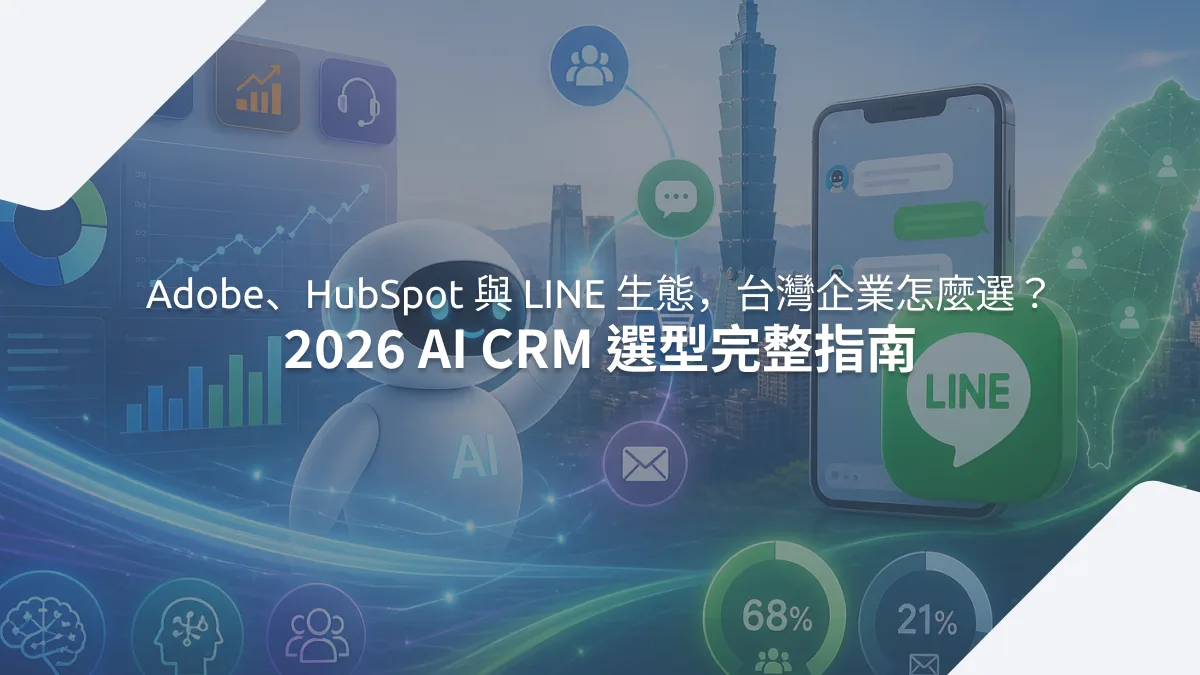
LINE has more than 22 million monthly active users in Taiwan, with penetration above 90% (2025 data). Even more important, brand LINE Official Accounts see an average message open rate of 68%, compared with just 21% for email. That gap determines which channel lets an AI agent actually capture a customer's purchase intent.
OakMega Social CRM is built on exactly this market reality. Unlike HubSpot or Adobe, OakMega's AI agents are deeply embedded in the LINE conversation ecosystem, and the difference shows up on three levels:
Semantic Intent Analysis: Understanding Unstructured Conversations
Traditional CRM segmentation relies on tagging rules that people set up by hand. OakMega's AI agents take a different path: an NLP model optimized for the Taiwanese market interprets the underlying intent of every LINE conversation in real time. When a LINE friend asks, "Does this come in other colors?", the AI recognizes it as a high-intent purchase inquiry rather than casual curiosity. When a friend forwards a product post, the AI gauges how strong that signal is within their buying journey. In internal testing, semantic recognition accuracy exceeds 85% (1H 2025 data).
The challenge here is cultural as much as technical. LINE conversations in Taiwan are full of nonstandard signals: mixed languages (Mandarin with English and Taiwanese Hokkien), forwarded messages, sticker replies, and more. No general-purpose NLP model handles that well out of the box. That's exactly why a semantic engine deeply optimized for Taiwan is the foundational capability brands really need on their owned LINE channels.
Automated 12-Hour Intelligence Reports: AI Engages Customers Externally and Delivers Decision Intelligence Internally
This is OakMega's most concrete differentiator from global tools. Every 12 hours, the AI agent automatically produces an intelligence report that summarizes the day's LINE engagement trends, lists high-intent LINE friends, and flags changes in segments, then pushes it to sales managers. No one has to dig through data; the AI delivers decision-ready intelligence directly.
Working with brands, we've noticed a common pattern: sales managers don't suffer from too little data. They suffer from too much to review every day, with no way to tell what matters. The intelligence report was designed to solve exactly that. Every day, the AI "reads" every LINE interaction on the manager's behalf, filters out the leads truly worth following up on, and sends them straight to their phone.
Cost Structure Advantage: Optimizing CPA at High Interaction Volumes
OakMega uses a subscription plus modular pricing model built for predictable ROI. In high-frequency owned-channel scenarios, a fixed cost structure actually beats HubSpot's per-lead pricing. Once monthly LINE conversation volume reaches a certain scale, OakMega's cost per interaction (CPA) falls well below that of pay-per-outcome models.
In Practice: A Beauty Brand's LINE Conversion Problem
Take a fast-moving consumer beauty brand in Taiwan. Its LINE Official Account had grown to more than 80,000 LINE friends, but the marketing team could only send the same broadcast message to everyone, because no tool could automatically tell the difference between "a high-intent friend who has asked about sunscreen three times" and "a passerby who clicked a link once and never engaged." After adopting OakMega's semantic segmentation, the AI automatically sorted friends into five tiers by purchase intent. Conversion on promotions to the high-intent segment rose to 2.4x the previous rate, and average monthly broadcast costs fell 31%, because the brand stopped sending the same message to everyone.
Mapping the Three Approaches: Which One Fits You?
The Quick Version:
- You're a multinational group with millions of members and a full IT team → Start with Adobe AICX
- You prioritize CPL control and standardized inbound marketing → HubSpot Breeze's outcome-based model deserves a serious look
- Your customer interactions happen mainly on LINE, and you need to capture purchase intent in real time → OakMega is currently the most targeted option in the Taiwanese market
Our Take
A lot of coverage frames the 2026 CRM decision as "compare features, pick the lowest price." But only one question really matters: Where do your customers live?
HubSpot's outcome-based pricing is an elegant, good-faith business model innovation. The vendor ties its own interests to the brand's business results, and that's a direction worth applauding. But no pricing model, however good, can fix an AI that can't see 70% of your customer interaction data. At that point, the basis for calculating $1 per lead is already distorted: the "lead" you're paying for was filtered from just 30% of the picture.
Adobe has a similar problem. It's an extremely precise engine, but Taiwan's racetrack wasn't built for it. Drive an F1 car up a winding mountain road and the car isn't the problem; the car and the track simply don't match.
OakMega's positioning matters not because it's "better" than HubSpot or Adobe. On their home turf, both have overwhelming advantages. OakMega matters because it answers a question the global giants have no incentive to take seriously: How do you make AI agents truly effective inside the owned LINE ecosystem?
That's also the question I believe B2B brands in Taiwan should be asking above all when choosing a CRM in 2026: "Can my AI CRM understand every purchase signal that happens on LINE?" If the answer is no, all that system gives you is an analysis report built on 30% of the picture.
Our advice for businesses: don't pay for a feature list. Invest in data coverage. First figure out where your customer journey actually happens, then decide which AI CRM architecture best covers your real business.
What do you think of HubSpot's outcome-based pricing or AI for owned LINE channels?
👉 Tell us about your CRM selection experience
FAQ
Q1: How is an AI agent CRM different from a traditional CRM?
An AI agent CRM isn't just a smarter database. It's an agent that can independently make judgments and carry out business tasks. With a traditional CRM, people have to read the data before making decisions. An AI agent CRM interprets customer interactions in real time, triggers personalized action sequences, and proactively pushes decision intelligence to managers, with no human intervention required. According to Salesforce's 2025 State of Service report, service agents using AI save about 4 hours a week on routine cases, and by 2027, 50% of service cases are expected to be resolved autonomously by AI (up from 30% in 2025).
Q2: What exactly is HubSpot Breeze's outcome-based pricing?
Outcome-based pricing is the new pricing model for HubSpot Breeze that took effect on April 14, 2026. Instead of a fixed monthly fee, the vendor charges based on the business results actually delivered. Breeze Prospecting Agent now charges US$1.00 per qualified lead, and Breeze Customer Agent charges US$0.50 per successfully resolved customer service conversation (no charge if unresolved). By tying the vendor's interests directly to the brand's business outcomes, the model is seen as a pioneer of the pricing shift across the entire CRM industry.
Q3: Why is Adobe CX Enterprise a limited fit for the Taiwanese market?
Adobe AICX is an enterprise platform designed for Western digital journeys, and its AI capabilities assume that web, email, and advertising are the primary customer interaction channels. In Taiwan, however, over 70% of high-value interactions between consumers and brands happen in owned LINE channels, and Adobe's omnichannel orchestration struggles to reach that data effectively. On top of that, Adobe implementations typically take 6–12 months, and the overall TCO is high, putting it out of reach for most small and midsize brands.
Q4: What do businesses in Taiwan most often overlook when choosing an AI CRM?
The most common blind spot is data coverage. Many brands evaluate CRMs based on feature lists or monthly fees without first confirming whether the system can fully cover their main customer interaction channels. If your customers primarily talk to your brand on LINE and your CRM's integration with owned LINE channels falls short, the foundation of your AI analysis is already incomplete, and no number of features can make up for a 70% data blind spot.
Q5: What is OakMega's automated 12-hour intelligence report?
The automated 12-hour intelligence report is one of the core features of OakMega Social CRM. Every 12 hours, the AI agent automatically compiles a decision report covering LINE engagement trends for the period, a list of high-intent LINE friends, changes in segments, and alerts on potential opportunities, then pushes it to sales managers. Managers no longer need to pull data from the dashboard themselves; the AI delivers actionable decision intelligence directly. It's a dual agent capability: the AI engages customers externally while managing intelligence internally.