






Claude Managed Agents Is Here: Enterprise AI Agent Deployment Shrinks from Months to Days, 10x Faster
On April 8, 2026, Anthropic launched Claude Managed Agents in public beta, offering a complete cloud infrastructure with sandboxed execution, Vault, long-running sessions, and multi-agent coordination. Enterprise AI agent deployment now takes days instead of months, a 10x speedup.
 MarketingTeam
Many people assume “let AI automate my work” is a promise that can already be kept today.
In reality, until last week, getting an AI agent into production still meant engineers had to handle sandbox security, state management, credential access, and error recovery on their own. That infrastructure alone could eat up months for a serious team. On April 8, 2026, Anthropic launched Claude Managed Agents in public beta. It is not a new model. It is a complete cloud infrastructure for agents, and it takes over the parts that used to give engineers the biggest headaches.
Table of Contents
- What Is Claude Managed Agents?
- Four Core Capabilities: Infrastructure Is No Longer Your Problem
- Performance: Better Task Success Rates and Lower Latency
- Already in Production: Notion, Rakuten, and Asana
- Our Take
- FAQ
What Is Claude Managed Agents?
Claude Managed Agents is a suite of composable APIs from Anthropic that lets developers build and deploy scalable AI agents in the cloud without standing up their own backend infrastructure. Until now, getting an agent into production meant tackling sandboxed execution, checkpointing, credential security, permission scoping, and end-to-end tracing yourself. That work often consumed most of the development cycle: engineers burned months before users saw a single feature. The core idea behind Managed Agents is simple: you define what the agent should accomplish, which tools it can use, and where its boundaries are. Anthropic’s cloud infrastructure handles the rest. There is a bigger trend worth noticing here. Engineers used to be a prerequisite for AI automation, because “getting the AI to run” was itself a technical problem. Managed Agents is shifting that barrier from “can we build it?” to “do we know what we want it to do?” Infrastructure is no longer the bottleneck. Workflow clarity is.
Four Core Capabilities: Infrastructure Is No Longer Your Problem
Decoupling the brain from the hands: agents that don’t “black out”
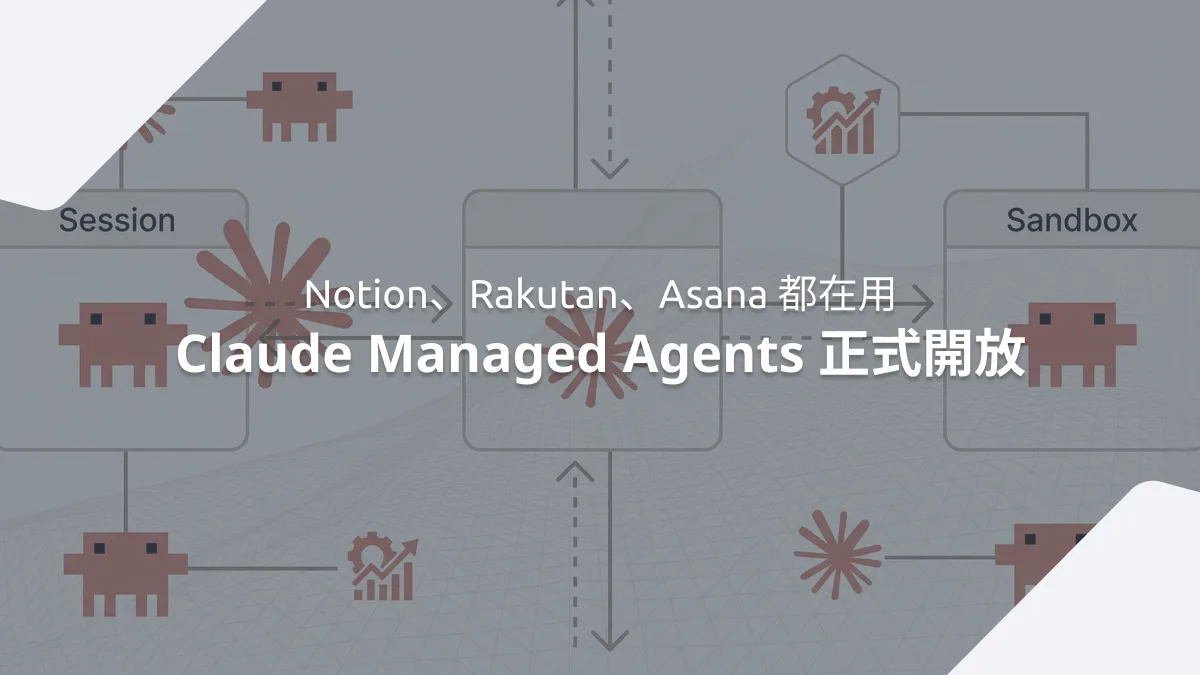
Managed Agents uses a “brain–hands separation” design that splits the AI’s reasoning (the brain), tool execution (the hands), and task records (the session log) into separate layers.
This solves a long-standing pain point. Previously, if the execution environment crashed, the agent lost all its progress. Now, when the environment fails, the system simply spins up a fresh sandbox; the agent pulls up the task log and picks up exactly where it left off. No wasted work, no manual restart. Anthropic’s official blog frames the shift as “pets vs. cattle”: servers used to be nursed back to health like a sick pet, while a broken execution environment is now simply replaced with a new one from the herd. The whole process becomes more stable and more like a factory assembly line.
Vault: the AI does the work but never sees your passwords
Vault is one of the most important security mechanisms in Managed Agents. The traditional approach hands API keys or OAuth credentials directly to the AI agent, which is extremely risky in the face of prompt injection attacks: a malicious instruction could trick the AI into leaking those credentials. In Managed Agents, credentials are locked in a Vault outside the sandbox. When the agent needs to call an external service (such as ClickUp, Notion, or GitHub), it obtains temporary authorization through a proxy mechanism, and the AI itself never has direct access to the raw credentials. Users just click to authorize, as with any normal OAuth login, without touching a single API key.
Long-running sessions: hours of autonomous work that survive disconnects
Managed Agents supports long-running autonomous tasks. Agents can work unsupervised for hours, with progress and outputs persisted, so even a network outage won’t stop the task. This matters most for complex, multi-step workflows that span multiple tools: from reading a codebase and planning a fix to opening a PR, the whole flow can run fully automated, with no human waiting in the middle to approve each step.
Multi-agent coordination: agents directing agents (Research Preview)
Now available as a Research Preview, multi-agent coordination lets a lead agent dynamically spin up sub-agents to parallelize complex tasks. For example, a lead agent can assign several sub-agents to work on different documents at once, then consolidate the results. In theory, this can compress work that used to take dozens of hours into a few minutes.
Performance: Better Task Success Rates and Lower Latency
Anthropic’s internal test results are worth a closer look.
In structured file generation tests, Managed Agents improved task success rates by up to 10% over a standard prompting loop, with the biggest gains on the hardest tasks.
— Claude official blog
The latency improvement is the most tangible change this time. When testing AI agent products, “when does the first word appear?” often determines how much users trust the tool. Wait too long and it feels like the tool is stuck thinking, and you’re not sure it even received your instruction. Managed Agents uses lazy loading that starts tools only when needed, cutting time to first token by 60% to 90%. That is enough to move the experience from “waiting for a computer to boot” to “talking to a person.”
Already in Production: Notion, Rakuten, and Asana
Picture this: at 5 p.m. on Friday, you hand this week’s sales meeting recording to an AI agent and head out to dinner. On Monday morning, you open your laptop and Notion already has a complete to-do list, with every task assigned to the right owner and the due dates filled in. This isn’t hypothetical. Rakuten’s business teams already work this way: from assigning a task to receiving the deliverable (a spreadsheet, a slide deck, an analysis report), no technical staff need to step in. By the time Managed Agents launched, several companies had already completed early deployments:
Notion is building Claude-powered custom agents into its product in a private alpha, letting team members delegate tasks to AI right inside their Notion workspace. Engineers use it to write code, knowledge workers use it to build web pages and presentations, and dozens of tasks can run in parallel.
Rakuten deployed a dedicated agent for each of its product, sales, marketing, and finance departments in under a week. The agents are integrated into Slack and Teams, so employees can assign tasks directly and receive deliverables such as spreadsheets, slide decks, or apps.
Asana built its “AI Teammates” feature on Managed Agents, letting AI agents work alongside humans in Asana projects, pick up tasks, and draft deliverables. Asana says that with Managed Agents, it shipped new features “much faster than originally expected.”
What these three cases have in common: deployment cycles shrank from “months” to “days,” and every agent operates within permission boundaries the company controls.
Our Take
Much of the coverage frames Managed Agents as “a more convenient AI tool,” but I think that framing is too conservative. What strikes me most about this launch isn’t the performance numbers themselves. It’s the productization potential it opens up. Here’s an analogy. Building an AI agent used to be like making a chair by hand without relying on a professional carpenter: you had to source the wood, learn the joinery, and sand and finish it yourself. One person makes one chair, gains experience, and slowly gets better. But if you want a million people sitting on that chair, you don’t need better woodworking skills. You need a factory.
Managed Agents is that factory. It doesn’t solve “how do I build an agent?” It solves “how do I mass-produce agents, replicate them, and put them in everyone’s hands?”
What does that mean? We’re likely to see a wave of “agent template commoditization.” Just as you can download a SaaS tool from the App Store today and use it right away, we may soon see “agent template packs” designed for specific industries and processes: download them from GitHub or subscribe directly, no engineers required, plug in and go. Notion is already heading in this direction. For businesses in Taiwan, the lesson is this: organizing your workflows now matters more than waiting for the tools to mature. Agents can only automate what you can define. A company with unclear processes won’t get results even with the best tools. Start by mapping out “manual tasks that repeat more than three times a week.” That’s your first agent pilot.
Which industry do you think will be the first to have its way of working reshaped by AI agents?
FAQ
Q1: What is Claude Managed Agents?
Claude Managed Agents is a cloud infrastructure service for AI agents that Anthropic launched in April 2026. Delivered as composable APIs, it lets developers quickly build and deploy scalable AI agents without building their own sandboxed execution environment, credential management, state persistence, or other backend infrastructure. It is currently available as a public beta on the Claude Platform.
Q2: How is Managed Agents different from using the Claude API directly?
When you use the Claude API directly, you have to handle all the infrastructure yourself: sandbox environments, recovery from interrupted tasks, credential security, execution tracing, and more. Managed Agents hosts all of that for you. Developers only define the task goals and tool scope, and Anthropic’s infrastructure takes care of the rest. According to Anthropic, Managed Agents can shrink the time from prototype to production from months to days.
Q3: How does Vault protect my API keys and account passwords?
Vault is the core security mechanism of Managed Agents. User credentials (API keys, OAuth authorizations) are stored in an isolated vault outside the execution sandbox. When the agent needs to call an external service, it obtains short-lived temporary authorization through a proxy mechanism, and the AI itself can never read the raw credentials. This fundamentally prevents credential leaks caused by prompt injection attacks.
Q4: How can businesses in Taiwan start evaluating Managed Agents?
Managed Agents is currently available as a public beta on the Claude Platform API, and teams with development capacity can apply to use it directly. For companies without engineering resources, a good starting point is to watch whether SaaS tools that integrate Managed Agents, such as Notion and Asana, roll out new AI features. That is the lowest-barrier way in. Before adopting any agent tool, though, it’s more important to map out your internal workflows first: agents can automate what you already know how to do, not what you haven’t figured out yet. Start by mapping out “manual tasks that repeat more than three times a week.” That’s your first agent pilot.
Q5: When will multi-agent coordination be generally available?
Multi-agent coordination (which lets a lead agent dynamically launch and direct sub-agents) is currently available as a Research Preview, and access requires a separate application to Anthropic. Also in Research Preview is “agent self-evaluation and iteration,” which lets agents keep trying against custom success criteria until they reach the goal. Anthropic has not yet announced when either feature will be generally available.