






AI Is Filtering Your Customers’ LINE Notifications, and Neither You Nor They Know It
Gemini Intelligence can now silently filter LINE push messages across apps, and image-only messages are an information black hole to AI. Learn how to make your LINE marketing AI-friendly with Flex Message and capture the conversion upside first.
 MarketingTeam
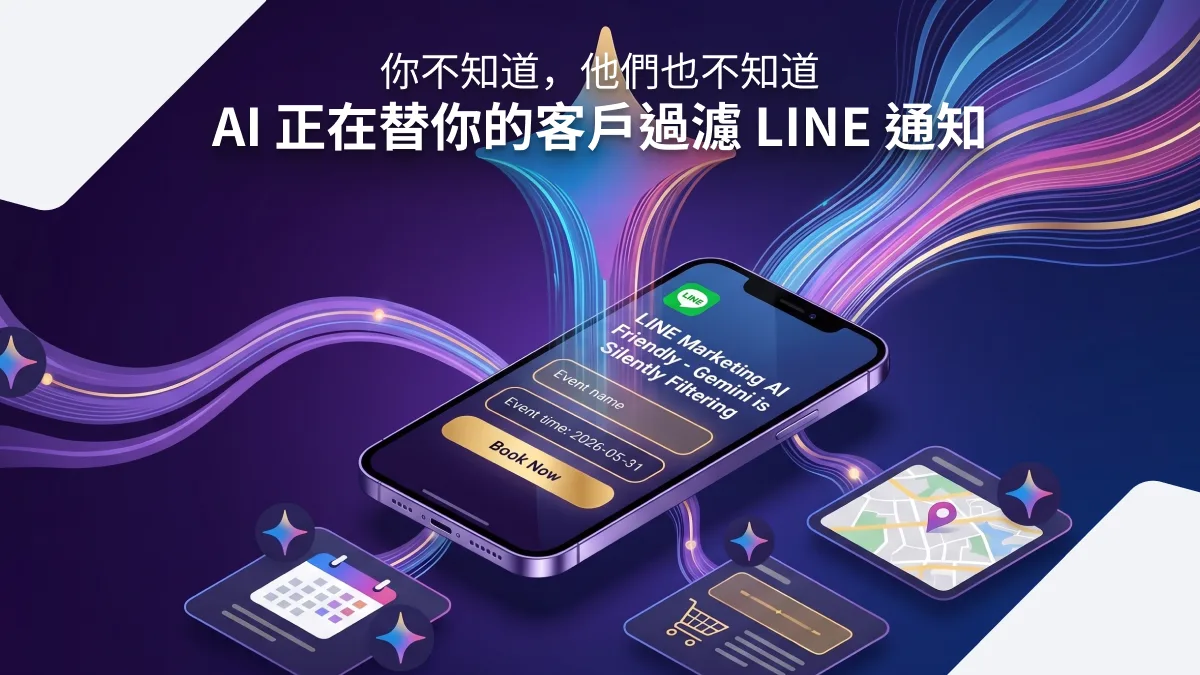
In May 2026, Google Gemini Intelligence officially launched on Android as the world’s first OS-level AI agent, able to read LINE messages across apps and carry out tasks automatically. This fundamentally changes how LINE marketing works: image-only push messages are an information black hole to AI, and visual navigation through the rich menu is no longer the only path. Brands that don’t proactively make their messaging “AI-friendly” will lose conversions silently—no warnings, no data, nothing to see.
Table of Contents
- The Conversion That Never Happened
- “Better Design” Isn’t the Answer
- AI Reads Your Structure, Not Your Design
- The Social CRM Moat Is Only Now Showing Its Real Strength
- FAQ
The Conversion That Never Happened
This May, the marketing manager of an auto service chain in Taipei sent out a LINE push message she considered “well designed”: a polished image promoting a limited-time engine maintenance package, with bright visuals, a clear discount, “20% off when you book before 5/31,” and a prominent “Book Now” label. The message reached more than 30,000 members with an 18% open rate—not bad. Yet that weekend, the booking system barely moved.
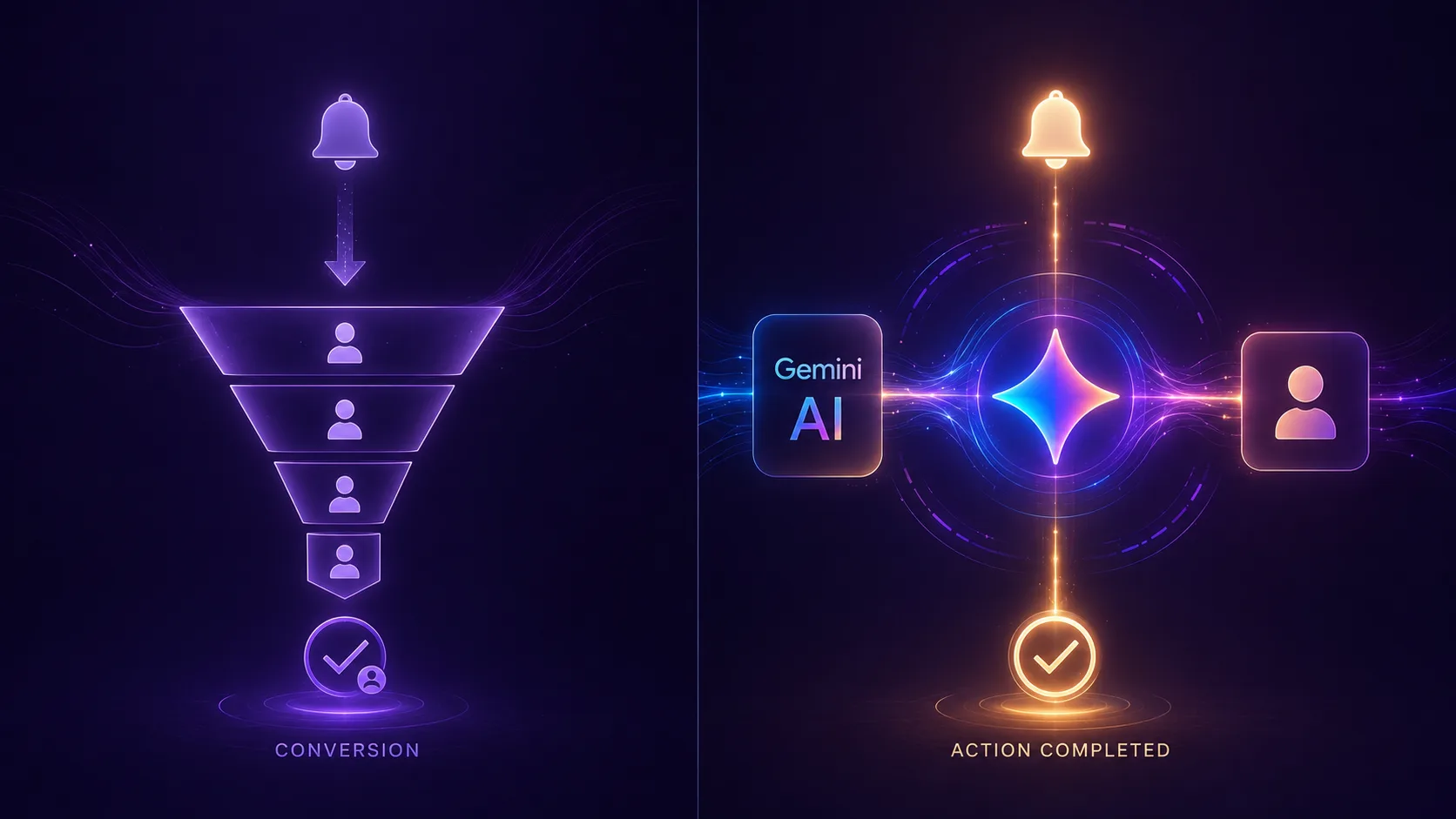
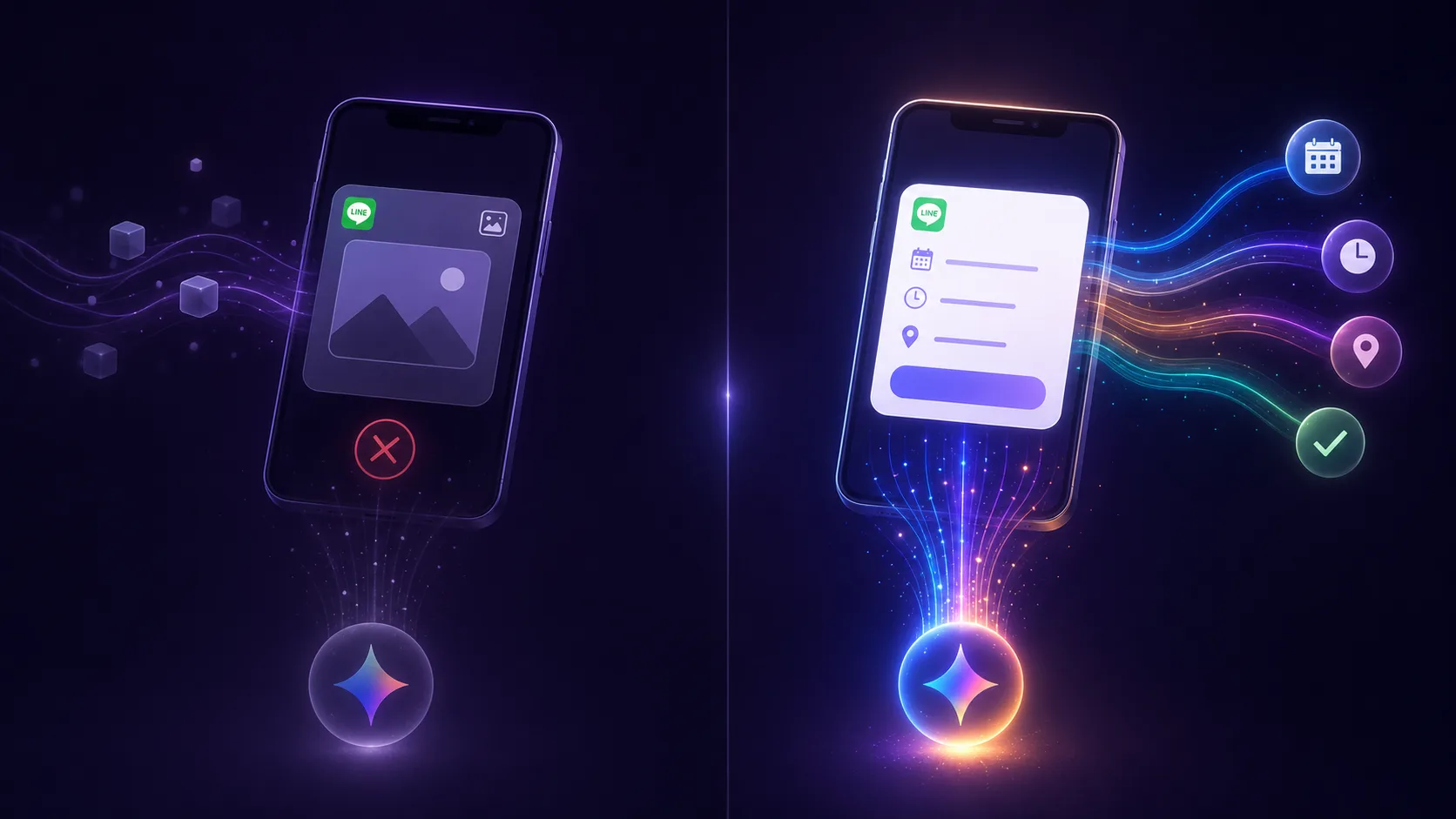
What she didn’t know was that behind the notification bar of those 30,000-plus Android phones, Gemini Intelligence scanned the message, identified it as an image, found no date to extract and no structured booking link, concluded there was “no actionable task,” and silently skipped it. No prompt appeared on users’ phones, and users never realized they had missed anything. The conversion simply vanished—no error message, no alert, and the LINE dashboard still showed everything as “normal.”
A few kilometers away, another service shop sent a Flex Message version of the same promotion: the campaign dates appeared as text, the deadline was clearly marked, and “Book Now” was a real structured button. When Gemini scanned the message, it recognized “an actionable task for the user” and proactively surfaced a prompt on the home screen: “You received a promotion on LINE. Want me to book it for you?” That weekend, their booking system didn’t stop ringing.
The gap between the two shops wasn’t copy, design, or budget. It was a question most brands haven’t yet considered: Can AI actually read your LINE messages?
“Better Design” Isn’t the Answer
Had you asked any seasoned LINE marketing consultant in early 2026 how to improve push conversion rates, the answers would almost all have fallen into familiar territory: optimize the visual flow of your rich menu, make the first 20 characters of your copy more eye-catching, and cut form fields to reduce friction. This advice isn’t wrong. It has worked well in recent years and is backed by solid user behavior data.
The core assumption behind this logic is that users see the push message, tap into it, and complete the flow you designed. The entire conversion funnel is optimized around the premise that “the user is the active actor”—your job is to remove every possible point of friction so users’ eyes and fingers move smoothly to where you want them.
“Before the AI agent era, every LINE marketing optimization rested on a premise that is about to break: the user is the active actor.”
Since May 12, 2026, that premise has been quietly eroding. The launch of Gemini Intelligence means one thing: users’ phones now have an agent, and that agent inserts its own layer of judgment between your messages and your users. It may not follow the visual flow you designed, may not pass along the copy you carefully crafted, and may ignore the rich menu you’ve run for six months entirely. AI is not a user, and its behavior is fundamentally different from how humans read visually—and AI now sits between your users and your messages.
AI Reads Your Structure, Not Your Design
The core logic of Gemini Intelligence: only what can be parsed can be acted on
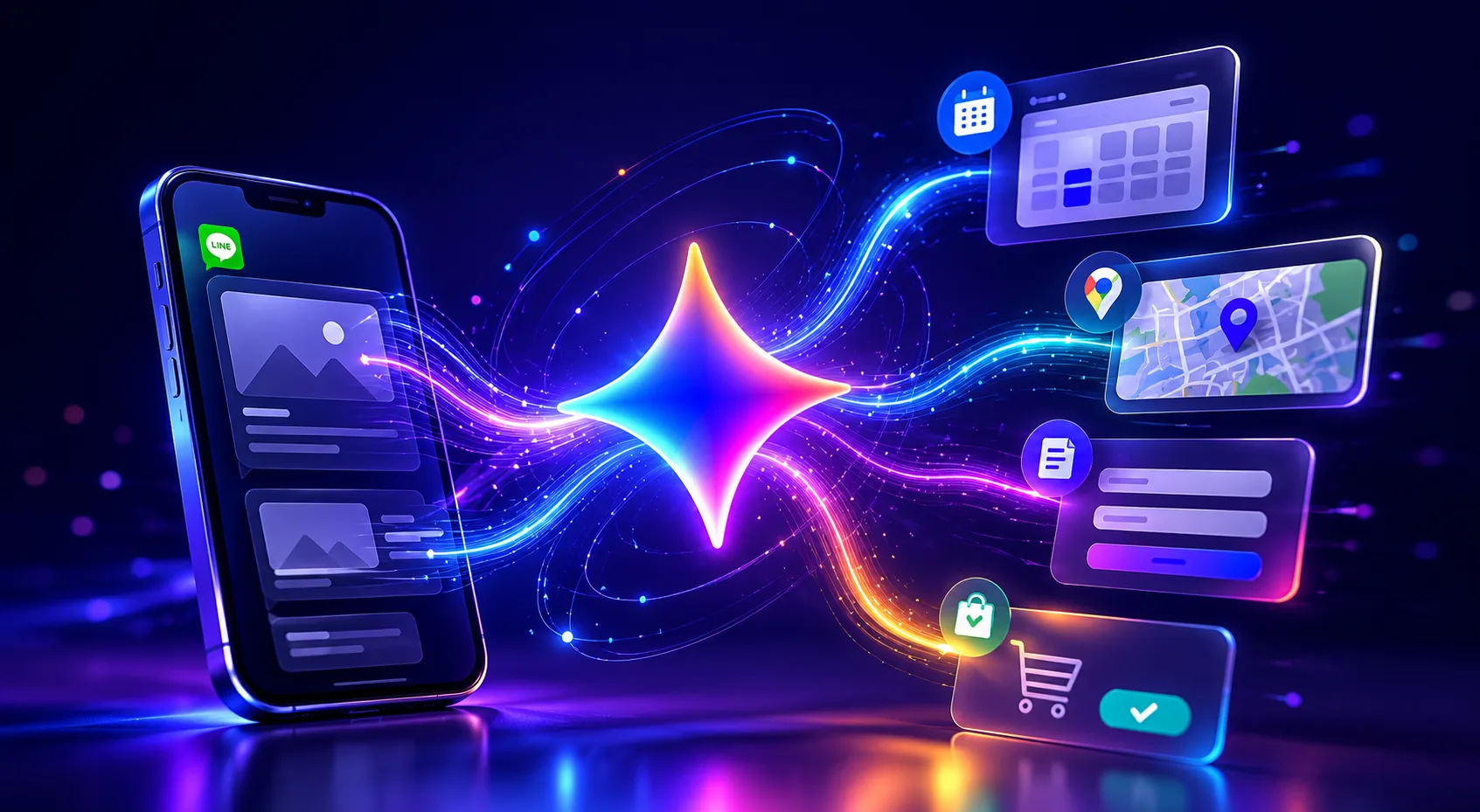
On May 12, 2026, Google officially launched Gemini Intelligence at The Android Show: I/O Edition. It is the world’s first system-level AI agent built into the Android operating system, able to understand on-screen text and visual content across apps and complete multi-step tasks automatically. Its logic is straightforward: scan recognizable text and structured labels on screen, extract actionable information (dates, locations, links, amounts), and then complete the next step for the user.
The catch is that Gemini can only “act” on what it can “read.” To Gemini, an image is fundamentally an image tag, not data. Whatever is written in the image—whether there’s a date or a booking link—is invisible to it. By contrast, a LINE Flex Message is built on structured JSON data. “Event time: May 23, 2026, 14:00” and “Book Now (URI button)” exist as readable data fields that Gemini can fully parse in milliseconds before deciding whether to act for the user.
“If brands assume AI is smart enough to read images, they aren’t waiting for AI to improve—they’re waiting for competitors to capture the automated conversion upside first.”
Three marketing doctrines that are breaking down
Visual navigation through the rich menu is no longer the only path. When an Android user tells their phone, “Book this service shop for next Saturday,” Gemini searches the LINE chat screen directly for structured buttons and text links it can trigger, instead of waiting for the user to tap a visual menu. Gartner predicts that by 2028, more than 60% of brands’ mobile interactions will be initiated by AI agents rather than by users themselves. In Taiwan, where LINE penetration reaches 94% (about 22 million monthly active users) according to LINE Taiwan’s official 2025 data, this trend will emerge one to two years ahead of the global average.
The key push metric is shifting from “open rate” to “notification survival rate.” Gemini Intelligence offers proactive notifications: when it determines that a LINE push message “matches and matters” for an open slot in the user’s calendar, it surfaces a task reminder on the home screen. Conversely, if a message can’t be parsed as an actionable task, it may not relay the notification at all. That means your push message’s alt text and first 20 characters must be redesigned from “getting people to tap” to “getting AI to flag it as an important task”—two entirely different logics.
The “fewer form fields is better” principle is starting to reverse. To reduce form abandonment, brands have long trimmed fields deliberately, trading data accuracy for conversion. Gemini Intelligence’s cross-app autofill lets AI populate and submit details such as a user’s name and phone number. As form friction disappears, brands can confidently add back the fields their business actually needs (budget range, interests, past service history), because AI will handle the form filling.
Time pressure in Taiwan: the window is shorter than you think
Samsung plans to bring Gemini Intelligence to 800 million devices in 2026, and Android holds more than 40% market share in Taiwan, so Gemini will spread much faster than most brands expect. Brands that have already structured their messages with Flex Message are claiming the conversion upside of AI automation while competitors are still waiting on the sidelines. This first-mover window may last only 6 to 12 months.
The Social CRM Moat Is Only Now Showing Its Real Strength
OakMega is a LINE Social CRM platform built for brands in Taiwan, helping marketing teams systematically build up LINE member data, behavioral tags, and CDP assets to deliver precise, personalized communication. **Social CRM (social customer relationship management)** is a marketing strategy in which brands use social platforms such as LINE to systematically collect user behavior data and build personalized communication relationships — its core value lies not in owning a chat channel, but in turning every interaction into a data asset that can be accumulated and put to use.
The concern I hear most often in client meetings is: “We’ve invested years in LINE Social CRM. Do those assets still count in the AI era?” It’s a great question, but the answer is the exact opposite of what they fear.
What you’ve built in LINE Social CRM over the past three to five years — member data, tagging systems, conversation history, CDP assets — hasn’t lost value. In the AI agent era, it’s a moat that external AI can’t cross. However powerful Gemini Intelligence is, it can’t enter a brand’s CRM back end, can’t read your historical tags on each member, and can’t tap your CDP data for personalized recommendations. Only the brand holds these assets, and only a complete Social CRM can systematically accumulate and use them.
“In the AI agent era, the real value of Social CRM is only beginning to be seen — because the limit of what AI can do is exactly where your CRM data assets end.”
But there’s a prerequisite: AI must first be able to read your LINE messages. If your push messages are all images, and all your campaign information is locked inside JPGs, then no matter how rich your CRM data is, Gemini can’t help your users accomplish anything on the front end. CRM is the moat, and Flex Message is the drawbridge that lets users cross it — you need both.
“CRM data is the moat, and Flex Message is the drawbridge that lets AI bring users in on their behalf. No matter how deep the moat, it’s useless without a drawbridge.”
Here’s the most concrete action I recommend to brands right now: open your LINE Official Account dashboard, list every push message from the past six months, flag the ones that are image-only, and check whether any key information (time, location, deadline, CTA link) is locked inside the image. If so, those are the messages to migrate to Flex Message first. This doesn’t take a big budget or a new system. It just takes a shift in mindset: you’re not “making images look better,” you’re “enabling AI to help your users take action.”
Five steps to make your LINE messages AI-friendly:
- Export your LINE Official Account push message list from the past 6 months
- Flag every message whose core information (time/deadline/CTA) is locked inside an image
- Prioritize migrating frequently sent campaign notifications and limited-time offers
- Use Flex Message templates in LINE Official Account Manager and make sure “event time,” “deadline,” and “button link” appear as text fields
- After publishing, track changes in notification click-through and task completion rates as the baseline for your next round of optimization
The next competition in AI marketing isn’t about whose copy is more compelling. It’s about whose messages AI can act on more easily. That competition has already begun. To learn how OakMega helps brands make their LINE messages AI-friendly, book a conversation with our consultants.
FAQ
Q: What is Gemini Intelligence, and how is it different from a typical AI assistant?
Gemini Intelligence is a system-level Android AI capability Google launched on May 12, 2026. Its defining feature is “OS-level execution”—it doesn’t just converse; it operates the phone directly across apps, such as reading LINE notifications, blocking time in Google Calendar, and automatically filling out and submitting forms, all without the user stepping in. Unlike earlier AI assistants confined to a single app, Gemini Intelligence breaks down app silos and becomes a “global agent” on the phone, proactively filtering and executing tasks for users.
Q: Why do image-only LINE push messages cause conversion loss in the AI era?
When Gemini Intelligence scans the screen, an image is just a meaningless image tag; it can’t extract text, dates, prices, or links from it. When AI can’t identify an actionable task in a message, it won’t prompt the user to act, so under Gemini’s logic the push message is effectively an “invalid message.” Brands receive no error notice and the LINE dashboard shows nothing unusual, but conversions are already slipping away silently.
Q: What is LINE Flex Message, and why is it better than image messages?
LINE Flex Message is a JSON-based message format in which all text, buttons, dates, and links appear as readable data fields rather than being locked into image pixels. For Gemini Intelligence, Flex Message content is fully parsable—event times, deadlines, and CTA buttons are all clear structured data that AI can understand in milliseconds before deciding whether to complete follow-up tasks for the user. Flex Message also supports high-quality visual design, so brands don’t have to sacrifice aesthetics; they just need to free their core information from images.
Q: What should brands in Taiwan prioritize right now?
The top priority is auditing your existing LINE Official Account push messages, identifying every message whose core information is locked inside images, and deciding whether to migrate it to Flex Message. With LINE penetration at 94% and Android market share above 40% in Taiwan, Gemini Intelligence will spread faster than most brands expect, and brands that become “AI-friendly” first will gain a 6- to 12-month conversion advantage.
Q: Does accumulated Social CRM data still have value in the AI agent era?
It does—and it’s a moat external AI can’t replicate. Gemini Intelligence handles front-end notification filtering and task delegation, but it can’t enter a brand’s CRM back end or read member tags and conversation history. The data assets built up in LINE Social CRM are a brand’s exclusive resource for precise personalization; paired with structured Flex Message on the front end, that data can be truly amplified by the automation of the AI era.
Q: What tools do I need to create a LINE Flex Message?
Creating a LINE Flex Message requires no coding. Brands can apply Flex Message templates directly in the built-in message editor of LINE Official Account Manager, or use the Flex Message Simulator to design and preview visually. Brands already integrated with a Social CRM platform (such as OakMega) can usually send structured Flex Messages directly through the platform’s messaging module, with no extra technical resources needed, so marketing teams can do it on their own.
References
- Google (2026). “Gemini Intelligence: An AI that understands your whole phone.” Google Blog. Retrieved from: https://blog.google/products-and-platforms/platforms/android/gemini-intelligence/
- TechCrunch (2026). “Google brings agentic AI and vibe-coded widgets to Android.” TechCrunch. Retrieved from: https://techcrunch.com/2026/05/12/google-brings-agentic-ai-and-vibe-coded-widgets-to-android/
- Gartner (2026). “Gartner Predicts 60% of Brands Will Use Agentic AI to Deliver Streamlined One-to-One Interactions by 2028.” Gartner Newsroom. Retrieved from: https://www.gartner.com/en/newsroom/press-releases/2026-01-15-gartner-predicts-60-percent-of-brands-will-use-agentic-ai-to-deliver-streamlined-one-to-one-interactions-by-2028/
- LINE Developers (2026). “Flex Message Overview.” LINE Developers Documentation. Retrieved from: https://developers.line.biz/en/docs/messaging-api/using-flex-messages/
- Gartner (2025). “Gartner Predicts 40% of Enterprise Apps Will Feature Task-Specific AI Agents by 2026.” Gartner Newsroom. Retrieved from: https://www.gartner.com/en/newsroom/press-releases/2025-08-26-gartner-predicts-40-percent-of-enterprise-apps-will-feature-task-specific-ai-agents-by-2026-up-from-less-than-5-percent-in-2025/
- Android Authority (2026). “Google's Rambler feature could replace dedicated dictation apps.” Android Authority. Retrieved from: https://www.androidauthority.com/gboard-rambler-gemini-intelligence-3665653/