Inside OakMega|How We Make AI Actually Work with Forward Deployed Engineers (FDE)
Last December, OakMega posted an FDE opening, a role that is still rare in Taiwan. A week later, a TVBS reporter reached out. They had noticed how unusual the position was in Taiwan and wanted to know what the job actually involves. That call made us realize something: what we thought was an internal problem actually reflects a shift happening across the entire industry.
 Irene ChaoExecutive Assistant

Late last year, we started looking
Last December, OakMega posted an FDE opening, a role that is still rare in Taiwan. Honestly, we didn't expect it to get much outside attention. We were simply solving a real problem: when companies adopt AI, someone needs to stand in the gap between technology and business and push things forward. But a week after the posting went live, a TVBS reporter reached out. They had noticed how unusual the position was in Taiwan and wanted to know what the job actually involves. That call made us realize something: what we thought was an internal problem actually reflects a shift happening across the entire industry.
Companies aren't just buying AI tools anymore. They need someone to help them actually put AI to work. That person is the FDE.
We're not looking for a jack-of-all-trades. We're looking for someone who gets itchy hands when they see a problem, loves fixing things on the ground, and doesn't mind meeting with engineers and business owners in the same day.
If that sounds like you, check out our opening: 👉 OakMega FDE opening
⬇️ Or start with TVBS's story on us to see what a day in the life of an FDE looks like ⬇️
Table of Contents
What is an FDE (Forward Deployed Engineer)?
How does FDE work actually run?
When AI adoption fails, it's usually not a technology problem.
If you've worked on a few enterprise AI projects, this will sound familiar. The model performs well, the demo runs smoothly, leadership signs off. Then it hits the client's environment and everything stalls. Data formats don't match, legacy systems need customization, workflows need redesigning, and the whole project drifts into an endless state of "ongoing discussion."
The technology was ready. Deployment wasn't.
That's where we started when we designed the Forward Deployed Engineer (FDE) role.
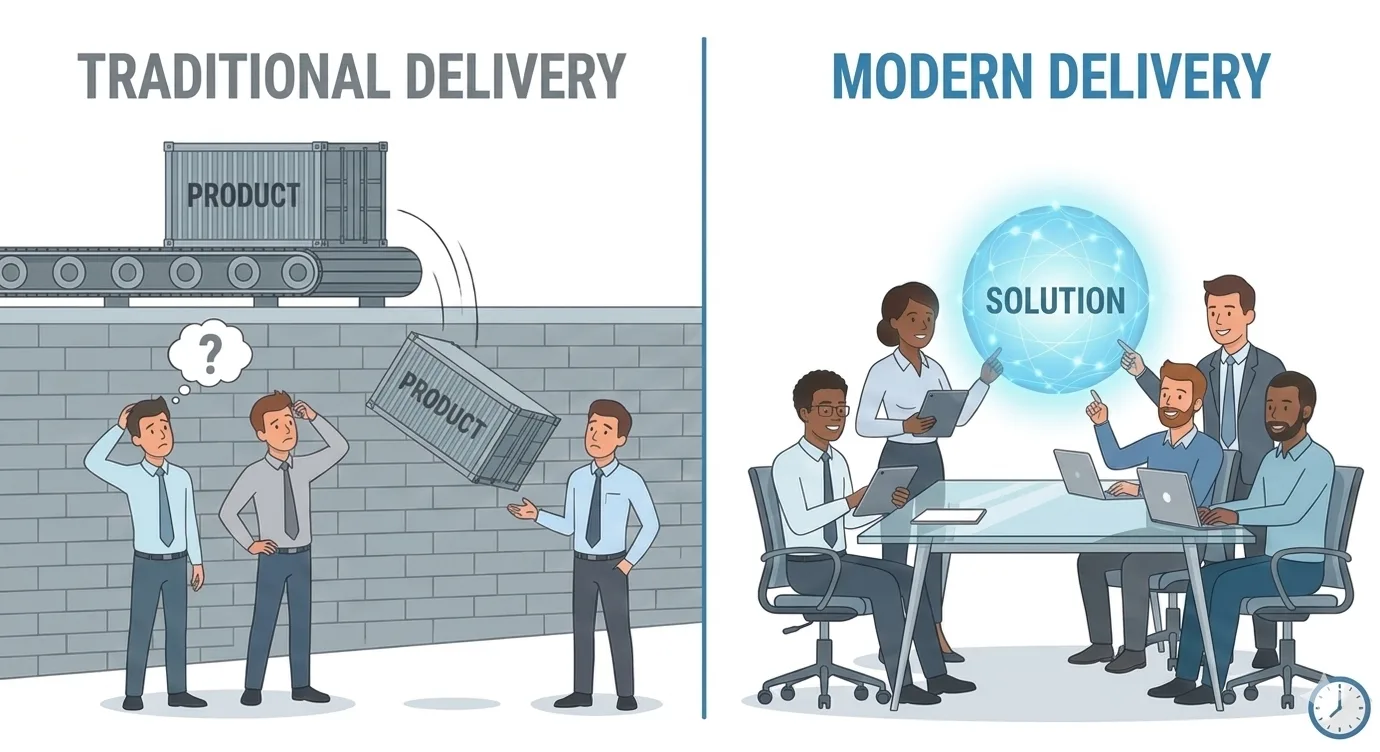
The way technology gets delivered is changing
Enterprise software used to follow a simple delivery logic: build the product, sell it to the client, and let the client's IT team handle the rest. Engineers stayed at the vendor, clients stayed on their side, and between them sat a document, a support inbox, and the occasional training session.
That model is breaking down in the face of more complex AI systems.
The reason isn't that the technology is too hard. It's that the distance between the technology and the real-world operation is too great. When an AI system has to integrate with a client's ERP, work alongside their data engineers, and explain to their managers "why the model made that call," a document simply isn't enough.
That's why technology delivery is shifting from "product delivery" to "solution delivery."
And the Forward Deployed Engineer is the concrete result of that shift.
So what exactly does an FDE do?
Palantir pioneered the FDE concept in the early 2010s. They embedded engineers directly with government and large enterprise clients, not to "support" them, but to "solve problems together." Internally, these engineers were called "Deltas," and the role eventually evolved into today's Forward Deployed Engineer.
Think of an FDE as a solutions architect who writes code, and then some.
A traditional consultant tells you what to do; an FDE gets it done with you. A traditional engineer waits for a requirements document; an FDE defines the requirements with you.
More specifically, an FDE needs to bring all of the following:
- Working on the ground: discussing needs with the client's business side and architecture with their engineers
- Rapid prototyping: turning vague business needs into a working PoC as fast as possible
- Cross-system integration: not just AI models, but also data pipelines, API integrations, and compatibility with existing systems
- Bringing field experience back to the product: every client edge case is a chance to make the product more complete
The role sits between engineer, consultant, and product manager. It isn't any one of them; it's all of them combined, plus a little bit of magic.
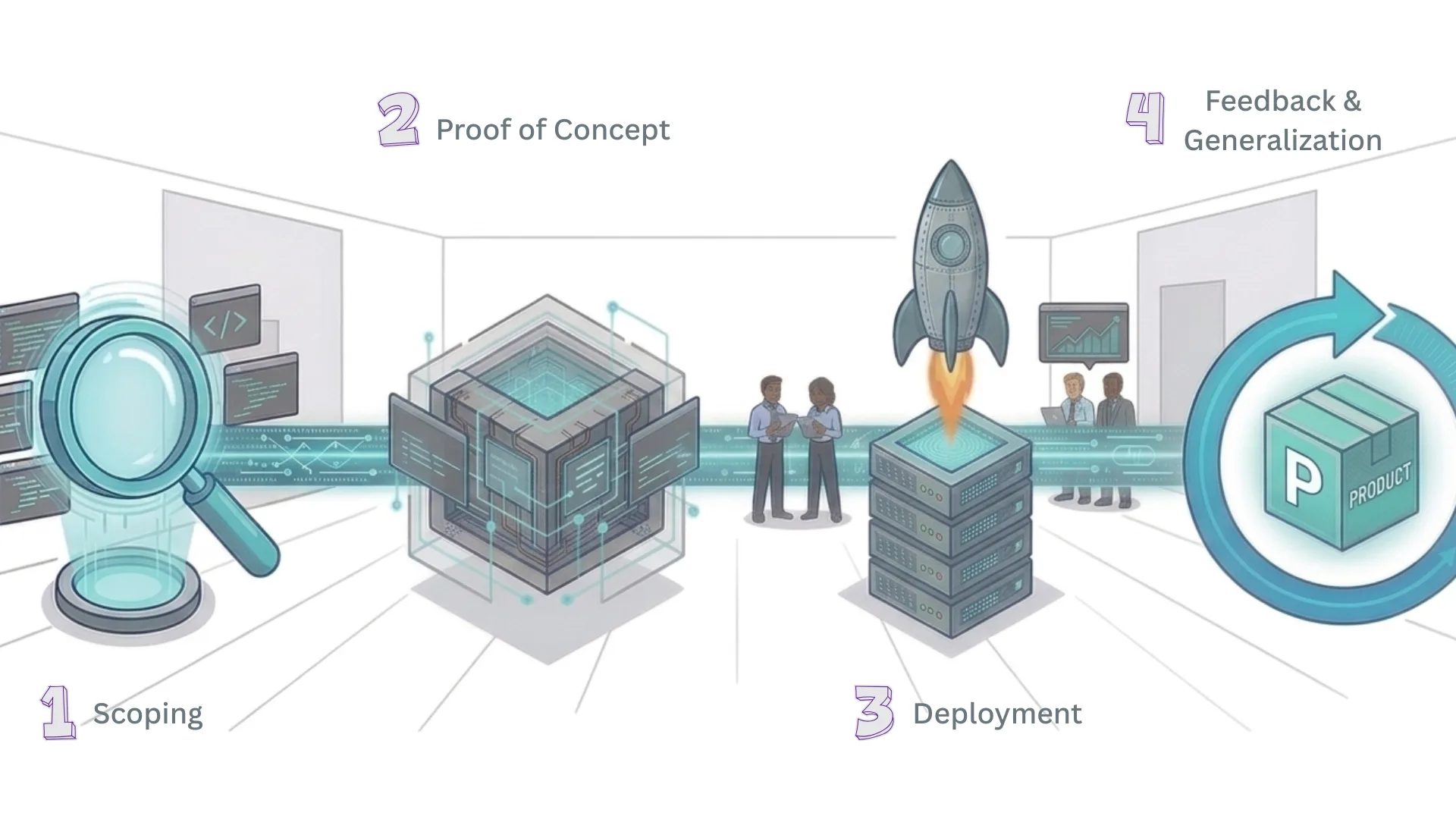
One project, four stages
FDE work isn't about taking a ticket, fixing a bug, and closing the ticket. Each project typically goes through four full stages:
Step 1: Scoping The client says, "We want to use AI to optimize our processes." The FDE's job is to translate that into "At step X, we'll use method Y to process data Z, with the goal of improving metric A by a certain %." Turning the vague into the concrete is the foundation of everything.
Step 2: PoC development and validation Start with a proof of concept that is small enough and fast enough. Test technical feasibility on real data and let the results, not the slides, do the talking. The goal at this stage isn't perfection; it's finding out quickly whether this path will work.
Step 3: Deployment Once the PoC is validated, the next step is turning it into a system that truly runs in production. Data integration, system connections, workflow setup: one piece at a time, making sure nothing breaks at 2 a.m. after launch.
Step 4: Feedback and generalization This is the step many roles tend to overlook. An FDE doesn't just deliver and leave. They bring what the project taught them back to the product team. Could this client's special request be a pain point that ten other clients share but haven't voiced yet? Client cases are the best material for evolving the product.
FAQ
Q: What is a Forward Deployed Engineer (FDE)?
A: An FDE is a cross-functional engineer who combines software development, system integration, and business understanding. FDEs work on-site with clients, deploying AI and automation solutions directly into real enterprise environments to make sure the technology actually takes hold and delivers results.
Q: How is an FDE different from a regular engineer or consultant?
A: Regular engineers usually build products in-house; consultants give advice. An FDE solves problems together with the client on-site, and can write code, define requirements, integrate systems, and feed insights back to the product.
Q: Why do companies need FDEs?
A: AI adoption usually fails not because of the technology itself, but because of the gap between the technology and real-world business processes. An FDE turns vague needs into workable solutions and makes sure the system runs reliably in a real environment.
Q: What exactly does an FDE at OakMega do?
A: An OakMega FDE's work spans four stages: Scoping, proof of concept (PoC), Deployment, and feeding field experience back to the product team so the solution keeps evolving.
Q: What kind of background suits the FDE role?
A: Engineers with software development skills who are interested in business processes, can communicate and collaborate with different people on the client side, and enjoy solving real problems fast.