How to Architect an AI-Native Business | CEO Insights
An AI-native business is one built with AI in every part of the company from day one, with its entire business model and value proposition designed around AI, rather than AI tools “bolted on” to existing processes. This post summarizes Harvard Business School Online's architecture guide: what AI-native really means, how it differs from “integrating AI into legacy systems,” and the four pillars of building an AI-native business.
 Porsche TsaiCEO

Key Takeaways
- AI-native ≠ AI-first: the former treats AI as the foundation; the latter simply layers AI on top of an existing business.
- Two more traps to avoid: Embedded AI (relying solely on third-party tools, where efficiency gains hit a ceiling) and Shadow AI (employees using AI privately, creating security and compliance risks).
- The four pillars: foundational data, security and privacy, a machine learning ecosystem, and guardrails with feedback loops.
- McKinsey: 92% of companies plan to increase AI investment by 2029. The real dividing line is whether you “bolt on” AI or rebuild around it.
In my last two CEO Insights posts, “Services Are Becoming the New Software” covered why services are turning into software, and “How to Build an AI-Native Services Company” covered how a startup builds one from scratch. But I know most of you reading this series already run a company. Your question isn't “Should I start from zero?” It's “How do I rebuild the company I already have into an AI-native one?”
A recent Harvard Business School Online (HBS Online) article by Tim Stobierski, “How to Architect an AI-Native Business,” answers exactly that. It defines “AI-native” clearly and breaks it into four pillars. Below is my full, faithful summary of the piece; my own take is at the end, under “My Take.”
👉 Original source: Harvard Business School Online, “How to Architect an AI-Native Business,” by Tim Stobierski
Contents
- What is an “AI-native” business?
- AI-First vs. AI-Native: layered on, or built in?
- Two more things to avoid: Embedded AI and Shadow AI
- The four pillars of an AI-native business
- Case study: an AI-native dental diagnostics company
- My take
- FAQ
Once AI moved out of the lab and into day-to-day operations, companies rushed to weave it into their workflows. According to a McKinsey report cited by HBS, 69% of companies had already started investing in AI before 2024, and 92% plan to increase that investment by 2029. But a growing number of companies are built with AI at their core from the ground up. Those are AI-native businesses.
1. What is an “AI-native” business?
HBS Online's “AI for Leaders” course defines an AI-native business as a company “built from the ground up to use AI for value creation and problem-solving.” AI is embedded in every stage of the organization, from R&D and marketing to customer interactions and HR.
The idea mirrors “digital-native” companies: businesses that grew up in the internet era and put digital infrastructure and customer experience first. AI-native businesses give AI that same place.
2. AI-First vs. AI-Native: Layered On, or Built In?
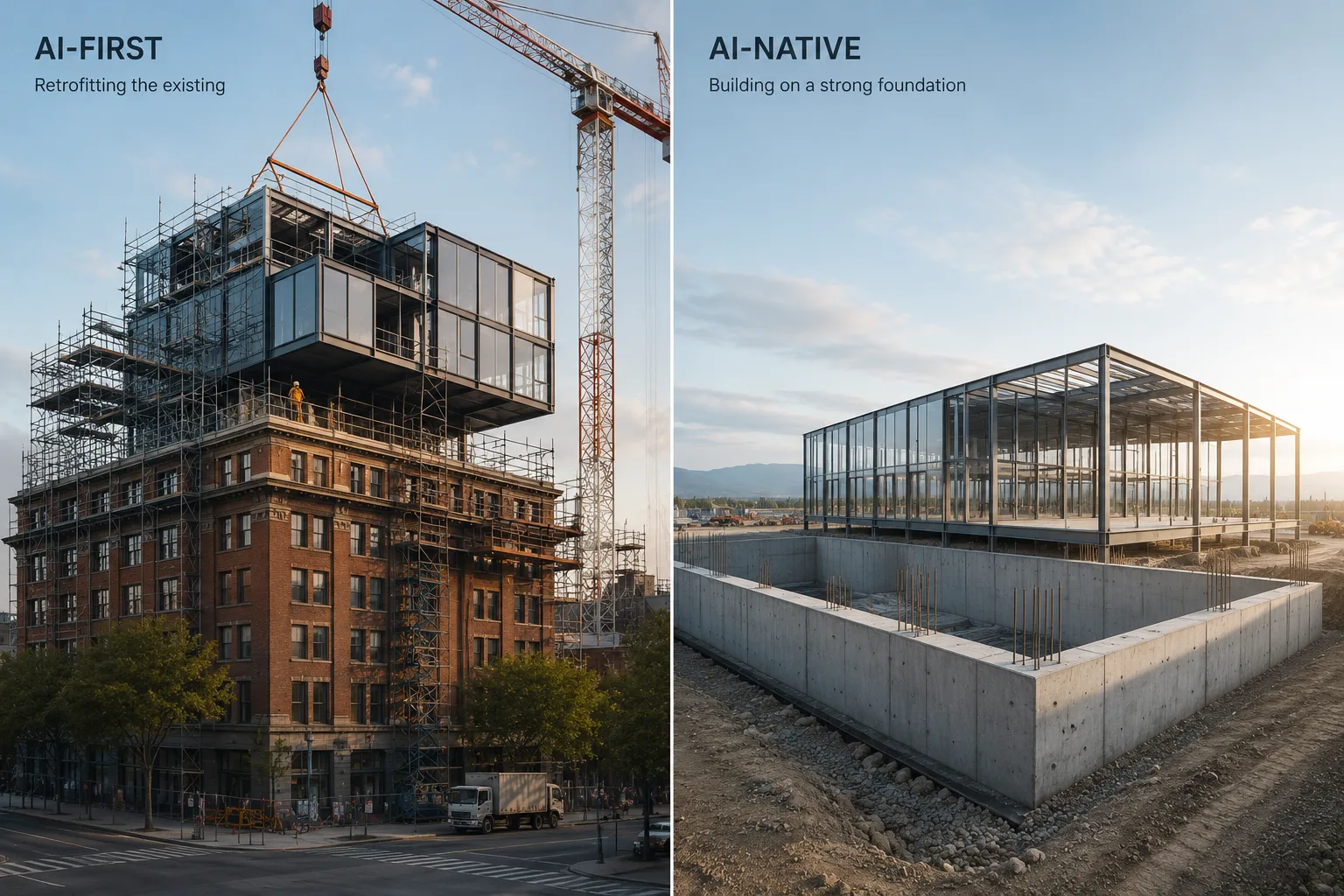
“AI-native” and “AI-first” are often used interchangeably, but they're different things. An AI-first company treats AI as a core capability that strengthens its existing products, services, and operations. An AI-native business goes further: it designs its entire business model and value proposition around AI.
HBS contrasts two companies:
- Company A: a 30-year-old firm that systematically rolls out AI tools across its systems. That's AI-first.
- Company B: a startup less than a year old that has built AI into every process since day one. That's AI-native.
In a sentence: AI-first “layers” AI on top of what already exists; AI-native treats AI as the “foundation” the whole company is built on.
3. Two More Things to Avoid: Embedded AI and Shadow AI
For most established companies, the AI journey starts with Embedded AI: adding AI tools to existing workflows. That delivers early value, but relying only on third-party tools limits you over time. Efficiency gains hit a ceiling, and you may end up with a patchwork of “fragmented intelligent systems” that don't talk to each other.
The other thing to watch for is Shadow AI: employees using AI tools on their own, without organizational oversight. It may boost productivity, but it brings serious security and compliance risks. HBS recommends three safeguards: set a clear AI usage policy, provide officially approved tools, and educate employees about the risks and protective measures.
4. The Four Pillars of an AI-Native Business
To build, or transform into, an AI-native business, HBS identifies four pillars. Each one is part of the foundation of an AI-native architecture.

Pillar 1: Foundational Data
HBS Professor Karim Lakhani, who co-teaches the course with Professor Iavor Bojinov, compares an AI system to a “factory” that turns data into insight. The raw material coming in is data, from numbers in spreadsheets to text and images. The factory processes that data and produces something useful at the other end, usually a “prediction”: a forecast of future demand, a recommendation of what a user wants next, or a classification such as “approve/deny.” Sometimes the output is a discovered pattern, a cluster of similar customers, or a piece of new content.
To support AI, organizations need robust data collection systems and processes that turn raw information into usable formats. They also need to understand the “data lifecycle”: generation, collection, processing, storage, management, and analysis. Without a solid data foundation, AI transformation simply can't happen.
Pillar 2: Security and Data Privacy
AI-native organizations train models on large volumes of sensitive data, including proprietary company information and customer records, and depending on the industry, possibly financial, medical, or biometric data. To keep customer trust and meet regulatory standards, they must put strong data governance practices in place to keep information secure and private. Without this layer, even the most advanced AI system can expose an organization to compliance risk and reputational damage.
Pillar 3: The Machine Learning Ecosystem
Every AI-native business relies on a machine learning ecosystem made up of three parts: algorithms (the logic that processes data), machine learning models (trained systems that generate predictions or recognize patterns), and an orchestration layer (the interface employees use to manage AI tasks).
To extend the factory metaphor: algorithms are the machinery on the factory floor, sets of instructions that process the incoming data. They help build machine learning models, and the models are the tools that actually produce predictions and recognize patterns. Most organizations start by applying open-source algorithms to their own proprietary data. As they mature, they move toward building their own models to support a distinctive value proposition.
Pillar 4: Guardrails, Safeguards, and Feedback Loops
Machine learning models naturally “degrade” as real-world data changes. To stay accurate, AI-native organizations need three mechanisms: guardrails set boundaries during development to ensure models are used ethically; safeguards monitor live models in real time and trigger alerts or human review when outputs look off; and feedback loops track performance over time so models can learn from new data and keep improving. Together, they underpin reliability, fairness, and trustworthiness.
5. Case Study: An AI-Native Dental Diagnostics Company
HBS uses dental AI company VideaHealth as its example: an AI-native organization serving the healthcare industry, built around AI-driven diagnostic tools.

In the course, CEO and co-founder Florian Hillen explains that dental diagnosis is genuinely hard. Dentists often review images on small screens under time pressure, which makes it easy to miss things, and patients who can't clearly see what's going on tend to question the diagnosis. He also notes that dental patients distrust their dentists more than patients in any other area of medicine.
VideaHealth's answer was to build the entire business on AI diagnostics: it trains AI models to read dental X-rays with high accuracy, giving clinicians an objective “second opinion.” The result is greater diagnostic confidence and more transparency for patients. Today its VideaAI platform runs more than 30 diagnostic models and serves an estimated 50,000 dental professionals worldwide. That success shows the value an AI-native strategy can create.
Most organizations “add” AI to existing systems. AI-native businesses are different: they embed AI at the core of strategy, operations, and value creation. Just as digital-native companies used the internet to transform industry after industry, AI-native organizations are poised to do the same with AI, reshaping from the inside out how businesses create value.
My Take
After reading the HBS piece, I want to give B2B readers in Asia an honest reality check. Frankly, most of our companies can't even call themselves AI-first yet. At best, we're at what HBS calls Embedded AI: we've bought a few tools and stuck them onto old processes. There's nothing wrong with that; it's a necessary starting point. But HBS is spot on: if you stop there, your efficiency gains will hit a ceiling.
The pillar I want to zoom in on is Pillar 1: foundational data. There's a reason the article lists it first. Of the four pillars, it's the prerequisite for the other three. Yet for manufacturers and B2B companies in Taiwan, it's exactly the weakest one. The most critical customer data often isn't in the company's hands at all. It's scattered across individual salespeople's messaging app accounts, Excel files, and stacks of business cards. If you can't even answer “Where is our data, and who owns it?”, then the machine learning ecosystem, the guardrails, and the feedback loops are all just talk.
So for companies still on the transformation journey, my advice is simple: don't rush to chase models. Lay your data foundation first, and pull your scattered customer relationships together into one dataset that your company truly owns and can actually govern. That's the very first thing OakMega Social CDP and our FDE service do. AI-native doesn't start with buying a model. It starts the day you finally own your own data.
To close, I'll echo HBS's conclusion: digital-native companies rewrote the rules of their industries with the internet, and AI-native businesses will rewrite them again with AI. The only question is this: will you build from the foundation up this time, or keep bolting things onto old walls?
What do you think? Let's talk 👉 Contact us
FAQ
Q1: What is an AI-native business?
An AI-native business is a company built from the ground up to use AI for value creation and problem-solving, with AI embedded in every stage, from R&D and marketing to customer interactions and HR. It's similar to a “digital-native” company, except that the core is AI instead of the internet.
Q2: How is AI-native different from AI-first?
AI-first treats AI as a capability that strengthens existing products and operations; AI-native designs the entire business model and value proposition around AI. The former “layers” AI on top; the latter treats AI as the “foundation.”
Q3: What are Embedded AI and Shadow AI, and how do you prevent Shadow AI?
Embedded AI means adding third-party AI tools to existing workflows. It delivers early value but eventually hits a ceiling. Shadow AI means employees using AI on their own without organizational oversight, which creates security and compliance risks. Three ways to prevent Shadow AI: set a clear usage policy, provide officially approved tools, and educate employees about the risks and protective measures.
Q4: What are the four pillars of an AI-native business?
According to HBS, the four pillars are: foundational data; security and data privacy; the machine learning ecosystem (algorithms + models + orchestration layer); and guardrails, safeguards, and feedback loops. Together they form the foundation of an AI-native architecture.
Q5: Why is foundational data the most important first step?
Because it's the prerequisite for the other three pillars. Without usable, governable data, there's no machine learning ecosystem or feedback loop to speak of. Understanding the data lifecycle (generation, collection, processing, storage, management, and analysis) and turning raw information into usable formats is where AI transformation begins.
Q6: Why does VideaHealth count as an AI-native company?
Because it built its entire business on AI diagnostics instead of adding AI alongside an existing service. It trains AI to read dental X-rays and provide an objective “second opinion,” and its VideaAI platform now has more than 30 diagnostic models serving an estimated 50,000 dental professionals worldwide.