






Should Stronger AI Come With Stronger Brakes? What the Claude Fable 5 Wake-Up Call Teaches Businesses About Risk | CEO Insights
The controversy and pullback that followed the launch of Claude Fable 5, Anthropic's most capable model, hold lessons on the risk awareness every business needs when adopting AI, and on how OakMega meets this challenge with international security certifications.
 Porsche TsaiCEO
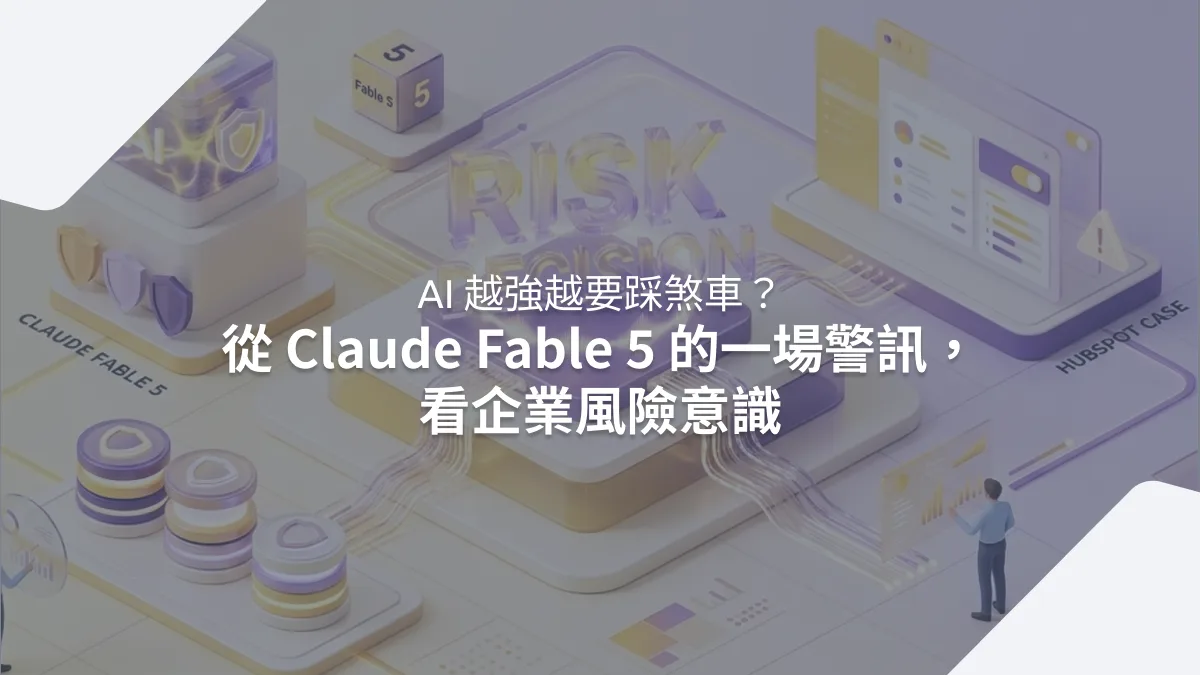
If you've been using Claude lately, you may have noticed something odd: a perfectly ordinary request suddenly triggers a safety warning, and the conversation gets blocked.
You're not alone. After Anthropic launched Claude Fable 5, its most capable model to date, in June, security researchers publicly complained that simply asking the model for a basic code review got their requests flagged as high-risk and blocked. One engineer described the mechanism as something like keyword matching: brush up against anything that sounds like "security," and you're likely to get caught in the dragnet.
It sounds like a product flaw. But I think it hides a question worth thinking about:
When a technology becomes powerful enough to be abused, is "making it a little dumber" a mistake, or a deliberate choice?
Contents
- From launch to pullback to relaunch
- No zero-risk answers, only continuous correction
- Beyond technical risk: trust risk can be just as fatal
- How we see it
- Final thoughts: capability and restraint are two sides of the same coin
- FAQ
From launch to pullback to relaunch
The model's predecessor showed an unusually strong ability to uncover vulnerabilities during internal testing, and the vulnerabilities it found were real and exploitable. In defenders' hands, that capability is a powerful tool. In the wrong hands, it's a weapon. That's why Anthropic initially held back from releasing the internal version widely.
Fable 5 timeline
- June 9: Public launch
- June 12: An Amazon research team's report reveals a technique for bypassing the safety guardrails; the model is pulled in an emergency
- June 12–30: Anthropic, the government, and Amazon re-examine the evidence and find the risk is not unique to Fable 5
- July 1: Relaunched after new classifiers are trained
Fable 5 went live on June 9. Just three days later, it was pulled in an emergency: an Amazon research team had found a way around its safety guardrails that got the model to identify multiple software vulnerabilities, and in one case even produce code demonstrating how a vulnerability could be exploited. A US export control order required restricting access for certain nationalities, and since Anthropic couldn't verify users' nationalities in real time, it simply suspended service for everyone. The outage lasted eighteen days.
The really interesting twist came after the pullback. Anthropic spent nearly two weeks re-examining the report with the government and Amazon, and found that even less capable models such as Opus 4.8, GPT-5.5, and Kimi K2.7 could identify the same vulnerabilities. In other words, the high-risk capability first deemed "unique" turned out to be an edge case flagged by early, conservative guardrails. It didn't mean the model itself was exceptionally dangerous.
On July 1, after training a new generation of classifiers said to block more than 99% of similar techniques, Anthropic reopened Fable 5. Flagged requests aren't rejected outright; they're handed off to Opus 4.8, whose risk is easier to contain. That's why users who get blocked usually still get an answer. It's just handled by a more conservative brain.
No zero-risk answers, only continuous correction
Back to the puzzle we started with: why do ordinary, harmless requests get flagged as high-risk? Anthropic admits that about 5% of conversations are currently misclassified and rerouted. That's one in every twenty normal conversations intercepted for no good reason.
But to me, this "imperfection" is the most telling part. One veteran security researcher took a pragmatic view: better to over-block a bit at this stage than to start too loose and tighten later; start strict and loosen gradually. That points to a truth people often overlook: risk management is never one-and-done. It's a dynamic process of constant verification and constant correction.
Even a company at the technological frontier like Anthropic didn't get its first risk call right; it took a follow-up investigation to correct it. A truly mature attitude isn't chasing perfection on the first try. It's being willing to admit your judgment may be wrong, and building mechanisms that keep reviewing and adjusting.
 Risk governance isn't finished once. It's constant recalibration.
Beyond technical risk: trust risk can be just as fatal
Fable 5 reminds us about judging technical risk. At the same time, CRM giant HubSpot offered a real-world lesson in trust risk. In early July, HubSpot announced changes to its terms of service that would let customers' contact data be shared with other customers to fill in each other's records. Customers were opted in by default and had to switch it off manually to opt out. The backlash was immediate. Some customers said outright that contact lists built over years could end up strengthening their competitors. Within just four days, HubSpot went from announcement to full reversal, and its executives publicly admitted the mistake.
At its core, this wasn't a technical vulnerability. It was a seemingly basic design decision: the default setting. Whether customer data is protected or shared by default determines whether a company deserves trust. It's really the other side of the Fable 5 story:
Risk doesn't just live in model capabilities. It lives in every default a company chooses for its customers.
How we see it
Watching Anthropic go back and forth between capability and safety, adjusting and verifying, I was struck by how closely it mirrors OakMega's approach to security: capabilities can be powerful, but the safeguards must be even more rigorous, and able to withstand ongoing scrutiny.
Where we differ is in how we verify. Anthropic grades risk and makes dynamic corrections at the model-capability level. OakMega holds itself to international standards at the system and data governance level. OakMega has earned ISO 27001, ISO 27017, ISO 27018, CMMC, and other international security and privacy certifications, and our team holds Lead Auditor qualifications. To us, these certifications mean that how we build our systems and run our operations has been examined against the strictest standards.
On the technical side, we support major cloud environments including Microsoft Fabric, GCP, and OpenAI, so customers can deploy flexibly on their existing IT architecture. We use CI/CD, Kubernetes, and Docker containerization, backed by SLAs, hot standby, and incident reporting, to keep operational risk to a minimum. And when it comes to data use, we believe transparency and informed consent aren't nice-to-haves; they're the baseline. Customers should always know how their data is used and who can access it, rather than having it buried in the fine print and discovered only after something goes wrong.
Many of the industries we've long served handle highly sensitive personal data every day: member privacy, financial data, transaction records. Once it leaks, there's no undoing it. For these customers, choosing a technology partner can't come down to how powerful or impressive the AI tools are. What matters more is whether there's security governance behind them that stands up to international standards. That's the real foundation for earning customers' trust.
 Truly trustworthy AI is built on governance, not capability.
Final thoughts: capability and restraint are two sides of the same coin
From testing to launch, pullback, and relaunch, the Claude Fable 5 saga took barely three weeks. Yet it distills an issue every business today needs to face: we crave more powerful tools, and more powerful tools inevitably bring risks that are harder to predict.
I've always believed good AI adoption isn't an arms race over whose model is stronger. It's about whether you can keep making responsible trade-offs between capability and risk control, and honestly face the moments when your judgment may be wrong, then go back and fix it. It's a principle OakMega keeps front of mind every time we design automated workflows for a customer.
FAQ
Q1: Why was Claude Fable 5 pulled in an emergency?
Just three days after launch, an Amazon research team published a report saying they had found a way to bypass Fable 5's safety guardrails and get the model to identify software vulnerabilities. Because an export control order applied and Anthropic couldn't verify users' nationalities in real time, it chose to suspend service for everyone.
Q2: Why was the risk thought to be unique to Fable 5 later disproven?
A follow-up review found that even weaker models such as Opus 4.8 and GPT-5.5 could identify the same vulnerabilities. That confirmed the risk wasn't unique to Fable 5, but an edge case produced by early, conservative guardrails. The lesson: first-pass risk judgments aren't necessarily the final word.
Q3: How does Fable 5's safety routing work, and is it a model for businesses?
When the system detects a sensitive request, it routes it to Opus 4.8, whose risk is easier to contain, instead of rejecting it outright. Anthropic admits a misclassification rate of about 5%. The takeaway for businesses: rather than chasing a perfect, zero-risk solution, build dynamic mechanisms that can keep correcting themselves.
Q4: How does OakMega view AI risk issues like this?
We believe the more capable you are, the less you should rush to prove you're flawless. What matters is facing your limits honestly and correcting course continuously. This isn't just a technical issue; it's about being accountable to customers. OakMega has earned ISO 27001, ISO 27017, ISO 27018, CMMC, and other international certifications, and holds Lead Auditor qualifications. But more important than any certification is our belief that trust is built through rigor, day after day, not through one-time claims.
Further reading
Custom Development: System Integration | OakMega
References
- Anthropic official announcement, Claude Fable 5 and Claude Mythos 5, June 2026
- TechCrunch, Cybersecurity researchers aren't happy about the guardrails on Anthropic's Fable, June 10, 2026
- Commercial Times (Taiwan), "The world's most powerful AI is back! US government officially lifts restrictions on Claude Fable 5, 7-day limited offer with 'no extra charge for paid users'," July 5, 2026
- MarTech, HubSpot reverses course after customers reject data sharing, July 2026