





Claude for Small Business Explained: How AI Agents Are Becoming the Operating System Layer for Taiwanese Enterprises
Anthropic’s Claude for Small Business connects to 20+ tools, including HubSpot and QuickBooks, so AI can execute business tasks directly. Learn the three hurdles Taiwanese companies must clear before adopting AI automation—data governance, on-premise integration, and security compliance—and why the LINE ecosystem gives local platforms in Taiwan a lasting moat.
 MarketingTeam
The boss wants AI. The marketing team spends three months testing every tool on the market, only to hit the same wall: AI can answer questions, but not always consistently. It can generate content, but it still can’t truly plug into the company’s systems and workflows.
Rephrase the question slightly, and you might get a completely different answer. Forget about having it understand customer status in the CRM, check the books, track contract progress, or help drive the next step.
In May 2025, Anthropic changed that equation.
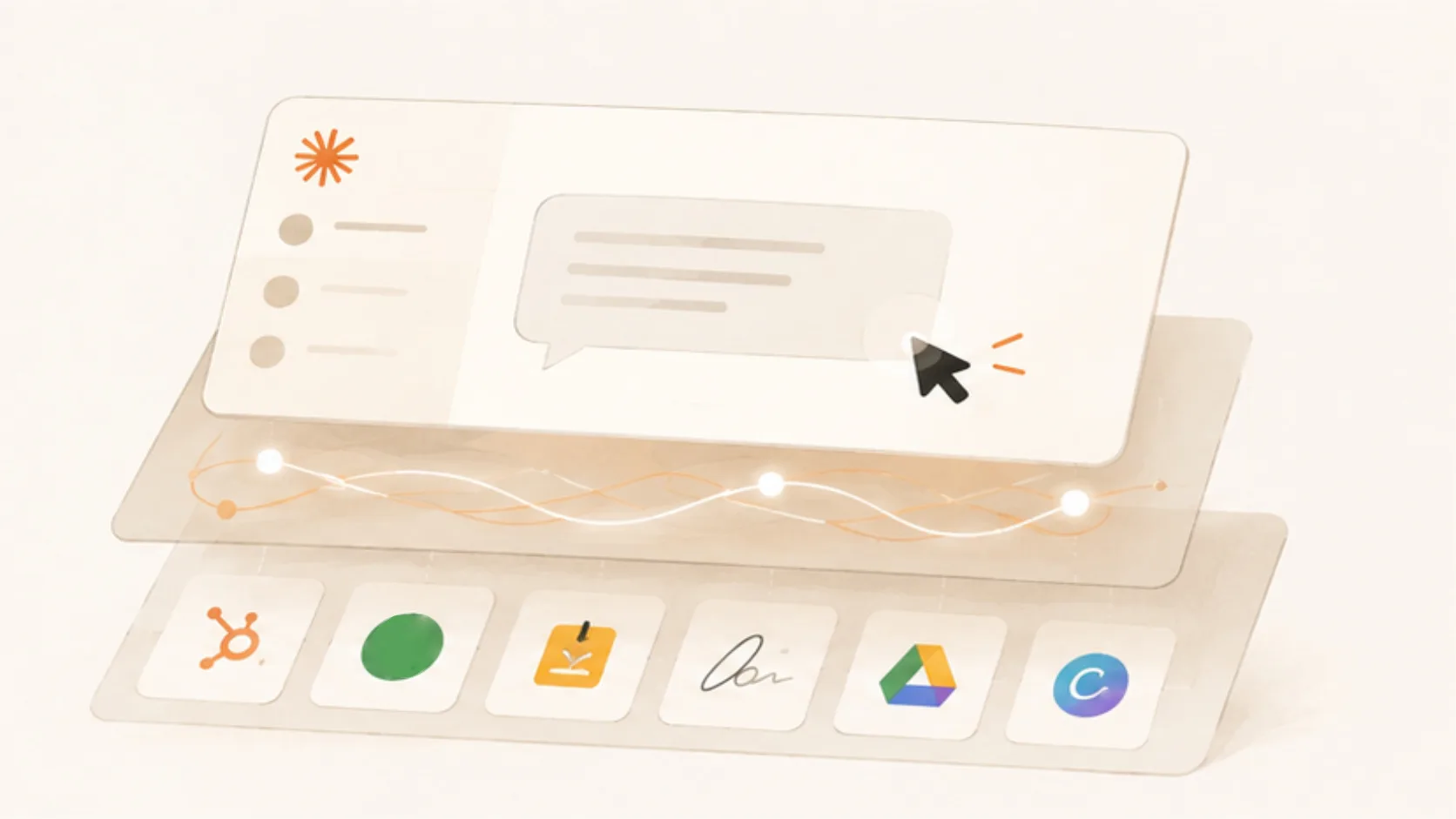
Claude can now connect directly to business tools like QuickBooks, HubSpot CRM, and DocuSign, taking AI beyond a simple Q&A interface and into the day-to-day operations of real companies. It doesn’t just return information—it helps find, evaluate, and organize data, and can even move tasks forward.
This is more than a feature update. It marks a watershed moment as AI evolves from “assistant” to “agent.” For the B2B market in Taiwan, the impact may run deeper than most companies realize today.
Claude for Small Business is an AI automation offering Anthropic launched on May 13, 2025. Built on the Claude Cowork platform, it connects to more than 20 SaaS tools (including HubSpot, QuickBooks, and DocuSign), allowing AI agents to read and execute business workflows directly instead of merely offering suggestions. It marks a pivotal shift in AI’s evolution from “conversational assistant” to the enterprise “operating system layer (OS Layer).” Before adopting it, mid-sized and large enterprises in Taiwan must first address three prerequisites: data governance, on-premise system integration, and security compliance.
Table of Contents
- What is Claude for Small Business?
- From “Chat Box” to “Enterprise Operating System”: The Core Logic Behind This Upgrade
- The On-Premise Challenge in Taiwan: Where the AI Wave Can’t Reach
- Three Layers of Impact on the CRM and System Integration Market
- What’s Next for Social CRM in Taiwan: From Customer Service to Proactive Auditing
- My Take
- FAQ
What is Claude for Small Business?
Claude for Small Business is an enterprise AI automation offering Anthropic launched on May 13, 2025. Built on the Claude Cowork platform, it provides more than 20 SaaS connectors that let Claude AI agents read and act on company data inside third-party tools directly, rather than just making suggestions.
Unlike earlier AI use cases that required manual copy-and-paste, Claude for Small Business integrates with these leading platforms:
- Finance: Intuit QuickBooks, PayPal
- Sales and CRM: HubSpot
- Legal and contracts: DocuSign
- Productivity: Google Workspace, Microsoft 365
- Design and marketing: Canva
“This isn’t the next evolution of the chatbot. It turns AI into an executor of business processes, not just an advisor.”
Core use cases include automated collections (pull overdue invoices from QuickBooks → check the customer’s contact history in HubSpot → send an email via Gmail), cash flow forecasting, automated marketing campaign creation, and payroll planning support. Anthropic also launched a nationwide roadshow of workshops across the U.S., directly addressing the core barrier business owners face: “I know AI is powerful, I just don’t know how to use it.”
From “Chat Box” to “Enterprise Operating System”: The Core Logic Behind This Upgrade
Anthropic’s strategic intent here is to make Claude the enterprise “operating system layer (OS Layer)”—reducing other SaaS tools to data sources rather than the center of work.
If that logic holds, the consequences for the entire SaaS industry are systemic. When users can query, analyze, and execute all their work inside Claude, their reliance on each tool’s own interface drops sharply. HubSpot’s marketing automation back end and QuickBooks’ reporting interface could gradually slide from “core platforms you must log into” to mere data gateways for Claude.
That’s also why Anthropic chose its partner list so precisely: finance (QuickBooks/PayPal), sales (HubSpot), and legal (DocuSign) cover exactly the three administrative burdens that hurt SMBs the most.
Claude for Small Business isn’t just a product update. It’s a strategic declaration that AI companies are moving from “tool vendor” into the “enterprise infrastructure layer.”
For business owners, the appeal is clear: no technical skills, no engineers to hire. With an account and the right permissions, Claude can run complex, cross-system workflows for you. The barrier to AI automation has officially dropped to almost zero.
The On-Premise Challenge in Taiwan: Where the AI Wave Can’t Reach
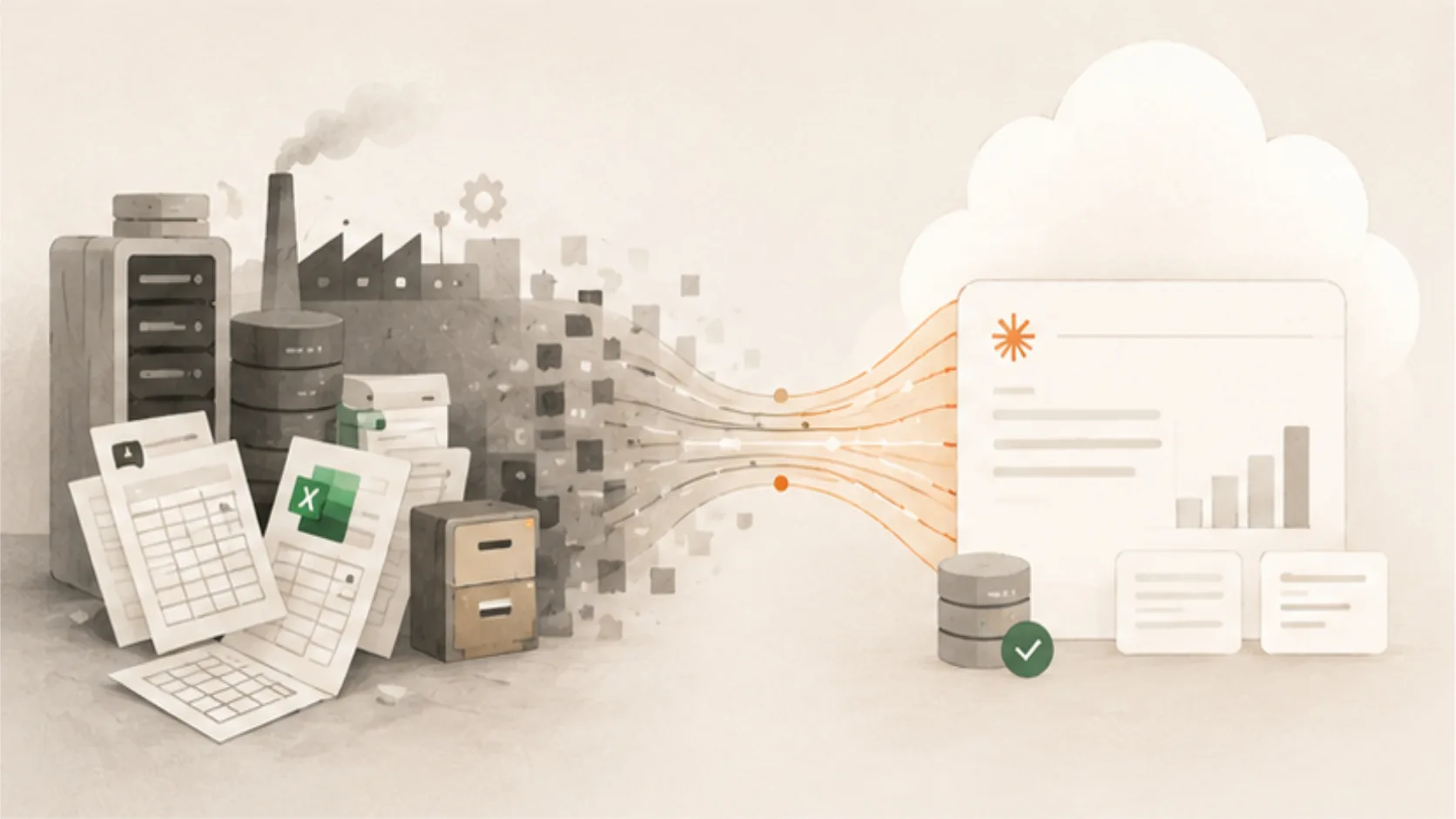
Yet there’s a core problem Claude for Small Business can’t solve: for mid-sized and large enterprises and traditional industries in Taiwan, most core data is locked in on-premise systems.
ERP, MES (manufacturing execution systems), WMS (warehouse management systems), NAS—these systems tend to be decades old, with uncleaned data fields and no standardized APIs. Anthropic’s 20 connectors all link to cloud tools with open APIs, like HubSpot and QuickBooks. They simply can’t reach the on-premise core of Taiwan’s manufacturing sector.
The central tension in data governance: no matter how powerful the AI, dirty data in means bad decisions out.
There’s a more fundamental principle at work: an AI model’s capabilities are bounded by the quality of the data it can read, not by how intelligent the model itself is. Hand Claude a garbled inventory sheet, and its analysis will be no better than a new intern’s. That’s why, in the AI era, data governance is no longer a technical issue for the IT department—it’s a strategic decision the CEO needs to own.
According to the IDC Taiwan 2025 Digital Transformation Survey, more than 65% of business executives in Taiwan see “siloed systems” as the main obstacle to digital transformation. Meanwhile, Gartner data shows that inconsistent data costs companies up to 20% of revenue each year. Together, these two numbers explain why global, general-purpose AI tools so often stall at the “last mile” when they enter the Taiwan market.
Security compliance is another very real hurdle. Pharmaceutical companies, government agencies, financial institutions, and some highly sensitive manufacturers in Taiwan must comply with Taiwan’s Personal Data Protection Act, ISO 27001, or even stricter CMMC dual certification. These customers simply can’t send their core data to the public cloud—which makes it hard for fully cloud-based products like Claude for Small Business to break into Taiwan’s top-tier market anytime soon.
Three readiness checks before adopting AI in Taiwan
Three Layers of Impact on the CRM and System Integration Market
Anthropic’s launch sets off a chain reaction across three layers of the B2B market in Taiwan:
Layer one: Data governance becomes non-negotiable
As more companies are drawn to Claude’s AI automation and rush to keep up, the first wall they hit is: “Our data isn’t even organized yet.”
That pushes data cleansing, ETL middleware, and data platforms from “nice-to-have” straight to “must-have.” Without a clean data foundation, any AI rollout is just talk.
Layer two: Traditional SIs face disruption from above
The business model of traditional system integrators (SIs) has long relied on connecting APIs for clients and delivering one-off projects. But when a giant like Anthropic makes “one-click SaaS integration” nearly free, traditional SIs that live on engineering fees will see their room to survive shrink dramatically.
The integrators that survive will be those that shift from an “engineer mindset” to a “business consultant mindset”—not just connecting systems, but helping clients redesign business processes, define AI use cases, and validate real-world results (for example, how much customer service response time dropped, or how much the complaint resolution rate improved).
Layer three: The LINE ecosystem is a unique moat in Taiwan
Not one of Anthropic’s current 20 connectors is for LINE.
For Taiwan, that’s a highly significant gap. LINE is the primary front line for customer interaction in Taiwan. According to LINE Taiwan’s official 2024 figures, Taiwan has more than 21 million active LINE users—a penetration rate of 89% of the population. Any AI automation tool that doesn’t understand the LINE ecosystem, or can’t integrate with LINE Official Accounts, rich menus, and rich media messages, will fundamentally fail to localize in Taiwan.
Platforms that deeply integrate first-party LINE conversation data and connect it to back-end CRM and ERP systems hold a moat in Taiwan that Anthropic can’t replicate anytime soon. That’s exactly the core competitive foundation of OakMega as a LINE Social CRM platform in Taiwan.
What’s Next for Social CRM in Taiwan: From Customer Service to Proactive Auditing
- Social CRM (social customer relationship management) is an integrated CRM strategy that brings first-party conversation data from social messaging channels like LINE and Facebook Messenger into a company’s CRM system to power personalized marketing, customer service automation, and member loyalty management. In Taiwan, LINE is the main battleground for this strategy.
While Claude for Small Business focuses on “AI that automates your admin work,” Social CRM players in Taiwan are heading in a deeper direction: turning AI from a passive responder into a source of proactive Operational Intelligence.
In practice, AI customer service at this new stage doesn’t just answer user questions. It can proactively surface answers to questions like:
- “Were any messages missed over the past month? Which time slots did they cluster in?”
- “Which chatbots has this specific user triggered recently?”
- “Which conversations from the past week could turn into complaints?”
Take a mid-sized retail brand that uses OakMega to manage more than 50,000 LINE friends. In the past, its customer service manager had to manually spot-check about 200 conversation logs every week to catch potential complaints that had slipped through—a task that took an average of 4 hours. With proactive auditing, the same job now comes down to typing one natural-language question, getting a list of this week’s high-risk conversations within 30 seconds, and then having a person confirm the order of priority. What you save isn’t just time—it’s the golden window to act before a complaint escalates.
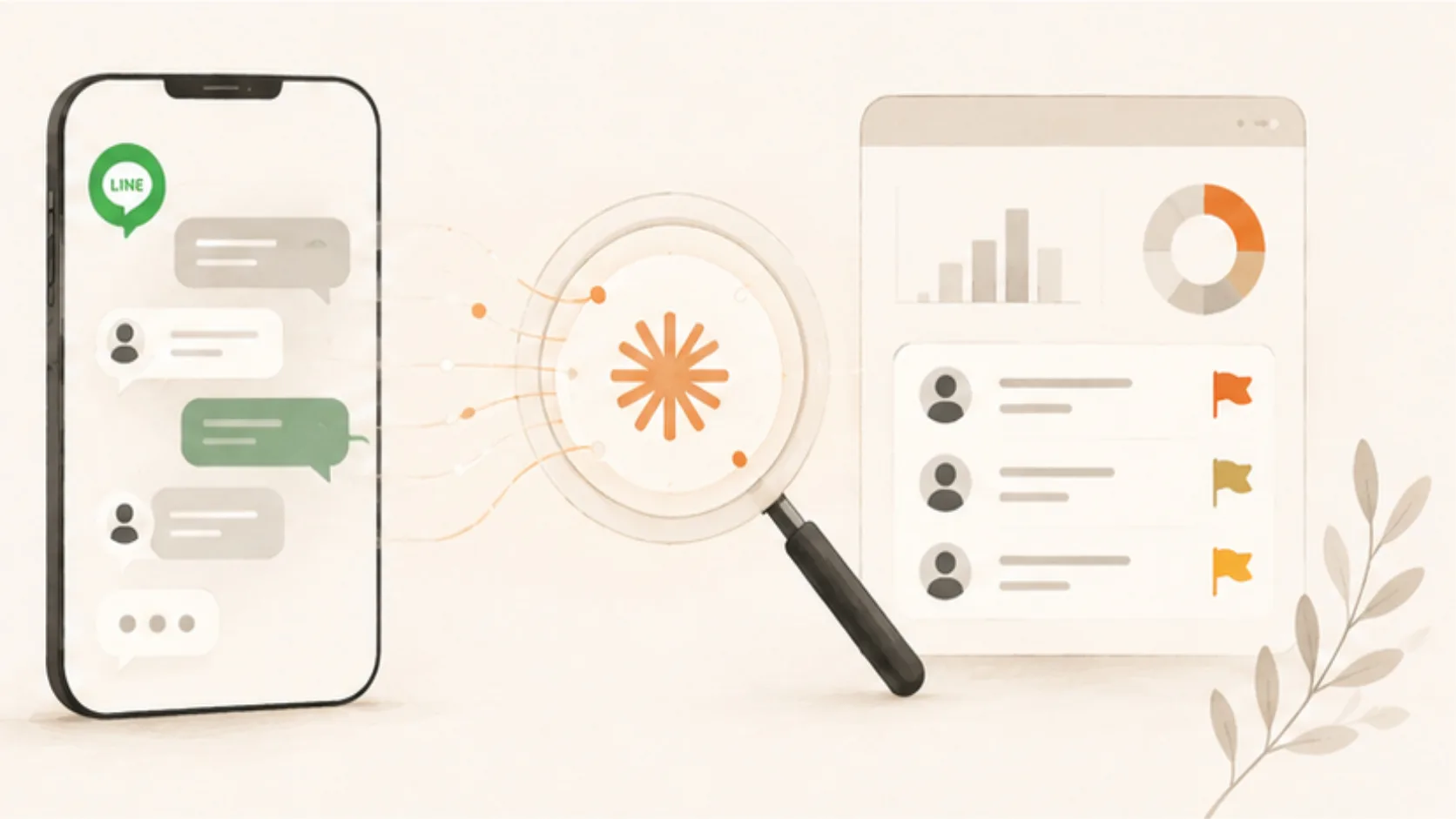
These three types of questions tackle the “management blind spots” that give customer service managers the biggest headaches every day. This data used to be buried in logs, requiring staff to pull and compare reports line by line. Now a single natural-language question delivers a “one-click audit.”
Once AI customer service moves beyond Q&A into proactive auditing and early warnings, it stops being a cost center and becomes a decision-support tool. For B2B buyers, that’s a value proposition on an entirely different scale.
On top of that, for highly sensitive local needs in Taiwan (such as public sentiment monitoring for political clients or compliant customer service records for pharmaceutical companies), building security identity verification (ensuring accounts at different levels can only access data matching their permissions) into AI conversation modules is another key differentiator in the Taiwan market.
My Take
Many reports frame Claude for Small Business as “a direct declaration of war on HubSpot and Salesforce,” but I think that framing is a bit superficial.
The more fundamental significance of this launch is that Anthropic has established a new product paradigm for the global SMB market: AI no longer waits for you to use it—it moves into your work systems and executes tasks for you. This is the first real attempt to bring Agentic AI from concept to the mass market at scale.
For companies in Taiwan, this isn’t a threat. It’s a strategic question that deserves serious thought: is your company’s data ready for AI to act on it?
From our hands-on work with manufacturing and retail clients in Taiwan, the opening line we hear most often isn’t “AI is useless for us.” It’s “Our ERP was built 15 years ago, our reports are compiled by hand in Excel, and IT says it’ll take six months just to clean up the data.” The problem has never been that AI isn’t powerful enough—it’s that company data simply isn’t ready for AI to understand. The launch of Claude for Small Business is essentially a trailer showing business owners “how great AI automation can be.” But to turn the trailer into the feature film, companies in Taiwan still need a preparation phase focused on data governance and system integration.
That means local cloud/on-premise integration experts and Social CRM platforms in Taiwan aren’t facing a competitor—they’re gaining the most powerful market educator there is. Anthropic has fired up the market’s imagination, but the ones who actually make AI work cleanly and securely on the ground in Taiwan are the ones who will ultimately win the deals.
My advice for businesses: the smartest investment right now isn’t the coolest AI tool. It’s the foundational work of cleaning up your data and making your systems readable by AI. Get that right, and any AI tool you bring in will be ready to use from day one.
What do you think is the biggest sticking point for companies in Taiwan adopting AI automation—the technology or the data?
Add our LINE Official Account and let’s talk!
FAQ
Q1: What is Claude for Small Business?
Claude for Small Business is an AI automation offering Anthropic launched on May 13, 2025. Built on the Claude Cowork platform, it provides more than 20 SaaS connectors that integrate leading tools such as HubSpot, QuickBooks, and DocuSign, enabling AI agents to directly execute cross-system tasks like financial planning, automated collections, and marketing campaign creation, rather than just offering suggestions.
Q2: How is Claude for Small Business different from the standard version of Claude?
Standard Claude is a conversation-based AI assistant that needs users to supply data manually before it can carry out tasks. Claude for Small Business connects directly to the SaaS tools a company uses through the Cowork platform, giving AI “read and execute” permissions. It can pull data from QuickBooks or create marketing tasks in HubSpot on its own, with no manual copy-and-paste.
Q3: Why can’t mid-sized and large enterprises in Taiwan use Claude for Small Business right away?
Most mid-sized and large enterprises in Taiwan store their core data in on-premise systems such as ERP and MES, which lack standardized APIs. Claude for Small Business can only connect to cloud SaaS tools with open APIs, so it can’t reach legacy on-premise systems. In addition, highly regulated industries such as pharmaceuticals, government, and finance are legally barred from sending core data to the public cloud, making it difficult for a fully cloud-based Claude offering to enter Taiwan’s top-tier enterprise market in the near term.
Q4: How does Anthropic’s launch of Claude for Small Business affect the Social CRM market?
Anthropic’s launch accelerates market awareness of and demand for “AI-automated marketing and customer service.” However, Claude for Small Business doesn’t currently support LINE or other leading messaging platforms in Taiwan. That means Social CRM platforms that deeply integrate first-party LINE conversation data still hold a local advantage in Taiwan that Anthropic can’t replace in the short term—especially for operational intelligence use cases like “proactively auditing missed messages” and “early warnings for potential complaints.”
Q5: How should companies in Taiwan evaluate whether to adopt AI automation tools now?
When evaluating AI automation tools, companies in Taiwan should first confirm three prerequisites: (1) whether core data has been cleaned and standardized (ETL-ready); (2) whether core systems offer open APIs or a cloud/on-premise integration option; and (3) whether security compliance requirements (such as ISO 27001, GDPR, and Taiwan’s Personal Data Protection Act) can be met within the chosen platform’s architecture. If these three aren’t in place yet, invest in foundational data governance before rolling out AI tools.
Q6: How can small businesses in Taiwan (with cloud tools already in place) get started with Claude for Small Business?
If your company already uses cloud tools such as HubSpot, QuickBooks, or Google Workspace, you can upgrade to a business plan directly through Claude.ai and authorize Claude Cowork to connect to your SaaS accounts in the settings. A recommended starting point: pick one high-frequency, low-risk task (for example, the weekly reminder emails for overdue invoices), let Claude run it for a month, and then expand based on actual results. This “start with a small-scale POC (proof of concept)” approach lowers the learning curve and organizational resistance to AI automation.