What Is OCE? The Omnichannel Customer Engagement Strategy Every Pharma Company Needs
As digital transformation sweeps the globe, pharma companies keep looking for new technology to boost productivity. Omnichannel Customer Engagement (OCE) is the most important piece of a pharma CRM strategy: it unifies online and offline, cross-device, multi-scenario communication and records every touchpoint with HCPs, giving pharma companies a 360-degree view of each customer.
 Porsche TsaiCEO
OCE: The Key Strategy for Boosting CRM Productivity
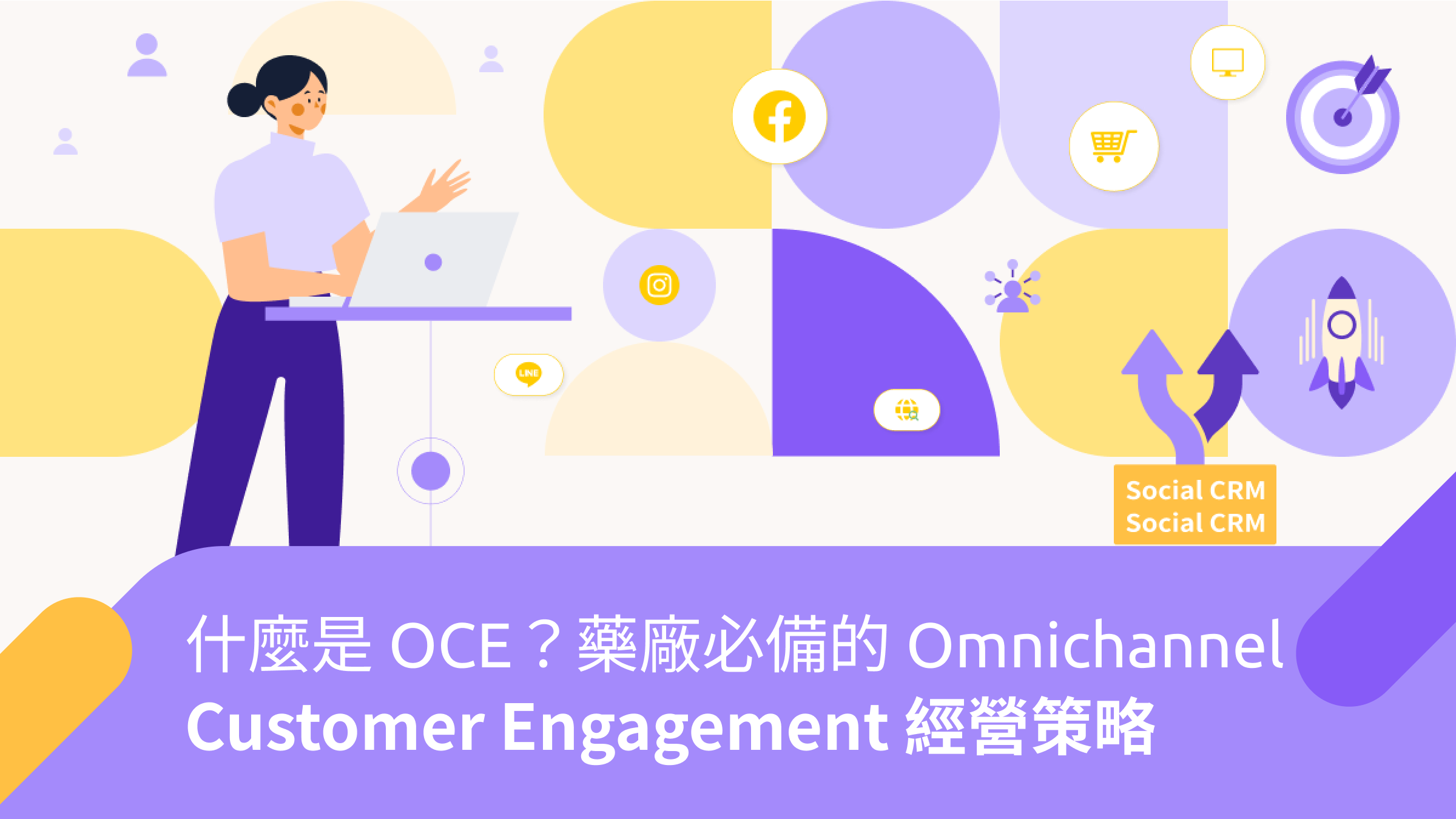
As digital transformation sweeps the globe, pharma companies keep looking for new technology to boost productivity. Omnichannel Customer Engagement (OCE) is the most important piece of a pharma CRM strategy. It unifies online and offline, cross-device, multi-scenario communication and records every touchpoint with HCPs, giving pharma companies a 360-degree view of each customer.
Adopting an OCE strategy opens up a lot of opportunities. With omnichannel communication in place, pharma companies can extend their touchpoints, learn what HCPs need across every channel, segment their audiences, and design customer journeys that feel personal. Shifting from one-way message blasts to two-way engagement lets the knowledge and care of sales reps reach beyond hospitals (HP) and general practices (GP), dramatically increasing HCPs’ trust in the products—and ultimately driving sales.
OCE is about connecting people.
At its core, OCE is a simple idea: use technology to help pharma companies deliver a consistent experience to HCPs across settings, making communication more precise and efficient.
Is the OCE I’m Buying a Concept or a Product?
Omnichannel Customer Engagement means customers can connect with a business through more than 3 communication channels and move fluidly between them.
“What exactly is OCE?” I often run into people who can talk about OCE fluently but are actually pretty fuzzy on what it is. So if you ask around, “How should I write the RFP for my OCE project?” you’ll get a thousand vague answers. Some suggest an on-demand SaaS service; others say you need to build something custom from scratch. Some insist OCE means integrating online, offline, email, web, and IM; others think having a LINE OA is OCE. Some will tell you their whole company uses their OCE system; others say only a handful of people do.
There are so many interpretations of OCE because it’s still new—even as we learn from each other, new needs and approaches keep emerging. Opinions on the definition vary widely, but after talking with many people who have rolled out OCE, I believe a genuine OCE has to meet these basic criteria:
- OCE receives HCP identity and interaction data from 3 or more channels and resolves it to a single identity;
- OCE can interact with HCPs through 3 or more channels;
- OCE lets 3 or more roles interact with HCPs.
Take Pharma Company A. Its OCE captures Dr. Any reading OB-GYN articles on the HCP portal, their registration and check-in records for an offline seminar, and their text conversations about products on the LINE OA—and it recognizes that all of these come from the same Dr. Any. That meets the first criterion. On top of that, Ben in marketing can send seminar registration notices via the LINE OA and share journals with HCPs through a QR code at the OB-GYN seminar, while Chris in sales can use RTIM to send thank-you messages to HCPs who attended. That meets the second and third criteria.
In short, OCE is a software application that lets HCPs engage two-way with 3 or more pharma roles through 3 or more channels, while matching identities across platforms. What platform it’s built on, what the UI looks like, and how advanced the features are will vary from company to company in this early stage of OCE.
What Does a Pharma Company Get from OCE?
We spent dozens of hours preparing, walked the boss through the strategic value of OCE in a meeting, and mapped out an OCE blueprint. The boss’s next question: “What results do you expect from OCE?” They want you to explain why OCE is worth the investment—and why it needs to happen now.
First, be clear with your boss: a good OCE rollout should make HCPs gradually like and trust the company more without even noticing. HCPs shouldn’t feel an obvious difference, especially when it comes to cross-platform identity matching. So don’t rush to judge success or failure by HCP feedback!
Second, while HCPs’ verbal feedback isn’t a reliable signal early on, their behavior is honest. The goal of OCE is to strengthen engagement between HCPs and the company, so looking at HCP behavior in the data is the clearest way to see OCE’s impact. For example: Does your audience list include new contacts your sales team wouldn’t otherwise reach? Have the number and quality of touchpoints improved? Has seminar participation gone up? Are you seeing more high-value customers in your customer pyramid? These are the success metrics a vendor should work out with you during the sales process. In our experience, you can expect multifold growth after rolling out OCE.
Finally, OCE is ultimately about helping pharma companies grow revenue and profit margins—and sales reps feel most directly whether money is being made. So whether the sales team feels OCE helps them get twice the results with half the effort is another dimension I recommend pharma companies watch. The positive impact of a well-implemented technology should be obvious to everyone.
How Do You Implement OCE?
We live in the age of on-demand SaaS. Want to listen to music? You don’t need to buy a turntable and assemble a stereo—open a streaming platform like Spotify and you have a library of over 100 million songs. Want the gist of Atomic Habits? You don’t need to buy it from Taiwan’s Books.com.tw and spend an afternoon reading—ChatGPT will give you the spoilers in seconds. Implementing software works the same way: what used to take years can now go live in weeks and keep improving through agile iteration. Shorter development time also means pharma companies can cut project management costs and put resources into what matters more—planning and measuring results.
Implementing OCE takes five phases and can go live in about 15 weeks: Goal Settings, Define Specification, Vendor Assessment, System Implementation, and Workflow Optimization.
Phase 1, Goal Settings: produce a business plan for the OCE initiative and get the boss’s sign-off. While drafting the BP, first define the project owner and stakeholders. Together, set the company’s long-term goals and short-term business goals, identify the key challenges you face, and map out the corresponding strategies and solutions.
Phase 2, Define Specification: write the Requirements For Proposal for the OCE initiative. The team should bring in vendors to learn about each one’s OCE offering and case studies, so stakeholders can jointly assess which features meet their needs and help the project owner write the most effective RFP.
Phase 3, Vendor Assessment: choose the ideal partner. Procurement should ask vendors to bring their best capabilities and most sincere offer according to the RFP. Meanwhile, IT should require vendors to pass an IT security assessment to ensure the system is stable and secure.
Phase 4, System Implementation: actually build the OCE. The selected vendor begins implementing the system, provides consulting to build the OCE framework and workflows together with the pharma company, and runs internal testing and training. Finally, the project owner can throw a kickoff party to celebrate the new system going live!
Phase 5, Service Optimization: keep improving the OCE service. In today’s fast-moving world, the traditional waterfall model can’t meet pharma companies’ need to try new approaches quickly. Vendors should therefore provide ongoing customer success consulting—using QBR meetings to analyze whether OCE is hitting its targets, confirm business goals, and gather user feedback to keep optimizing the OCE system and workflows.
Conclusion
As digital transformation sweeps the globe, pharma companies keep looking for new technology to boost productivity, and Omnichannel Customer Engagement is the most important piece of a pharma CRM strategy.
OCE is people-centered. Its core is building friendlier, more genuine conversations that help pharma companies communicate more efficiently. It may sound abstract, but to build good relationships it has clear specifications to follow and a concrete implementation process to help you lead your team through another major digital transformation.
To learn why OakMega Social CRM is the best solution for your OCE, visit the OakMega website or fill out this form with your contact details, and a specialist will be in touch.