






Why Does Customer Acquisition Cost Keep Rising, and How Can Brands Stay Profitable?
Customer acquisition cost (CAC) is what a company spends to win a new customer. It is a key metric for gauging the health of your marketing funnel and whether your marketing strategy actually helps you land customers. But do you know how much your company spent on marketing and sales to acquire customers this month?
 Howard HuangMarketing Specialist

Picture this: your company signed nearly 100 new customers this month, a 60% jump over the average of previous months. Sales, marketing, and even product and engineering are thrilled. It means users value what you have built, and investors are more likely to take notice.
But do you know your current customer acquisition cost? In other words, how much marketing spend did it take to win those 100 or so customers?
What Is Customer Acquisition Cost (CAC)?
Customer acquisition cost (CAC) is the amount a company invests to acquire a new customer. It is one of the core metrics for gauging the health of your marketing funnel, and it tells you whether the money behind your marketing strategy is actually helping you win customers.
Why Does Customer Acquisition Cost (CAC) Matter So Much?
As mentioned above, a big month for new customers is worth celebrating. But as a sales or marketing leader, have you asked what the full journey actually cost? A prospect reads a blog post, gets interested, fills out an inquiry form, goes through several meetings with your sales team to confirm requirements, starts a trial, and finally signs. What was the cost-to-revenue ratio of that entire process? If you want to grow order volume without over-investing and straining operations, calculating your marketing costs is essential.
According to a 2019 study by ProfitWell, a subscription software company in Boston, the cost of acquiring new customers has grown by nearly 60% over the past five years for both B2B and B2C companies. Online ad competition is fierce, consumers have far more options than before and can research faster, and Google's search results pages (SERPs) increasingly keep prospects from clicking through to your site. All of this forces brands to spend more on advertising to win each new customer, which is why companies need to review their CAC every period to measure performance.
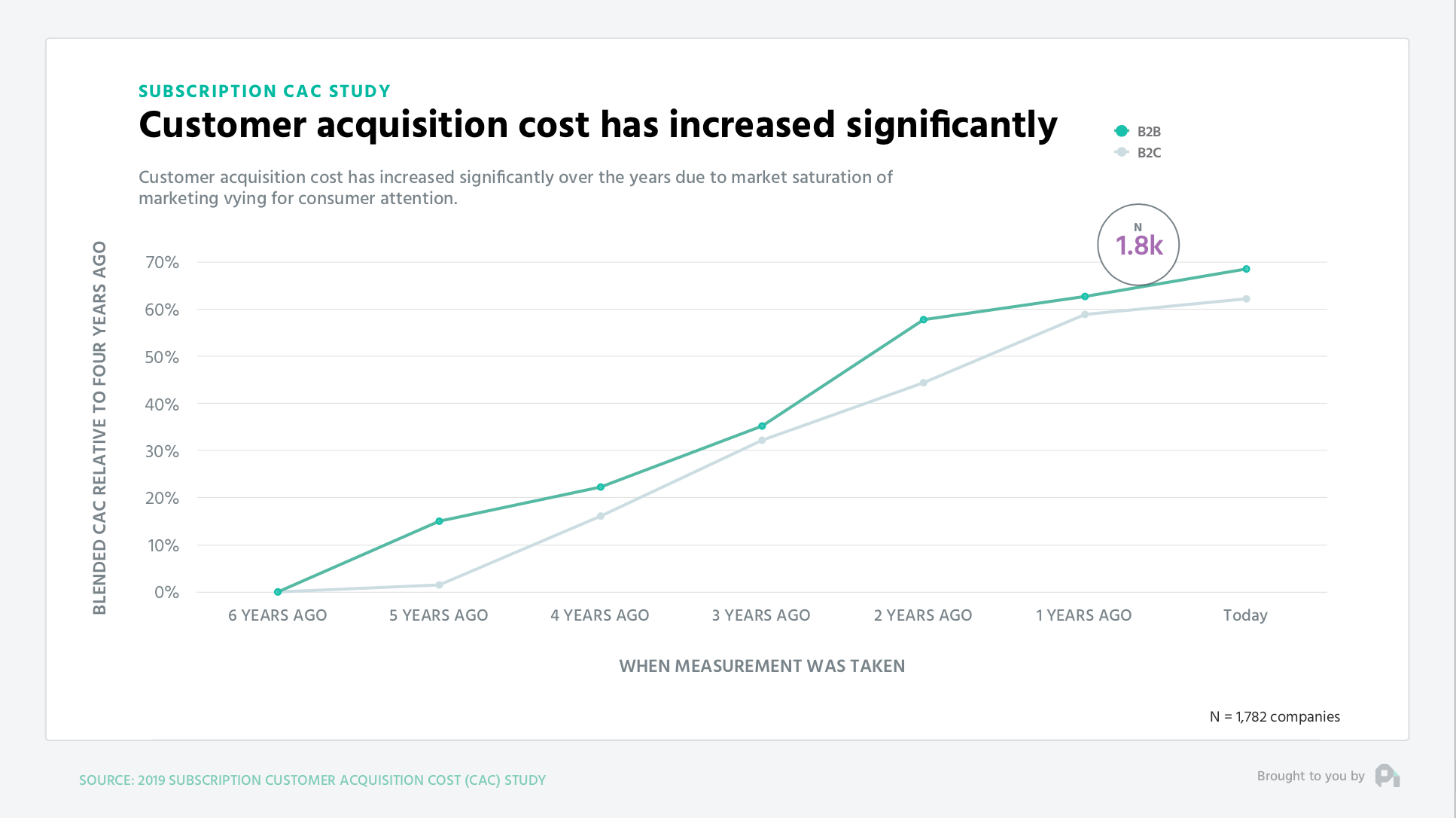 Source: Profitwell
How to Calculate Customer Acquisition Cost
Use the following formula to find your company's customer acquisition cost (CAC):
Customer acquisition cost (CAC) = Marketing and sales costs over a given period / Total new customers acquired in that period
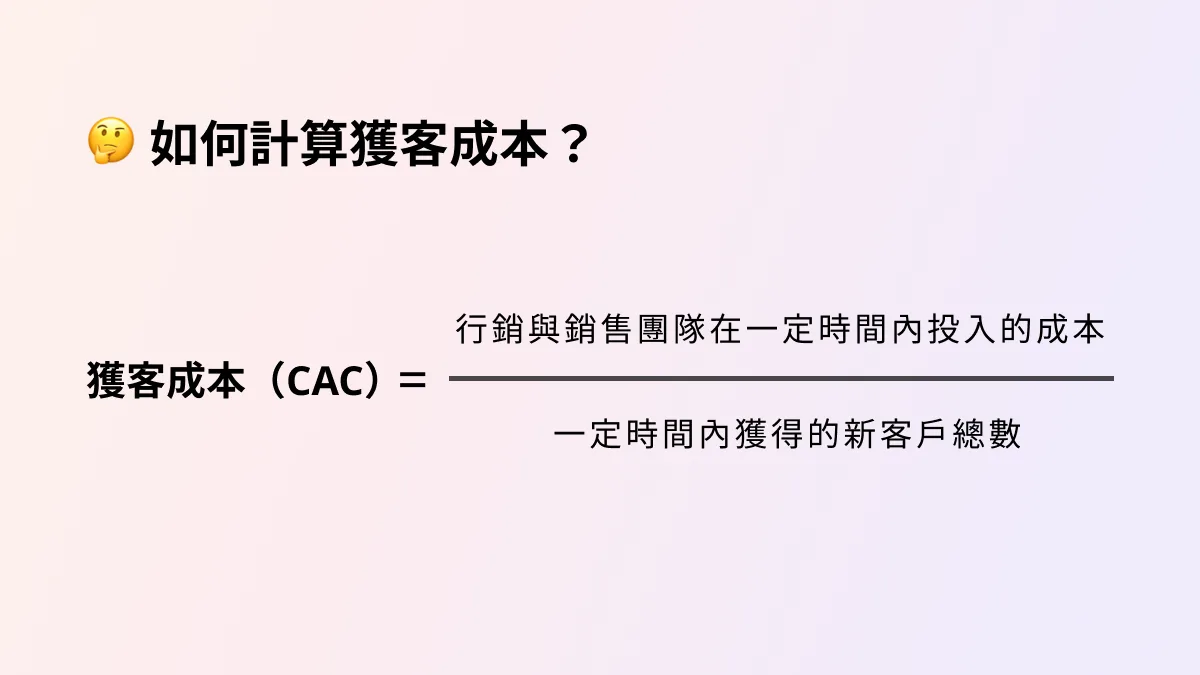 Customer acquisition cost (CAC) = Marketing and sales costs over a given period / Total new customers acquired in that period
When calculating CAC, make sure the following common cost items are included (using a software-as-a-service, or SaaS, company as an example):
Advertising
For SaaS companies, ads on social platforms such as Facebook and Instagram, or Google search ads, are common ways to drive sign-ups and acquire customers. You can measure campaign performance with click-through rate (CTR) and conversion rate (CVR).
Marketing Campaign Expenses
Marketing teams sometimes work with key opinion leaders (KOLs) to reach new customers. Sponsored content, affiliate partnerships, and online or offline launch events should all be counted as costs.
Marketing and Sales Salaries
This one is straightforward. Your marketing and sales teams drive the funnel and are a primary engine for winning new customers. Great people create more value, so their salaries belong in the cost calculation too.
Publishing Costs
UI/UX design to keep your website running and blog content written to capture attention and spark interest are frontline channels, so they should be counted as costs as well.
Sales Activities
Once a prospect submits an inquiry, every expense your sales reps incur to close the deal, including travel, phone bills, and preparing materials, should also be included.
Take a fictional software company called Software. Over one year, to win subscribers for its customer relationship management (CRM) service, it spent NT$700,000 on Google search ads, NT$200,000 on sponsored articles, and NT$100,000 on sales activities, plus NT$4,000,000 in marketing and sales salaries. A total of 400 customers subscribed, so its CAC is:
NT$5,000,000 / 400 customers = NT$12,500.
How Customer Lifetime Value Relates to CAC
Now that we know Software's CAC, how do we judge whether that number is good? Beyond tracking it regularly and comparing it with earlier periods, the most important factor is customer lifetime value (LTV). Why?
CAC is what you spend to acquire customers, while LTV is the revenue those customers bring in. If CAC exceeds LTV, you are pouring too many resources into acquisition without customers generating enough revenue in return. That is unsustainable in the long run, and it is a sign you need to revisit where your money is going.
How to Calculate Customer Lifetime Value (LTV)
Software's CRM service costs NT$2,000 per month, with an average gross margin of 70%. A typical customer signs a three-year (36-month) contract, so LTV works out to (based on Mixpanel: How to calculate lifetime value):
NT$2,000 x 0.7 x 12 months x 3 years - NT$12,500 (CAC) = NT$37,900
You can use the LTV / CAC ratio to assess how efficiently you turn spend into revenue. The ideal LTV / CAC ratio is 3:1. A ratio close to 1:1 means you are spending too much on sales. A ratio well above 3:1, say 5:1, means you have room to invest more in acquisition: widen your funnel and increase your ad budget.
For Software, the LTV / CAC ratio is 37,900 / 12,500 = 3.032. Its cost-to-revenue ratio is in the ideal range, and its SaaS acquisition costs are heading in the right direction.
How to Lower CAC and Acquire Customers More Efficiently
As noted earlier, online advertising has become more competitive, consumers research through more channels, and buying decisions are increasingly fragmented and harder to track. All of this keeps pushing CAC higher. So what can you do about it?
Raise Your Conversion Rate
Whether your inquiry form's UI/UX and call-to-action (CTA) stand out, and how fast your site loads, both affect how many visitors fill out the form. Google has also announced it is moving to mobile-first indexing. With a phone in nearly every hand, a mobile layout that is hard to read hurts both user experience and search rankings. Improving these areas can help you win customers with less ad spend and raise your conversion rate.
Add Value to Your Product
Listen to existing customers, always start from their needs, and keep improving your product. Gather feedback directly through your customer success team, or use your website's help center pages to find the most-viewed product questions and use them to guide product improvements.
Offer CRM Services
Today's sales, especially for subscription-based services, are not one-time transactions. Beyond a complete product, keeping customers renewing depends on a solid customer relationship management system so customers can reach you and get problems solved 24/7. You can even use OakMega Social CRM to connect your social channels with your CRM. A chatbot answers your friends' questions while you also see their behavioral profiles, so you can serve them more precisely.
Knowing your CAC shows you where your acquisition resources are going. Combine it with LTV and you can fine-tune your marketing and sales strategy and improve your cost-to-revenue ratio. Want to learn more about OakMega Social CRM? Visit the OakMega website to explore everything we offer!