






Third-Party Cookies Are Going Away. How Should Marketers Respond?
As consumers grow more privacy-conscious, Google has had to announce it will phase out third-party cookies in Chrome within the next 2 years, and Facebook has launched its Conversions API. Google’s move will reshape an online ad industry that has long run on cookies. How should marketers across industries respond to this fast-changing landscape?
 ILING WuProduct Marketing Manager


As consumers grow more privacy-conscious, Google has had to announce it will phase out third-party cookies in Chrome within the next 2 years, and Facebook has launched its Conversions API. Google’s move will reshape an online ad industry that has long run on cookies.
Safari introduced Intelligent Tracking Prevention back in 2017. Firefox has released a version that blocks third-party cookies used for corporate tracking, and Microsoft’s new Edge turns on tracking prevention by default.
According to NetMarketShare, Chrome’s market share began an unusual decline in August this year, slipping from 70.89% to 69.94%, though it remains by far the most widely used browser.
How do third-party cookies work?
Third-party cookies are set by a site other than the one you’re visiting. They most commonly come from advertisers, marketers, and social media platforms; Google Analytics and the Facebook Pixel are the third-party cookies you’ll find on most websites.
Here’s a simple example: one day you search for a “blazer,” browse a few sites, and don’t find one you like. Just as you decide to think it over, ads (search, dynamic, video, and more) start showing up everywhere. It feels like coincidence, but it’s really third-party cookies at work.

Platforms like Facebook and Google use cookies to collect user data, track users, and optimize ad delivery, finding target audiences more efficiently and improving ad performance. For marketers, that has undoubtedly been the best approach available.
Where does digital media go without third-party cookies?
Nearly 90% of Google’s revenue comes from advertising, and ads account for 98% of Facebook’s total revenue. Without third-party cookies, they’re surely more nervous than we are.
So how are these two ad giants responding to the wave of concern over personal data and privacy?
Facebook Conversions API
Facebook’s answer is the Conversions API, which lets advertisers send web events to Facebook directly from their servers. Server events are linked to the pixel and processed the same way as browser pixel events, so they can be used for measurement, reporting, and optimization just like browser pixel events.
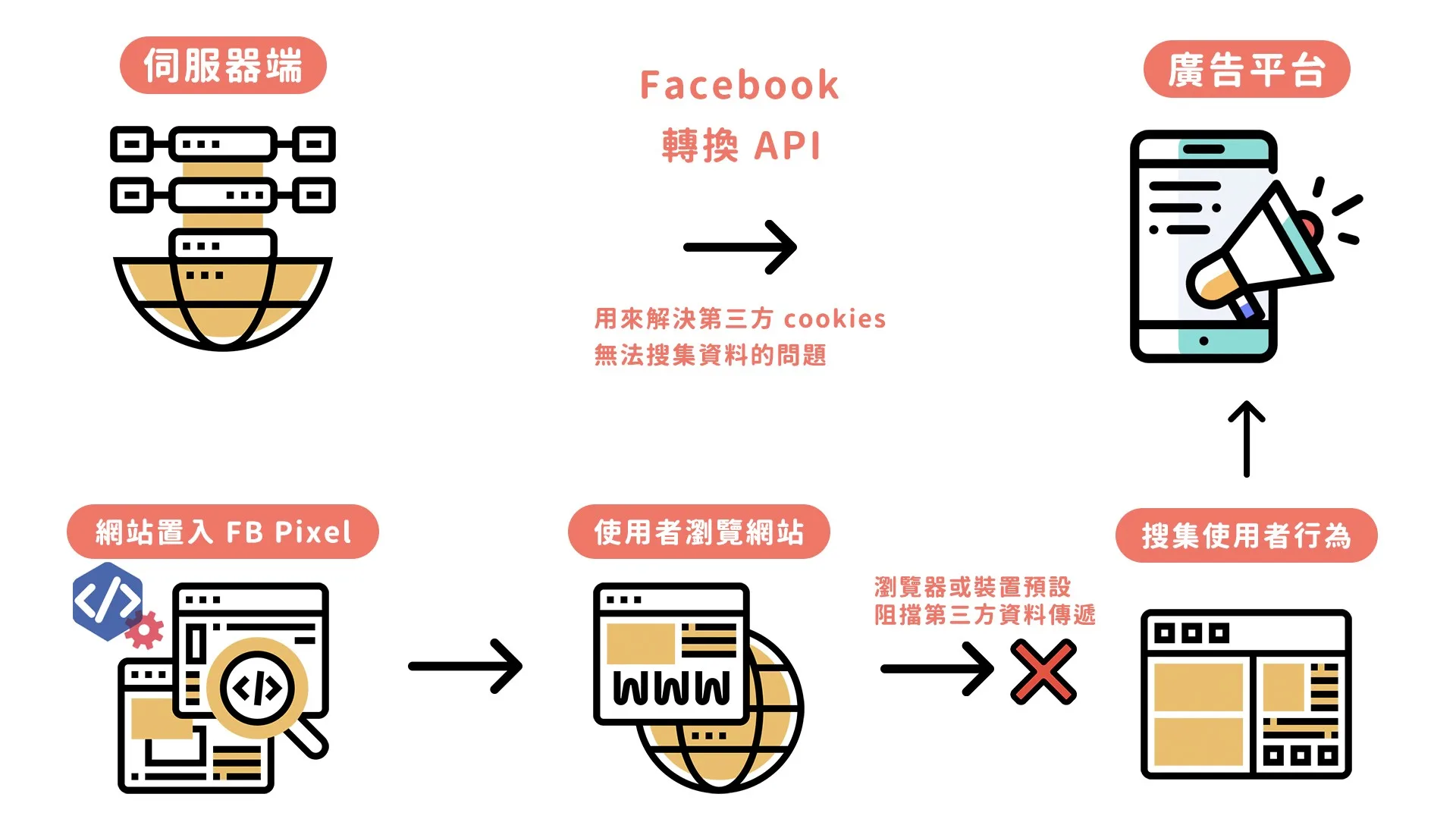
Put simply, the Facebook Pixel collects data from the browser, while the Conversions API collects it directly from the server. Used together with the pixel, it makes data collection more complete, and you still have a data source even when third-party cookies are blocked. It works both on offense and on defense.
Google’s new privacy initiative: the Privacy Sandbox
Google plans to fully phase out third-party cookies within two years and has introduced its new privacy initiative, the Privacy Sandbox. Chrome says it will protect user privacy while preserving the business models of everyone in the ad ecosystem, so advertisers and publishers don’t see revenue plunge as browsers restrict tracking.
A Google study of 500 publishers found that once cookies disappeared, publisher revenue fell 52%, and news sites were hit hardest, with revenue down 62%.
Google argues that a privacy standard is needed because simply banning tracking technologies can push privacy practices in directions users never expected. Using cookies as an example, Google notes that when browsers block cookies at scale, developers turn to other ways of tracking users, such as fingerprinting.
Other ad tech players
Ad tech company Beeswax sees limits on tracking as an inevitable trend, but notes the upside: if browsers agree on a unified standard, ad companies can build solutions that work everywhere.
Media group Vox responded to the trend by developing Forte, a first-party data platform that uses its many media sites to give advertisers insight into consumer interests and behavior. Building its own first-party data collection also prepares it for the privacy issues ahead.
French ad platform Criteo is actively testing non-cookie identifiers in its ads, pledging not to misuse any user data and to retain each user’s data for only 13 months.
Verizon Media has launched OneSearch, a privacy-focused search engine. Verizon promises not to track users with cookies or share data with other advertisers, and shows ads based only on search keywords.
Conclusion
Facebook and Google are currently the platforms working hardest to solve the third-party cookie problem; ad revenue is, after all, their main source of income. Other ad companies are looking for their own solutions.
For years, many have called on Facebook to stop tracking people’s personal behavior and activity. Digital footprints have long been a topic of debate and concern, and this move brings at least some improvement.
With wave after wave of privacy reforms, third-party cookie tracking is becoming history, and the digital ad industry faces serious challenges and change. There’s still some time before Chrome fully removes third-party cookies in 2022. If you work in marketing, are you ready?
References
1. Vox Media announces first-party marketing platform, Forte
2. How we use your data
3. Verizon Media Launches Privacy-Focused Search Engine, OneSearch
4. Google Chrome to phase out third-party cookies: how will internet businesses respond? (Business Next, in Chinese)

📣 Join the Taiwan Marketing Lab on Telegram to discuss with fellow marketers
OakMega Social CRM: the LINE CRM built for marketers
👏 Your applause keeps us going. Press and hold to clap again and again! Website / Facebook Page