







The SaaSpocalypse Is Three Years Late: The Real Question Isn't Whether SaaS Dies, but Whether AI Can Pay Its Way | CEO Insight
A trillion dollars in market value wiped out, and “SaaSpocalypse” is Wall Street's new buzzword. But this SaaS doomsday story is three years late. From ChatGPT replacing single-function software in 2023 to the rise of MCP and workflows in 2025, AI's disruption of SaaS has long been underway. The real threat isn't a Claude Cowork plugin; it's AI rewriting how enterprise software is priced and valued, shifting from per-seat fees to paying for workflow outcomes. Platform SaaS won't die, but can AI prove it's worth the price?
 Porsche TsaiCEO
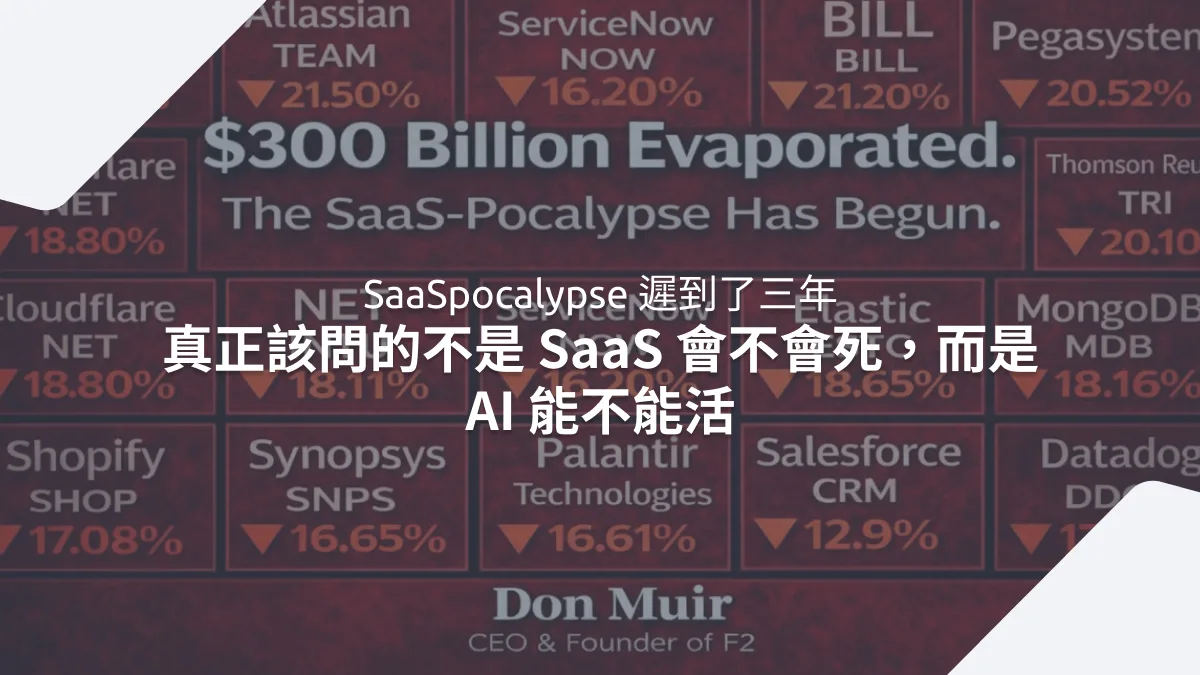
A trillion-dollar panic sell-off and a global software stock crash, yet what the market fears may not be the real threat at all.
On Monday morning, February 3, 2026, before Wall Street traders had finished their first cup of coffee, the numbers on their screens started to lurch. Thomson Reuters plunged 18%, LexisNexis parent RELX dropped 14%, and Wolters Kluwer fell 13% in Amsterdam. Jeffrey Favuzza of Jefferies' equity trading desk coined a new term mid-session: SaaSpocalypse, the end of software-as-a-service. Within a single week, global software and services stocks shed nearly a trillion dollars in market value.
The spark for this bloodbath looked like nothing more than a product update. On January 30, Anthropic announced 11 open-source plugins for Cowork, the platform built around its AI assistant Claude. One of them, a legal plugin, can automatically run contract reviews, triage non-disclosure agreements (NDAs), and handle compliance workflows. The market's reading was blunt: AI is coming for SaaS's lunch.
But look closely at the script of this panic and you'll notice something odd: what the market only started worrying about in 2026 actually happened back in 2023. And the question the market should really be worried about is one almost nobody is asking.
The SaaSpocalypse began in 2023, not 2026
Rewind to November 2022. ChatGPT launched, and the world got its first look at what large language models (LLMs) could do. Most people still treated it as a chat toy, and SaaS stocks didn't budge. The real shift quietly began in 2023.
That year, OpenAI rolled out Function Calling, Code Interpreter, and Web Search in quick succession. The LLM went from a model that could only chat to a tool that could execute tasks, write code, and search the web. At that moment, the moats of the first wave of SaaS companies began to crumble: software that charged for a single function, such as translation tools, summary generators, writing assistants, and simple data extraction services. When ChatGPT could do all of this for twenty dollars a month, who would pay separately for each feature?
In 2024, LLM APIs went mainstream and SaaS companies fought back. Salesforce launched Einstein Copilot, HubSpot had already folded AI/ML into its R&D organization back in 2023, and ServiceNow and Workday embedded AI features into their products. The keyword of the year was “Copilot”: every SaaS company stuffed an AI assistant into its product, trying to prove AI was an ally, not an enemy.
By 2025, things escalated again. MCP (Model Context Protocol) let AI connect directly to external tools, the concepts of workflows and skills matured, and users began completing tasks directly on AI platforms that used to require logging into a SaaS interface. What does that mean? Screen time on SaaS started to fall, and the value of the user interface shrank fast. You no longer need to juggle five browser tabs; a single AI platform can move between systems for you.
So when Forbes declared the arrival of the SaaSpocalypse in February 2026 under a headline about “$300 billion wiped out,” anyone who truly understands this industry could only smile wryly. This doomsday started three years ago. Wall Street is just now getting the bill.
In its January 2026 software industry report, Goldman Sachs divided AI's impact on software into four phases: the cloud golden age (2015–2021), AI infrastructure build-out (2022 to present), AI platform build-out (from 2025), and AI agent build-out (from 2026). Their framework backs up exactly this view: the pressure on SaaS to transform didn't appear overnight. It has been building up gradually, and each phase rewrites the rules of competition.
AI won't kill platform SaaS. It will feed it.
Yet the “SaaS doomsday” narrative misses a crucial distinction: not all SaaS looks the same.
Single-function SaaS does face an existential crisis. When AI can do the same job for less, a business model built on charging a monthly fee for one feature loses its reason to exist. But platform SaaS, meaning software with data storage, tracking and oversight capabilities, and team collaboration, won't shrink in the AI era. It may well grow faster.
There are three reasons. First, AI needs data. Even the smartest AI model, without a company's internal customer data, transaction records, and project documents to feed it, is just a martial arts master with nothing to fight for. Salesforce's Data 360, ServiceNow's RaptorDB, and the data lakes of Snowflake and Databricks are all prerequisites for AI agents to deliver. The Goldman Sachs report puts it plainly: the biggest bottleneck in enterprise AI adoption isn't weak models, it's poor data quality. In other words, the stronger AI gets, the more companies need to get their data in order, and organizing data is the core value of platform SaaS.
Second, enterprise processes still need to be managed systematically. AI can review a contract for you, but contract version control, approval flows, links to customer records in your CRM, and compliance audit trails all need a system to live in. Andrej Karpathy, OpenAI co-founder and founder of Eureka Labs, put it well: agent technology won't mature in any single year; it will keep evolving over the next decade. During this long transition, companies can't hand every process over to AI. They need a system to manage workflows where AI and humans collaborate.
Third, team collaboration can't be replaced by AI. One person can write a report with AI, but when ten people need to collaborate on the same report, track changes, assign tasks, and set permissions, you still need a SaaS platform. Goldman Sachs stresses in its report that a SaaS company's real moat isn't the code itself (the cost of writing code is falling fast) but the ecosystem built around the platform, the data context that can't easily be extracted through an API, network effects, and scale.
That also explains why Goldman Sachs rated Salesforce, ServiceNow, and Snowflake “Buy” in its software coverage, while rating Adobe and Datadog “Sell.” The former are platform companies with deep data moats; the latter face more direct AI competition. Results from Salesforce's Agentforce are already starting to show up in its revenue, and Goldman Sachs believes the compounding effect could add more than 10% in growth momentum. ServiceNow, with its cross-system workflow engine and agent orchestration capabilities, is seen as one of the companies best positioned to become the “control tower” of the AI era.
Claude Cowork plugins are personal tools, not enterprise solutions
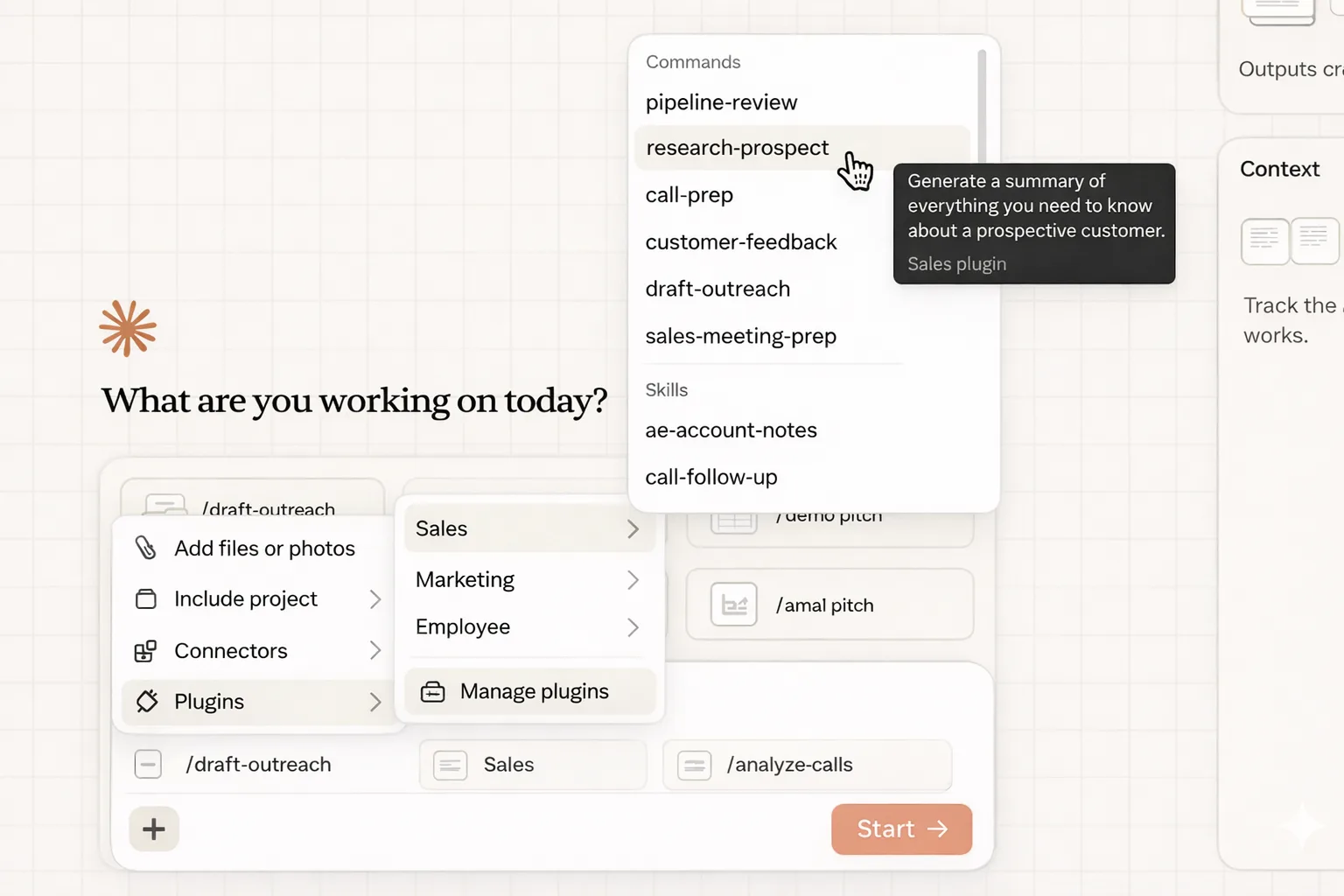
Back to the protagonist of this sell-off: what exactly are Claude Cowork's plugins?
Anthropic's 11 open-source plugins cover legal, sales, marketing, data analysis, and more. Take the headline-grabbing legal plugin: it can automatically triage NDAs, review contracts, and handle compliance processes. That does sound alarming. Could Westlaw, the legal database Thomson Reuters spent decades building, really be replaced by a free plugin?
The reality is nowhere near that.
First, Claude Cowork is at heart a personal productivity tool. Its plugins are stored on the user's own machine, with no enterprise-grade centralized deployment (Anthropic has said enterprise plugin management is still in development). Second, Cowork currently supports only macOS, and conversation history stays local. It isn't included in enterprise audit logs, compliance APIs, or data export. More importantly, its skill architecture, the instruction sets that let Claude run specific workflows, is essentially Markdown and JSON files: no code, no infrastructure, no build step.
What does that mean? A lawyer can use Claude Cowork to speed up their own contract reviews, but a 500-person legal department can't rely on it to manage the contract lifecycle across teams. Enterprises don't just need “AI, look at this contract for me.” They need a complete system: contract template management, approval permission controls, real-time sync with ERP and CRM, full audit trails, and cross-department visibility.
Think of it another way: a Claude Cowork plugin is like a very handy Swiss Army knife, great for an individual to carry around. But an enterprise needs a full set of kitchen equipment, from fridge to oven to dishwasher, with standardized processes, quality control, and safety certification. No matter how sharp the Swiss Army knife, it can't replace a kitchen.
So this sell-off looks more like an emotional reaction. Anthropic's product update just happened to give investors who were already uneasy about SaaS valuations a concrete excuse to head for the exit. As Talley Leger, chief market strategist at The Wealth Consulting Group, put it, the software sell-off has gone too far.
The AI that truly transforms enterprises is sold by the workflow
If Claude Cowork's plugin model isn't enough to upend enterprise software, what kind of AI is?
The answer lies in the shift in pricing models. Traditional SaaS charges per seat: if your team has a hundred people, you buy a hundred accounts. The underlying logic is that software is a tool for people, so more people means more revenue. But once AI agents can execute tasks on their own, the idea of a “seat” starts to fall apart. If ten AI agents can do the work of a hundred people, you only need ten seats, or maybe none at all.
AI services that companies will truly pay for must do one thing: work in units of workflows and directly replace labor and internal communication costs. That's not something a Copilot or a plugin can do.
Picture a concrete scenario: a company's procurement process, from raising a request, comparing supplier quotes, and reviewing contracts to approving payment, traditionally requires five or six people across departments working in three or four systems, with back-and-forth that can take weeks. A truly valuable AI service automates this entire workflow: an AI agent pulls supplier data from the CRM, checks it against the budget in the ERP, calls a legal AI to review contract terms, and finally generates approval documents for a manager to sign off. This doesn't just speed up one step; it eliminates the waiting and communication costs between steps.
LLMs alone can't pull this off. Goldman Sachs cites Palantir as an example: its US commercial revenue grew from $335 million in 2022 to an estimated $1.4 billion in 2025, a compound annual growth rate of about 60%. Palantir doesn't sell software for customers to figure out on their own. It sends Forward Deployed Engineers (FDEs) into client organizations to understand their data architecture, business processes, and org structure, then builds a custom ontology layer. The core insight of this model: the enterprise problem isn't a shortage of AI tools, it's that nobody can embed those tools into specific business processes.
So the AI service model that will truly change enterprises is FDE plus AI workflow automation: experts who understand the business build workflow-based AI automation tailored to each company. This model isn't priced per seat or by monthly subscription, but by workflow outcome: a fee per contract reviewed, per order processed, per customer analysis completed. IDC predicts that by 2028, pure per-seat pricing will be history, replaced by a hybrid of usage-based, outcome-based, and platform-fee models.
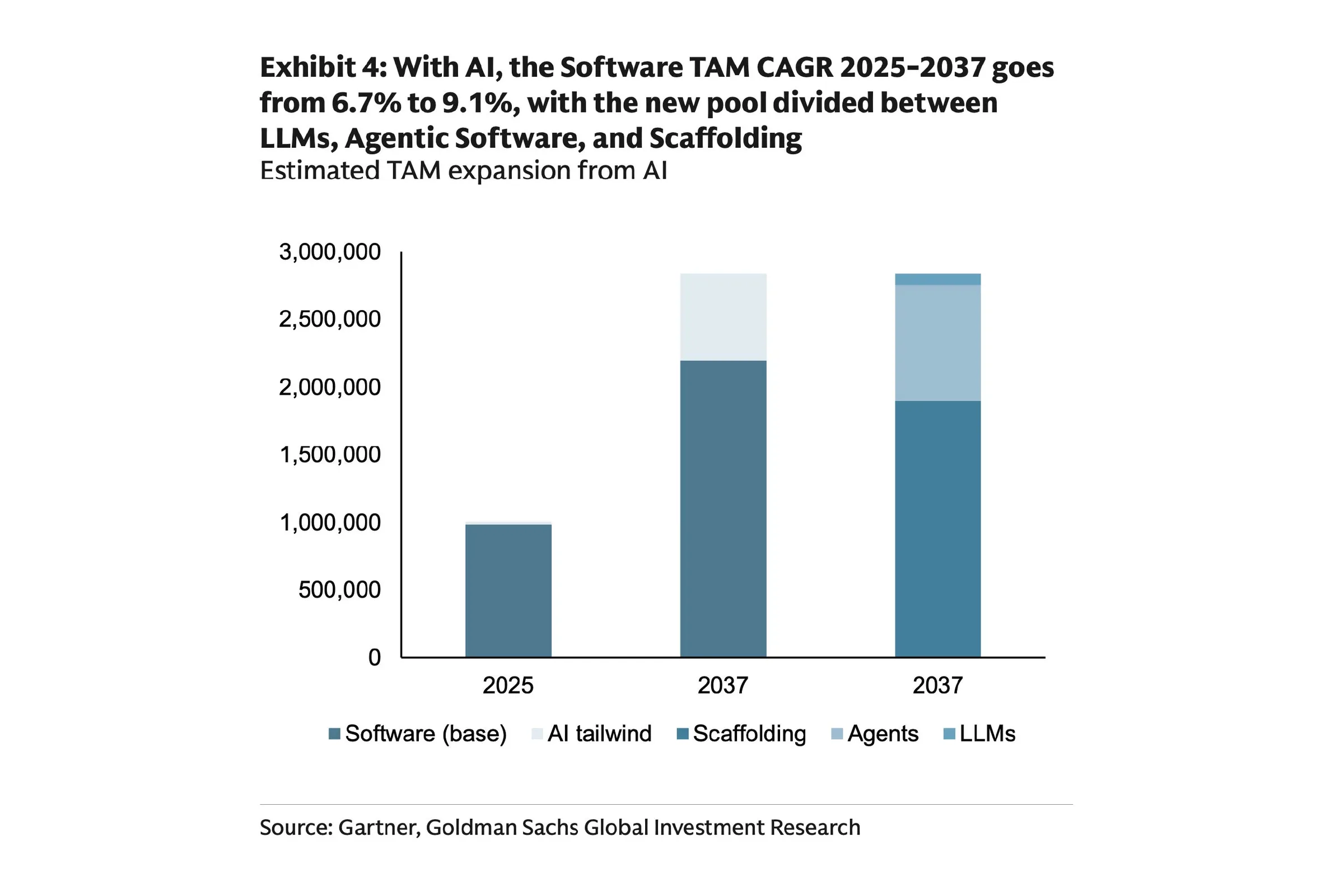
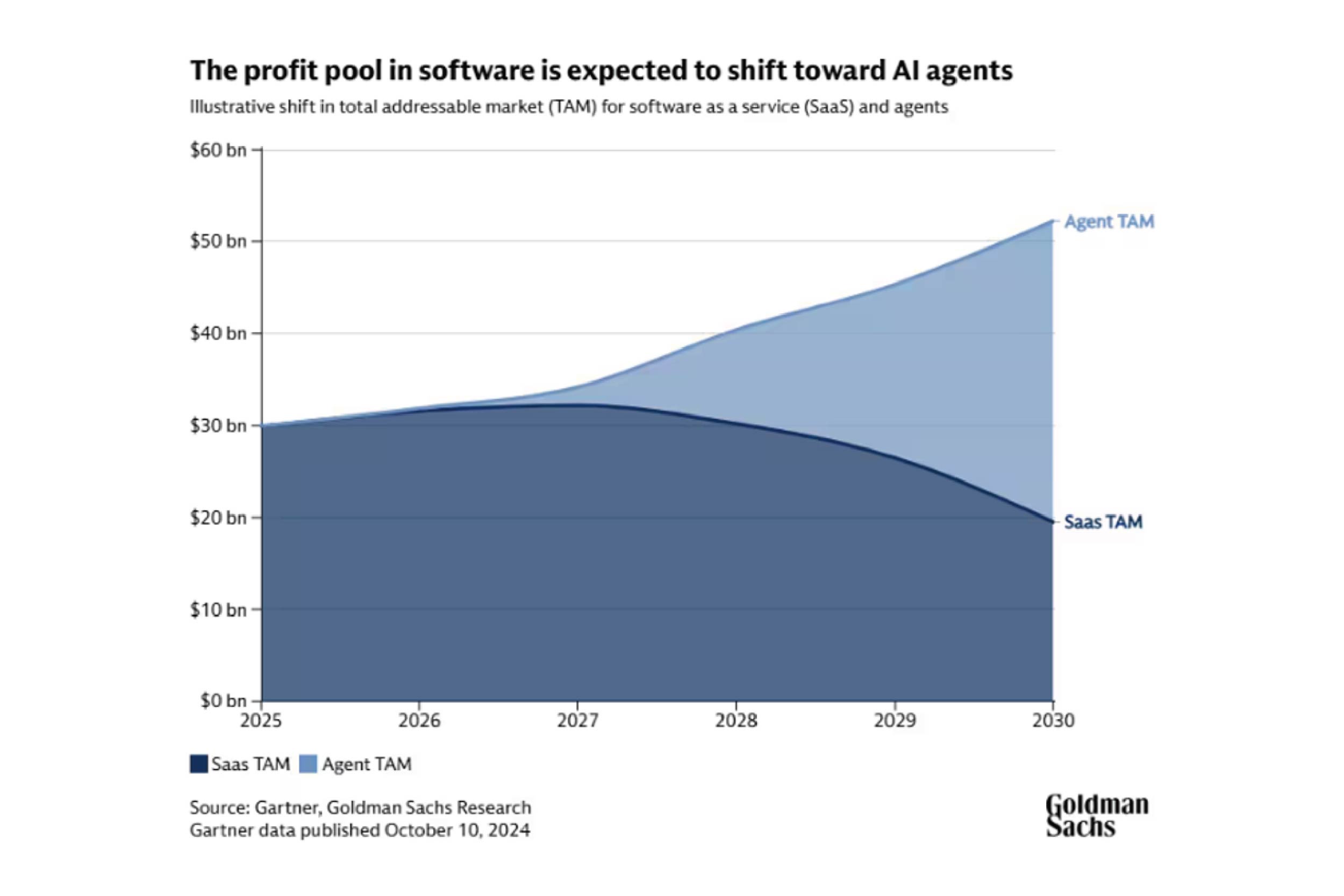
This brings us back to the core argument of the Goldman Sachs report: AI won't shrink the software industry's total addressable market (TAM). It will expand it. They estimate that if AI delivers a 15% baseline lift in US labor productivity, that equals $4.5 trillion in economic value in today's dollars. Assuming software companies capture 10% to 25% of that, the software TAM will grow from roughly $1 trillion today to $2.8 trillion by 2037, raising the 12-year compound annual growth rate from 6.7% to 9.1%.
The key point: this bigger pie won't be split evenly. It will flow to the companies that can turn AI from a “feature” into a “workflow,” whether they're established SaaS giants or a new generation of AI-native companies.
Can AI ultimately prove its worth?
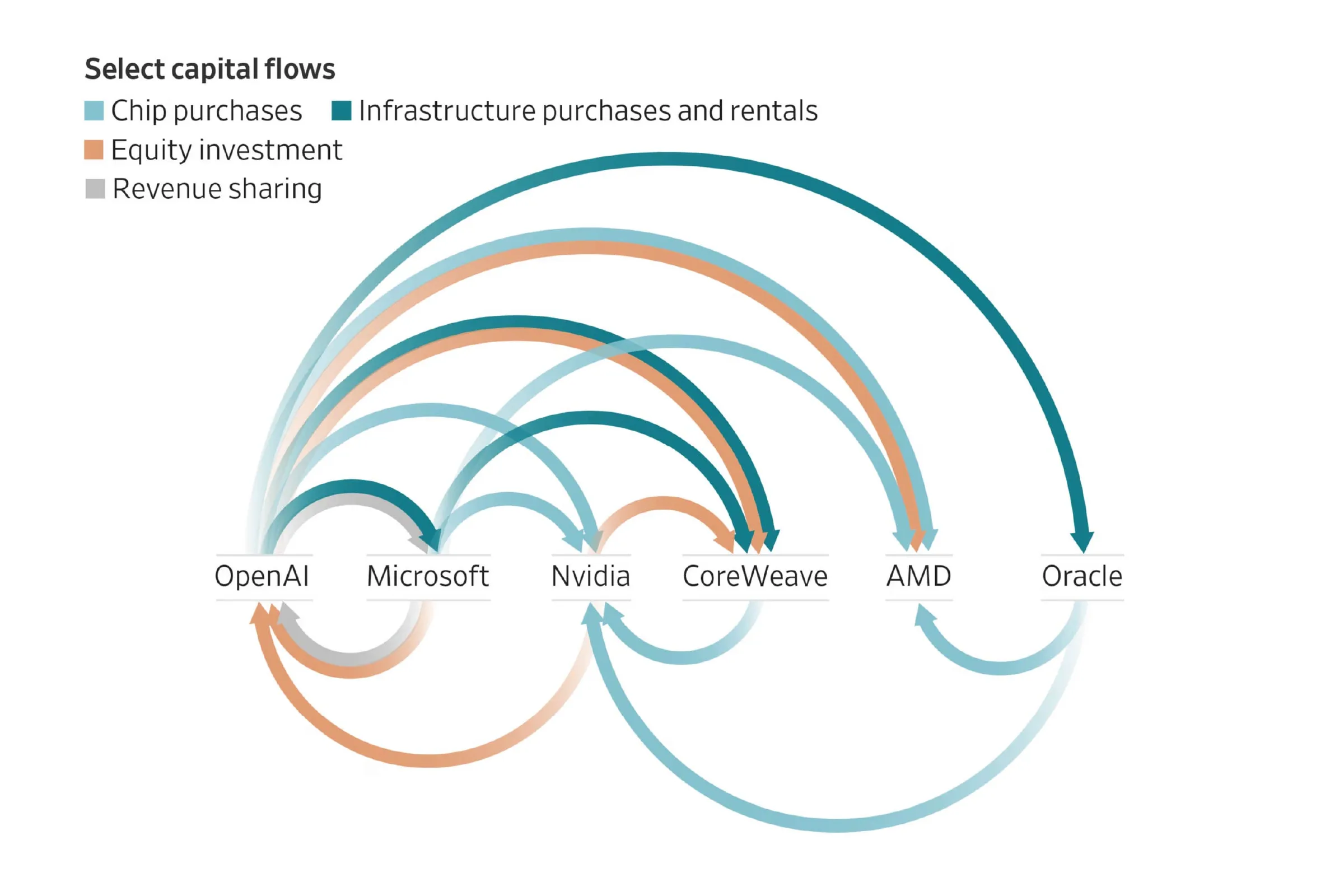
Over the past three years, hot money has poured into AI at an almost frenzied pace. Meta announced a $600 billion data center investment plan, OpenAI and SoftBank teamed up on the $500 billion Stargate project, and Anthropic committed to $30 billion in Azure compute purchases. By 2027, global annual capital expenditure on AI infrastructure could exceed $1.4 trillion.
But the Goldman Sachs report also admits that the value AI actually created for enterprises in 2025 was “disappointing.” The S&P 500 software index rose just 9% for the year, far behind the semiconductor index's 43% and the broader market's 15%. The market has seen astronomical investment but has yet to see matching returns.
Is this a bubble bound to burst? Or are we standing on the eve of a genuine industrial revolution, like the internet in the 1990s: first a wave of mania and a bubble bursting, then a decade that truly changed the world?
What do you think? Will the massive capital still pouring into AI ultimately prove its worth, or will this investment frenzy eventually face a reckoning? Let me know in the comments.