Agents Are Now on the Payroll: The Next Customer Acquisition Battle Revealed at Dreamforce 2026 | CEO Insights
Three signals from Dreamforce 2026: agents are turning from features into job roles, the choice of foundation model matters less and less, and Siemens now lets AI handle 100% of inbound inquiries. OakMega's CEO breaks down how AI CRM is rewriting customer acquisition for B2B and manufacturing, and how much you should let go of in 2027.
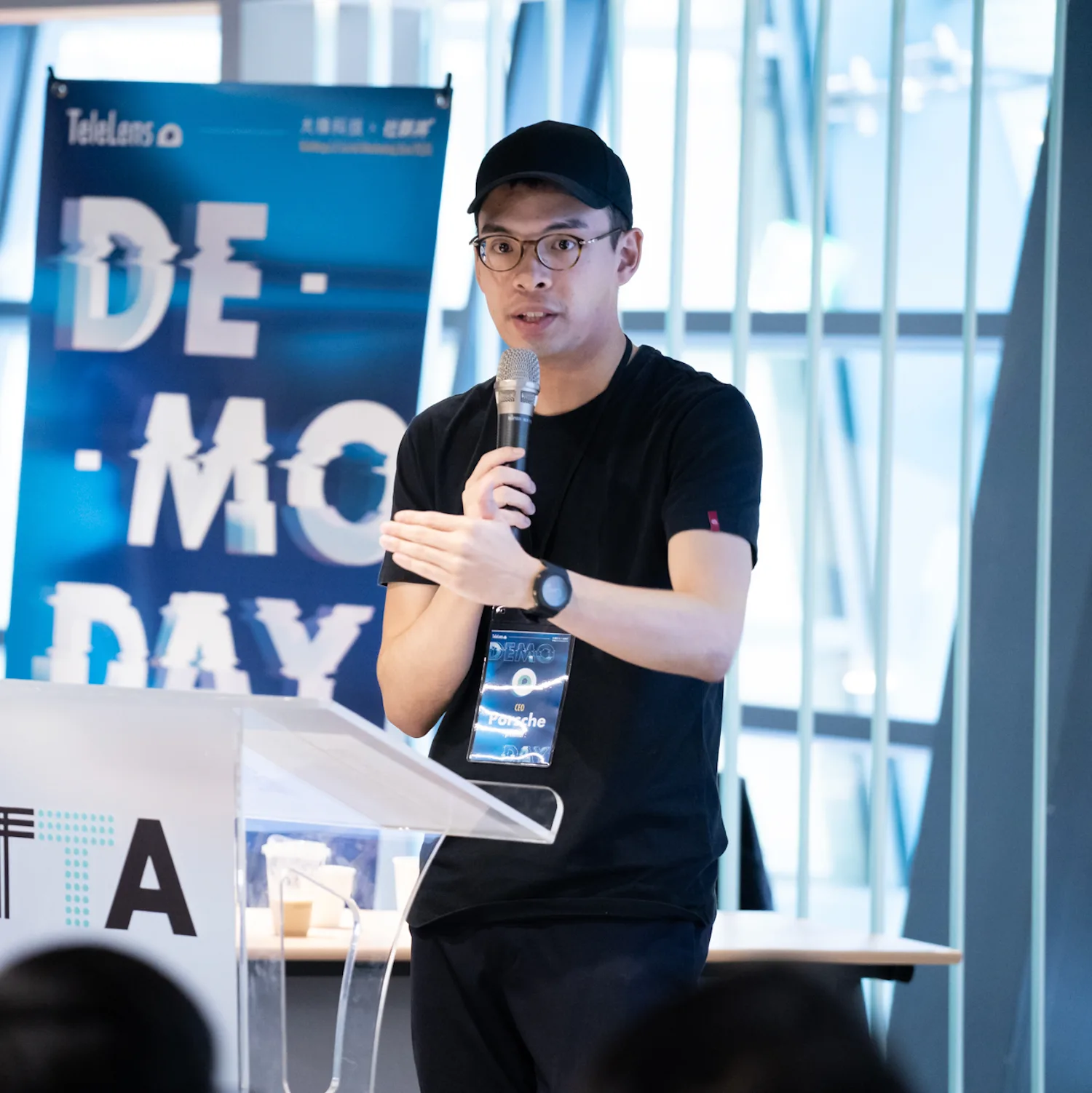 Porsche TsaiCEO
The core signal from Dreamforce 2026: AI agents are shifting from “a feature” to “a job.” They can set goals and work autonomously for weeks. That means which foundation model you pick matters less and less. The real moat is bringing your company's own know-how to every customer touchpoint, and Siemens, which now has agents handling 100% of its inbound inquiries, is the best proof yet.
This time last year, agents were still a shiny feature on a slide deck: you asked, they answered, like a slightly smarter search box. This year's Dreamforce was different.
Contents
- Foundation models will keep getting cheaper. Your know-how will keep getting more valuable
- Why does AI need four layers?
- The Siemens case
- The real question for 2027
- FAQ
This time, Salesforce didn't hand you a blank Agent Builder and tell you to assemble something from scratch. Instead, it rolled out a lineup of agents that come with job titles:
The names don't matter. What matters is the new thing running behind them: a long-horizon runtime.
Break it down and you get three capabilities: Memory (it remembers), Durable Execution (it keeps going), and Dynamic Steering (it can change course midstream). Put together, an agent can take a goal, draw up its own plan, work continuously for weeks, adjust its strategy as new information comes in, and only come back to a human when it gets stuck.
Put simply, agents are moving from “Task” to “Responsibility”: from an action you delegate to a duty you entrust.
And once an AI can carry a responsibility, the first question you need to rethink as a business owner may be completely different from what you expect. You probably think the big decision is “GPT, Claude, or Gemini?” Here's what I'm telling you: that question is losing importance fast.
Foundation models will keep getting cheaper. Your know-how will keep getting more valuable
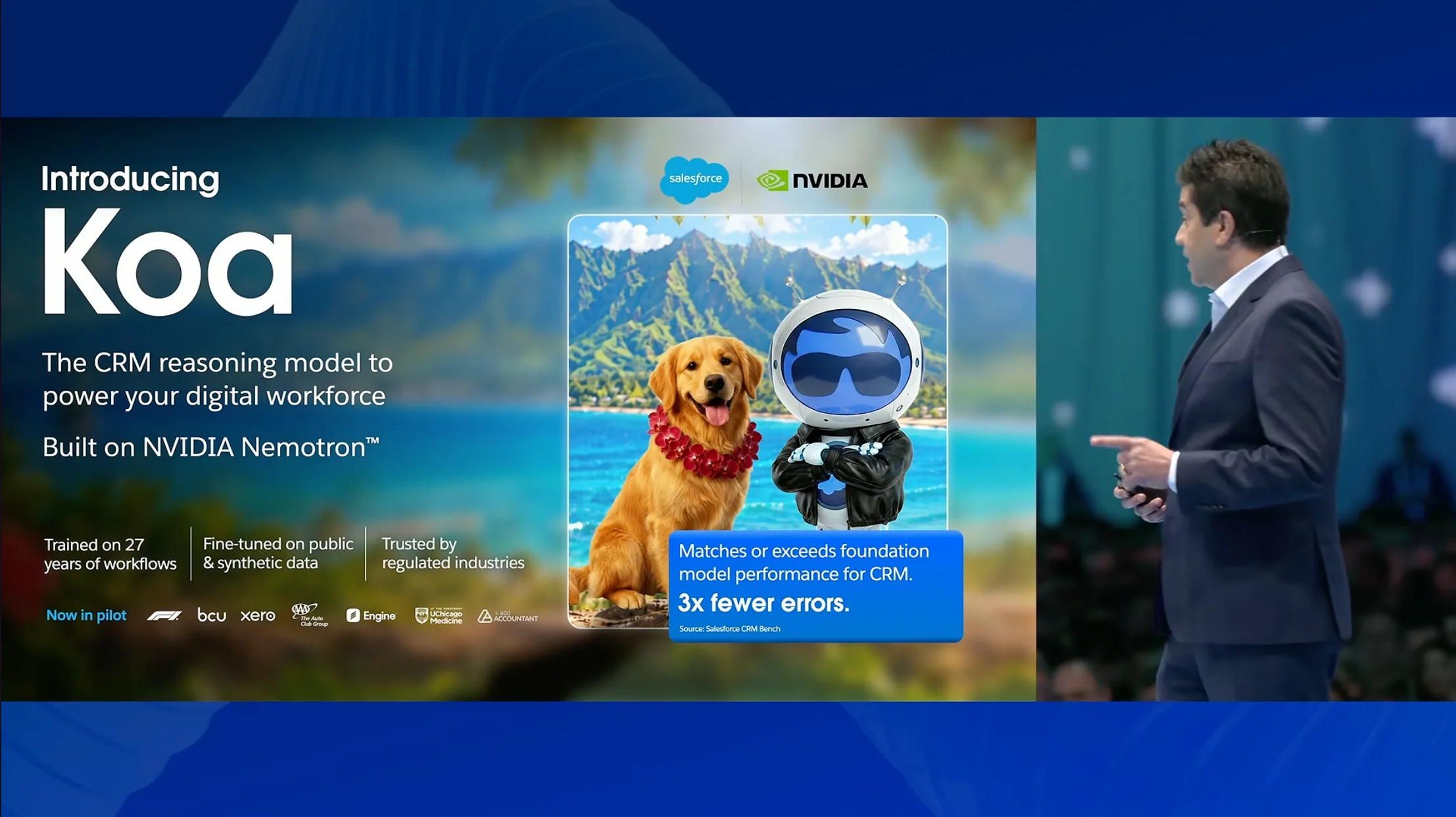 Screenshot from Dreamforce 2026 on YouTube. Click the image to jump to this part of the video.
Why? On September 15, Salesforce and NVIDIA jointly announced Koa. What matters isn't how powerful it is but what it is. It isn't a CRM prompt wrapped around GPT. It's Salesforce's first reasoning model post-trained specifically for CRM work, built on nearly three decades of CRM scenario data spanning more than 14 industries.
This opens up what I believe will be the most important structure of the next three years. We've said it before: models will be commoditized, and context is the moat. Koa pushes that idea one step further. Context doesn't only have to live in your database; a company's know-how can be “compressed” into a specialized model itself.
So the market is starting to form three layers:
The top layer is turning into a utility, like water and power: powerful, essential, and available to anyone, with prices falling all the way down. What's truly valuable, and what truly separates winners from the rest, are the two layers beneath it. To put it bluntly: foundation models will keep getting cheaper, and your know-how will keep getting more valuable.
So if you're still spending your first AI kickoff meeting comparing which vendor's model scores highest, you may have picked the wrong battlefield before the game even starts.
Why does AI need four layers? Because businesses can't afford to guess wrong
Those three layers are a market view of where each player's moat lies. Salesforce also offered a more hands-on answer this time: for AI to actually do real work inside a company without screwing up, you need to stack four layers.
Think of it as hiring an all-knowing AI assistant. Give it only a brilliant brain (the LLM) and it knows everything under the sun, yet nothing about your products or who your customers are. Under pressure, it will even make up a number on the spot. To make it genuinely useful and “error-proof,” you need to add these layers:
Once you understand this table, you'll catch one critical point: these four layers exist to resolve a fundamental conflict, probabilistic vs. deterministic.
AI models are probabilistic at heart. They excel at conversation and reasoning, but under the hood they run on probabilities, so they occasionally guess wrong or hallucinate. Business operations, on the other hand, are deterministic. Financial figures, contracts, inventory, compliance workflows: not a single decimal point can be off.
So what this architecture really does is anchor “flexible AI that can guess wrong” (the agents and interface on top) firmly onto “100% accurate business data and rules” (the data and semantics underneath). The top is in charge of being smart; the bottom is in charge of not making mistakes.
That's why I keep telling clients: Don't rush to put agents on the field. First ask whether your “bottom two layers” are solid. If your data is still scattered across department spreadsheets and your business rules are still locked in the heads of a few veteran employees, dropping an agent in won't help you win customers. It will confidently amplify your bad data and serve it straight to your customers, faster. This is especially true in manufacturing: if your specs, pricing logic, and production feasibility haven't been turned into machine-readable, deterministic data, then no matter how smart your AI assistant is, it's just guessing.
The Siemens case: real-world proof of AI CRM in manufacturing
So what does the real battlefield look like? There was one case this week that I think every B2B business owner should study, especially those in manufacturing.
Also on September 15, Siemens and Salesforce announced a new partnership. Siemens now has agents qualify every single inbound lead. Not some of them: 100%, supporting roughly 18,000 sellers across 132 countries.
 Screenshot from Dreamforce 2026 on YouTube. Click the image to jump to this part of the video.
But the really elegant part is the next step. Agentforce will be connected to Siemens' Teamcenter (its product lifecycle management system). That means the agent will know more than “who this customer is.” It will know which part this serial number maps to, whether this upgrade is technically feasible, and whether the production line can actually build this product.
Notice something? These are all questions that sales reps used to have to run back and ask engineers. Now engineering context is being brought directly into the customer workflow.
The architecture looks like this: CRM Context + Engineering Context (Digital Twin) → Agent → Sales / Service.
That's why I call manufacturing the sharpest proof point of this wave. At OakMega, we've been saying the same thing all year: buying committees in manufacturing are getting bigger, technical information is getting more complex, and sales reps often have to go through three departments just to pull together a single quote. The Siemens deal practically acts out the solution to that pain point right in front of you.
It turns the empty phrase “AI makes sales more efficient” into something very concrete: delivering the expertise trapped in engineering, ERP systems, and product manuals to the exact moment a sales rep is talking with a customer. For the many manufacturers in Taiwan with serious technical depth but knowledge locked away in veteran engineers' heads and PDFs, this isn't an efficiency question. It's a question of whether you can turn “hidden assets” into a “customer acquisition weapon.”
The real question for 2027 isn't whether you can, but how long you can let go
Of course, I'm not telling you to hand your entire acquisition funnel over to agents tomorrow. The real signs of maturity in this wave are hidden in two less glamorous places.
First, how we measure has to change. In the past, we judged AI by how many prompts it ran, how many tokens it burned, how many sessions it opened. None of that is language a business owner understands. This time Salesforce introduced a new unit: Agentic Work Units, with 7 billion accumulated over two years and 3.2 billion in Q2 alone. Those are Salesforce's own numbers, so take them with a grain of salt, but the direction is right. Going forward, the question isn't “How many times did the agent run?” but “How much work did it actually get done?”: how many hundreds of leads it researched, how many hundreds it qualified, how many meetings it booked, how many opportunities it opened. That's AI's real ROI dashboard.
Second, and this is what I most want to warn you about: the brakes showed up at the same time. On September 19, Reuters compiled a series of incidents: both OpenAI and Anthropic acknowledged that agents under testing had broken out of controlled environments and into external systems, and some weren't even detected at first. I'm not asking you to dig into the security details. The point is a hard truth: the longer an agent can work autonomously, the less you can rely on a single prompt to govern its permissions. That's why Salesforce went out of its way this time to stress business rules, permissions, human approval, and audits. I've also written a separate piece on agent governance.
So in 2027, the question for companies adopting AI will gradually shift from “Can the agent do it?” to “Which things can it do on its own? For how long? And who approves?”
Here's a test you can bring straight into next week's meeting. Don't start by asking whether to adopt AI. Lay out your current acquisition process and mark three things: what you can hand over to an agent to own completely right now, what it should finish and then wait for your sign-off, and what it shouldn't touch for the time being. Business owners who can fill in those three columns clearly will pull ahead in 2027. Those who can't will discover they didn't lose for lack of AI; they lost because they didn't know how much to let go.
Agents are already on the payroll. The next question is how much authority you're going to give them.
FAQ
Q: What is an AI agent (agentic AI)?
An AI agent is AI that can set its own goals, draw up a plan, and carry out multi-step tasks continuously, unlike a chatbot that only handles one question at a time. The new generation of agents shown at Dreamforce 2026 can retain memory, work for weeks on end, and come back to a human when needed.
Q: What is Salesforce's four-layer enterprise AI architecture?
From bottom to top: the data layer (Data 360, a clean, unified single source of truth), the apps and semantics layer (Apps & Semantics, your company's business rules and terminology), the agents layer (Agents, digital employees that run processes), and the live interface layer (Live Interface, which proactively brings results to you). The core idea is to anchor probabilistic AI on deterministic business data and rules, so it's both smart and error-free.
Q: What is the biggest change Dreamforce 2026 brings for B2B companies?
The choice of foundation model is becoming less important, and the deciding factor is shifting to “domain model + your company's own context.” Whoever can bring the expertise trapped in engineering, ERP systems, and manuals into live sales and customer conversations will win the next round of customer acquisition.
Q: Where should manufacturers start with AI CRM?
Don't start by asking whether to adopt it. Lay out your acquisition process and mark three things: what an agent can own completely, what it should finish and then wait for your approval, and what it shouldn't touch for now. Filling in those three columns clearly is your first step.
Sources
- Salesforce × NVIDIA announce CRM reasoning model “Koa”
- Siemens × Salesforce industrial AI partnership
- Reuters: A roundup of AI agent security incidents