How to Master Touchpoints: Three Stages of Content Marketing for Precise Customer Touchpoints
Customers can reach you through countless channels. Delivering your brand message precisely—and making every interaction count—starts with the fundamentals of touchpoints, the role content marketing plays across the customer journey, and the extra value a CRM gains from content marketing. Strengthening every customer interaction is how you stand out from the competition.
 Iris LiuMarketing Intern

No matter how big a company is or how much it spends on brilliant ads and high-quality products, the brands that stand out are usually the ones that leave customers with a good impression and a satisfying experience. That is the heart of mastering customer touchpoints. But with countless channels where customers meet your brand, how do you deliver your message precisely and effectively? This article gives you a quick look at the fundamentals of touchpoints, the role content marketing plays across the customer journey, and how a CRM backed by content marketing strengthens every customer interaction.
What is a touchpoint?
Simply put, a touchpoint is any opportunity for a customer to come into contact with a brand or company—every person, event, and object involved. Take Starbucks. The book Pour Your Heart Into It describes how Starbucks pays close attention to every moment a customer encounters its brand: the storefront décor customers see as they walk by, the aroma of coffee that greets them at the door, the friendly baristas, elegant interiors, and soft lighting, the way staff ask each customer’s name and preferences when taking an order, all the way to handing over the coffee. Even coffee storage, which customers never see, gets the same care: Starbucks insists on special packaging that keeps out air and moisture so the beans stay in the best possible condition.
Every touchpoint makes up Starbucks’ star product
Starbucks CEO Howard Schultz once said the company’s success comes down to having a product everyone loves. That product isn’t just the coffee or the Frappuccino—it’s every customer touchpoint, including in-store service, environment, and atmosphere, giving customers the best experience from start to finish. A brand’s image builds up one touchpoint at a time. If a customer has a negative experience at even one of them, it can do serious damage to the overall impression. To win in a fiercely competitive market, the secret is to treat every touchpoint with care. But how do you make sure you haven’t missed any?
Start with the marketing funnel and don’t miss a single chance to connect
Break the customer experience down with the marketing funnel and you get three stages: ToFu (Top of Funnel), MoFu (Middle of Funnel), and BoFu (Bottom of Funnel). They represent, respectively, how customers discover and get to know a brand, what they weigh when considering a purchase, and everything they do after buying. Companies can map out the buying patterns of their target customers in detail, identify each touchpoint, and build a marketing strategy for each one.
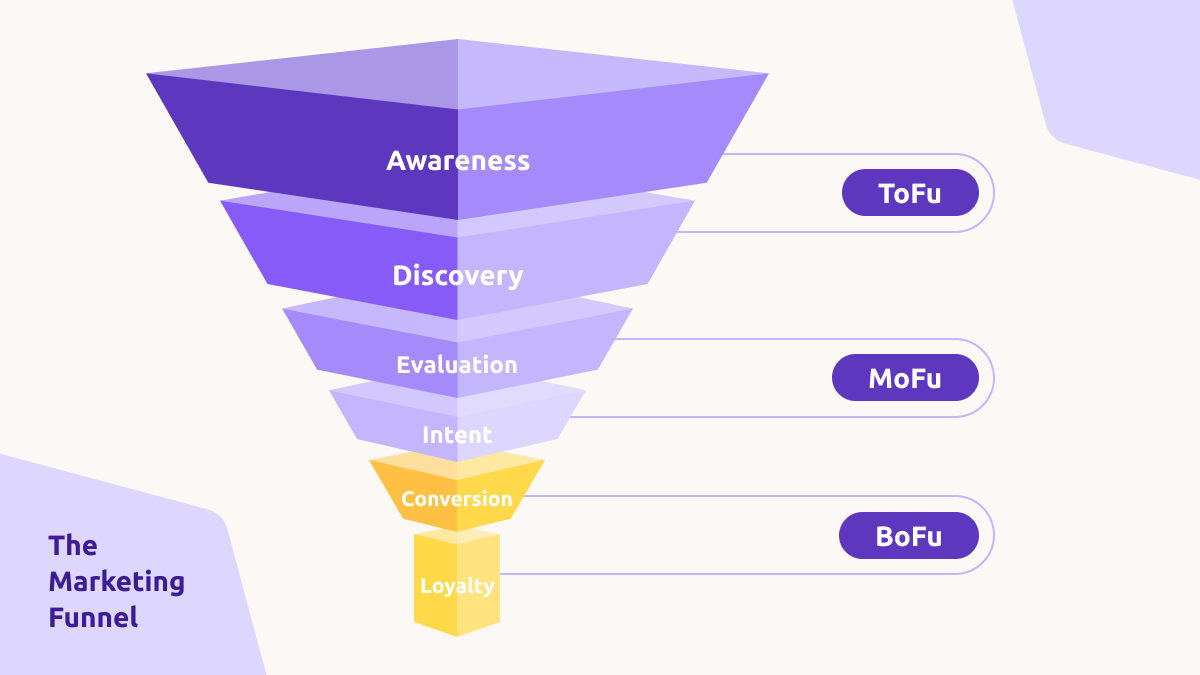 The Marketing Funnel
Strengthen customer touchpoints with the three stages of content marketing
Once you’ve identified every touchpoint, don’t start blindly courting customers. First understand what they’re thinking and what they need most at each touchpoint, then deliver timely information that addresses it. That’s the most efficient way to win them over.
Knowing how to say what customers want to hear matters, and that’s exactly what content marketing is for. Here’s a quick primer:
Content marketing (Content Marketing): a marketing strategy that creates content in various formats to deliver valuable, highly relevant information to customers. It resonates with them, builds trust in the brand, strengthens brand affinity, and ultimately influences purchase behavior.
How content marketing is commonly used across the funnel
Each stage of the marketing funnel has content formats that suit it best. Here’s an everyday example.
Say you have a crush on someone. At first you don’t know each other well, so you try—without putting pressure on them—to find out indirectly what they like and what’s on their mind. That’s the ToFu stage of the funnel: understanding customers’ pain points and the challenges they face. When customers develop a related need, they naturally come across your content while researching and get a first impression of your brand. Common ToFu content formats include:
- Blog posts
- Infographics
- White papers
- Podcasts
- Social media posts
Continuing the example: once you know the person a bit, you start getting into the details—their personality, their values, and so on. That mirrors the customer mindset at the MoFu stage. Customers want to learn more about product features and assess whether the product can meet their needs. These four content types work well here, spelling out product information and giving customers a comprehensive product guide:
- Case studies
- White papers
- How-to articles or videos
- Free resources
Finally comes the moment of decision: do you take the relationship further? Now the focus should be on showing you’re the best choice, not on endless courting. At the BoFu stage, emphasize that your product is the best fit for the customer rather than how impressive or feature-rich it is. Content should be professional, informative, and comparative, conveying your product’s advantages concretely so customers clearly see how much choosing your brand will help meet their needs. Common formats include:
- UGC (user-generated content)
- Comparison charts / sheets
- Product videos
- Research reports
- Webinars
- Events
- Demos
(Sources: mailchimp-contentmaketing, 4 Phases of a Winning Content Marketing Funnel, glints-contentmarketing)
Combine content marketing with CRM to optimize customer touchpoints
Understanding how content marketing works doesn’t mean sending the same message to everyone. With a CRM, you can see customer data in real time and send targeted messages to different customer profiles, getting the most out of every chance to connect.
How the automotive industry combines content marketing and CRM to build perfect touchpoints
If this still feels abstract, let’s look at how content marketing optimizes customer touchpoints within a CRM from the automotive industry’s perspective. As described in “Automotive Success Story: Delivering End-to-End Car Sales Service Through a LINE Official Account MINI App,” the car sales process has three stages: test-drive bookings before the sale, sales consultations and vehicle delivery during the sale, and maintenance and repair services after the sale.
ToFu: Test-drive bookings before the sale
Using customer data collected in the CRM, send introductions to models that match each customer’s budget, needs, and preferences, and proactively share nearby test-drive locations based on where the customer is.
MoFu: Sales consultations and delivery
Drawing on the footprint customers leave during test drives, sales reps can see what each customer cares about most and provide content that reinforces the product’s strengths—detailed brochures, performance comparison charts, test videos, and more. Hitting customers’ pain points squarely makes them think, “This brand really gets me,” shortening the conversation and lifting the overall conversion rate.
BoFu: Maintenance and repair after the sale
A CRM records every owner’s full history, so you can send regular service booking reminders based on vehicle age. For owners of older cars, you can go a step further with content like “tips for taking care of an older car,” gently reminding owners that their car is getting on in years. When they show interest in that topic, you can follow up with content about new models that solve their problems or offer better performance.
Many automotive brands are now actively adopting Social CRM to deliver more timely content, sustain the relationship between brand and owner, and turn owners into loyal fans.
Automotive Success Story: Creating a New Way to Engage with Social CRM—Managing Owner Relationships in One Place on a LINE Official AccountAutomotive brands use Social CRM tools to effectively manage customers coming in from different channels and help frontline marketing and sales teams segment with data, making test-drive bookings, sales consultations, and after-sales service management more efficient.https://oakmega.com/blog/improve-after-sales-customer-service-by-social-crm-on-line
Conclusion: Use content marketing in your CRM to make every interaction count
With content marketing, a CRM helps brands provide more valuable information at every customer interaction, increasing how much each touchpoint contributes to conversion. OakMega helps brands build long-term, warm connections with customers on messaging apps and send personalized messages powered by first-party data, so every interaction speaks directly to your customers.