



Use First-Party Data to Understand Customers and Run a Data-Driven Sales Process: Biopharma CRM Seminar Recap
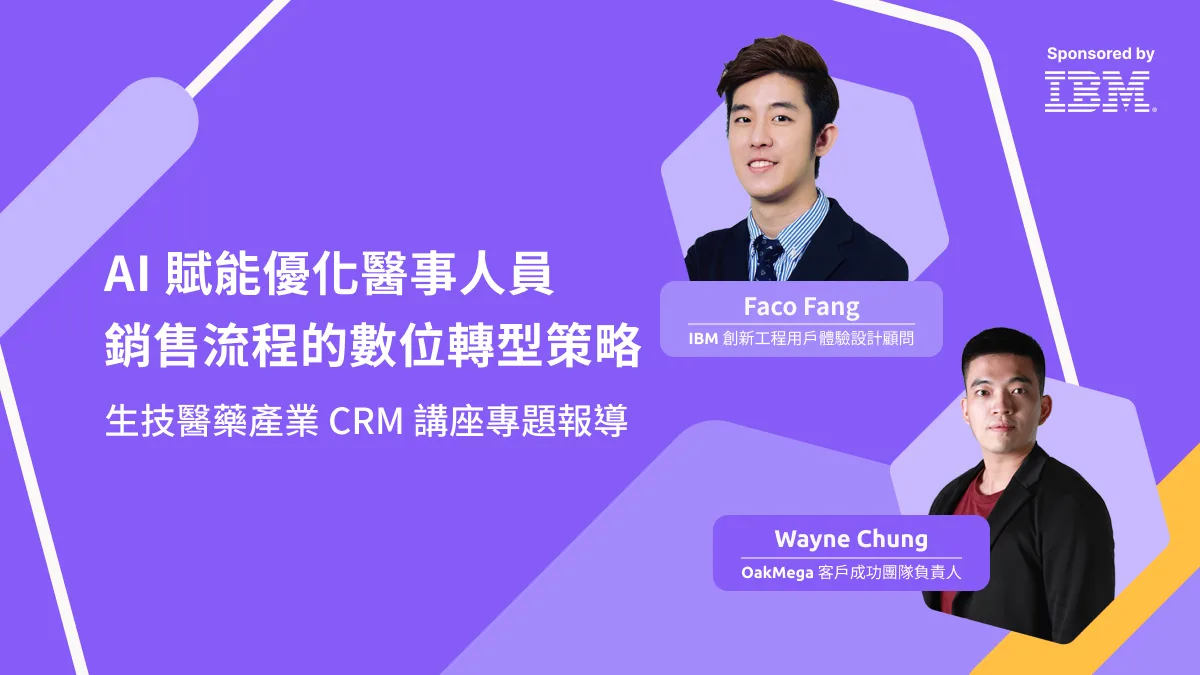
Our second CRM industry seminar of 2022 took place online on June 1, 2022. Focused on biopharma, it covered the latest digital transformation trends in the industry and how Social CRM fills the gap in last-mile behavioral data. We also invited Kao Hsing, head of biopharma at Salesforce Taiwan, who used CRM as a starting point to share “customer relationship strategies that build a first-party data mindset to improve sales performance.”
 Howard HuangMarketing Specialist
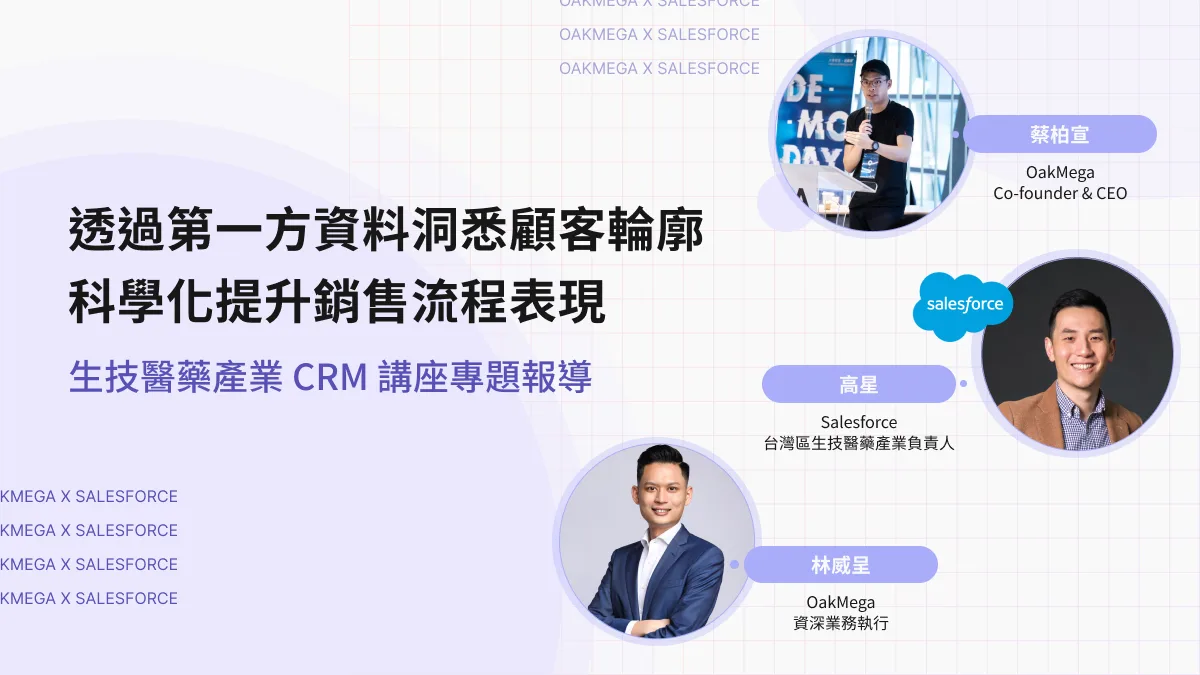
Our second CRM industry seminar of 2022 took place online on June 1, 2022. Focused on biopharma, it walked attendees through the latest digital transformation trends in the industry and how Social CRM fills the gap in last-mile behavioral data.
The host, OakMega, also invited Kao Hsing, head of biopharma at Salesforce Taiwan, who used CRM as a starting point to share “customer relationship strategies that build a first-party data mindset to improve sales performance.”
PART 1|Digital transformation trends in biopharma: what is OCE?
Citing relevant research and data, Porsche Tsai, OakMega co-founder and CEO, noted that the way biopharma companies engage customers is undergoing an unprecedented shift, forcing the industry to rethink its next business model.
The phase-out of third-party cookies is making customer acquisition, already restricted by industry regulations, even narrower and less precise. Meanwhile, Covid-19 has irreversibly changed the traditional model of visiting healthcare professionals, with more meetings and visits now happening online. Most significant of all, the government keeps cutting drug prices, and many drug patents expire in 2026, exposing brands to low-cost generic competition and eroding their long-term competitiveness.
A term you need to know for digital transformation|OCE, Omni-channel Customer Engagement
OCE is about connecting people.
“OCE has shot to prominence over the past year or two and become one of the most talked-about terms in biopharma,” Tsai said. OCE stands for Omni-channel Customer Engagement, and some pharma companies have even created OCE roles responsible for coordinating customer communication across every channel and building an entirely new customer engagement experience.
Tsai broke OCE into its O and E to define exactly how it helps the biopharma industry:
1. O (Omni-channel)|Integrate every customer touchpoint to understand customer behavior precisely
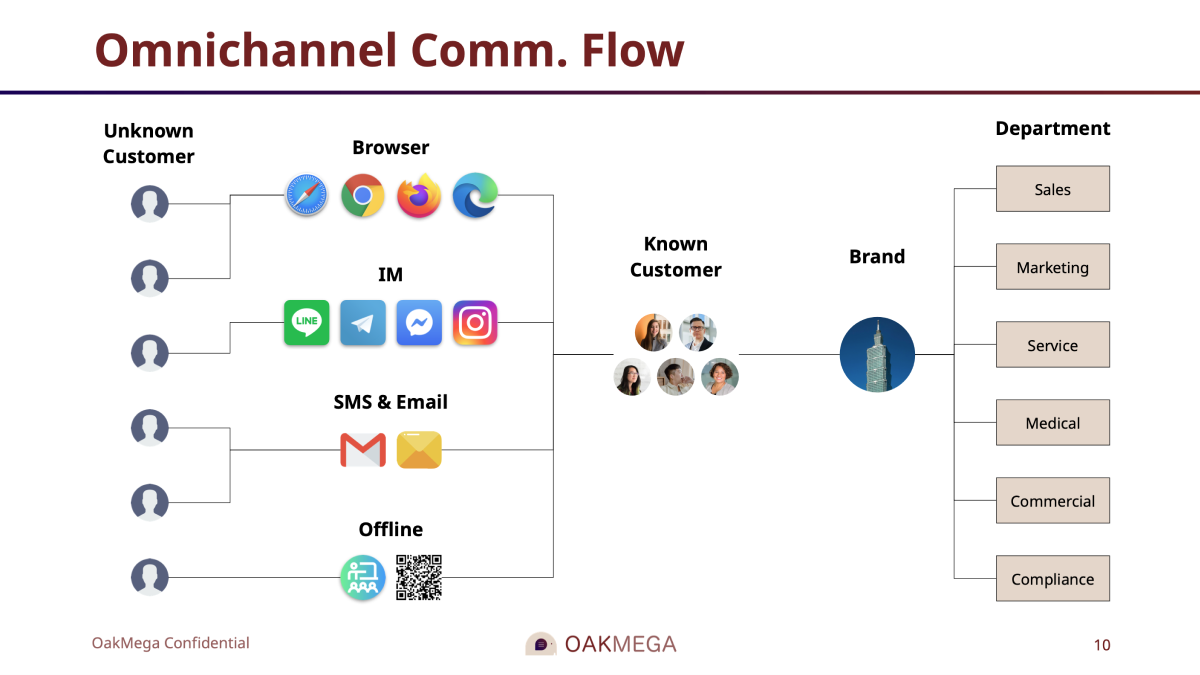
Omni-channel Customer Engagement (OCE) means a customer can connect with a business using any communication channel and move fluidly between them.
As the channels customers use to interact with brands fragment, existing marketing strategies find it harder and harder to identify customers. Brands need to make sure customers can reach them through any channel and get the same experience no matter which channel they switch to.
2. E (Engagement)|Put customers at the center and use first-party data to deliver the right content and move them along their journey
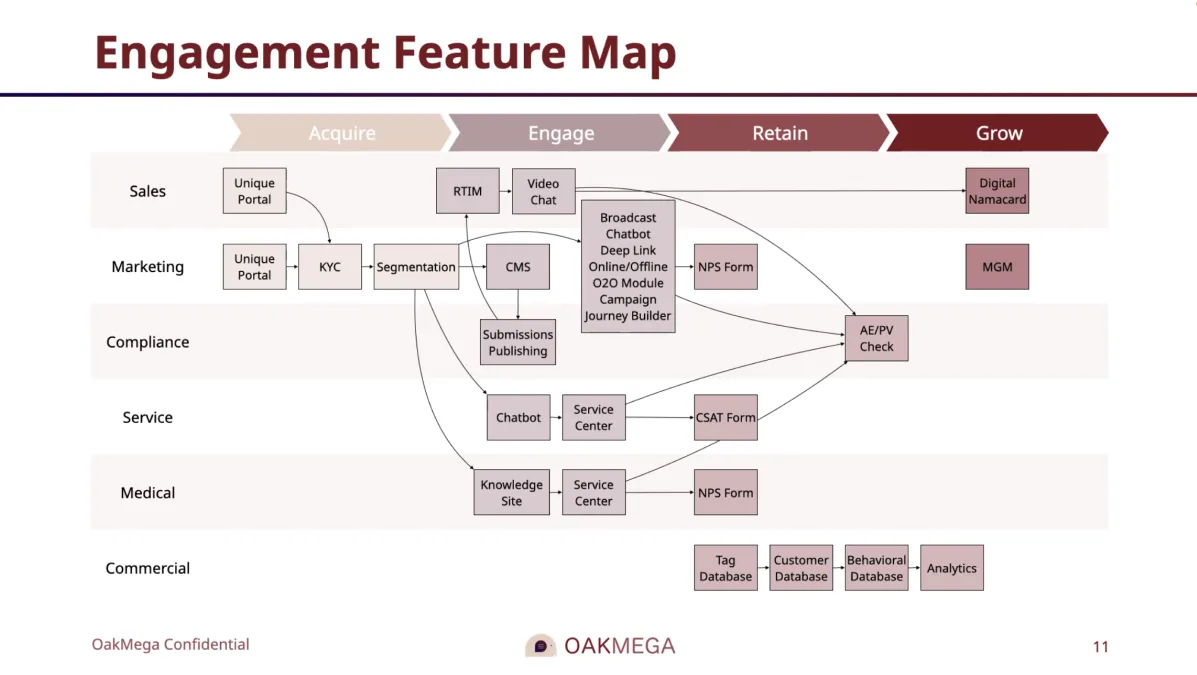
Omni-channel Customer Engagement (OCE) blurs the line between online and offline, giving customers OMO interactive engagement experience.
Once you have integrated customer touchpoints across online and offline channels and made sure every channel delivers a smooth experience, you also need to change how you communicate. Put customers at the center, build on data, and use first-party data to deliver personalized content to different customers. That is how you keep online and offline experiences consistent and extend and advance the customer journey.
Key Takeaways
Tsai concluded that to face new business models, the biopharma industry needs OCE to build loyal customers: put customers at the center, use first-party data as the foundation, and drive an integrated experience across online and offline channels. Only then can companies raise conversion rates, soften the impact of price cuts and weaker product competitiveness, and grow profits.
- Build loyal customers with OCE and increase customer lifetime value
- Develop a complete OCE strategy
- Use OCE to collect first-party data and understand your customers
PART 2|Inside CRM: managing the sales process with data
Because of the pandemic, companies accelerated their digitization by five years in just eight weeks. - McKinsey, Aut. 2020
Kao Hsing, head of biopharma at Salesforce Taiwan, opened with this McKinsey finding to drive home that digital transformation is an unstoppable trend. The questions biopharma companies need to answer next, he said, are what new business models should look like and how they will engage customers in the future.
Growth strategy trends for the future
Citing Salesforce’s 2021 sales research, Kao noted that in response to new business models, 79% of sales reps say they often have to adjust their strategy, and even adopt new sales management tools, to keep up with the new sales landscape. 85% of sales teams agree that sales operations (Sales-ops) now plays a much larger and more important role in sales strategy because it provides accurate data. And 77% of business leaders say digital transformation has become more important since the pandemic, enabling them to respond quickly to the market and making it a hub for growth.
(Source: State of Sales, Salesforce Research, September 2021)
The traditional biopharma sales process faces a major transformation
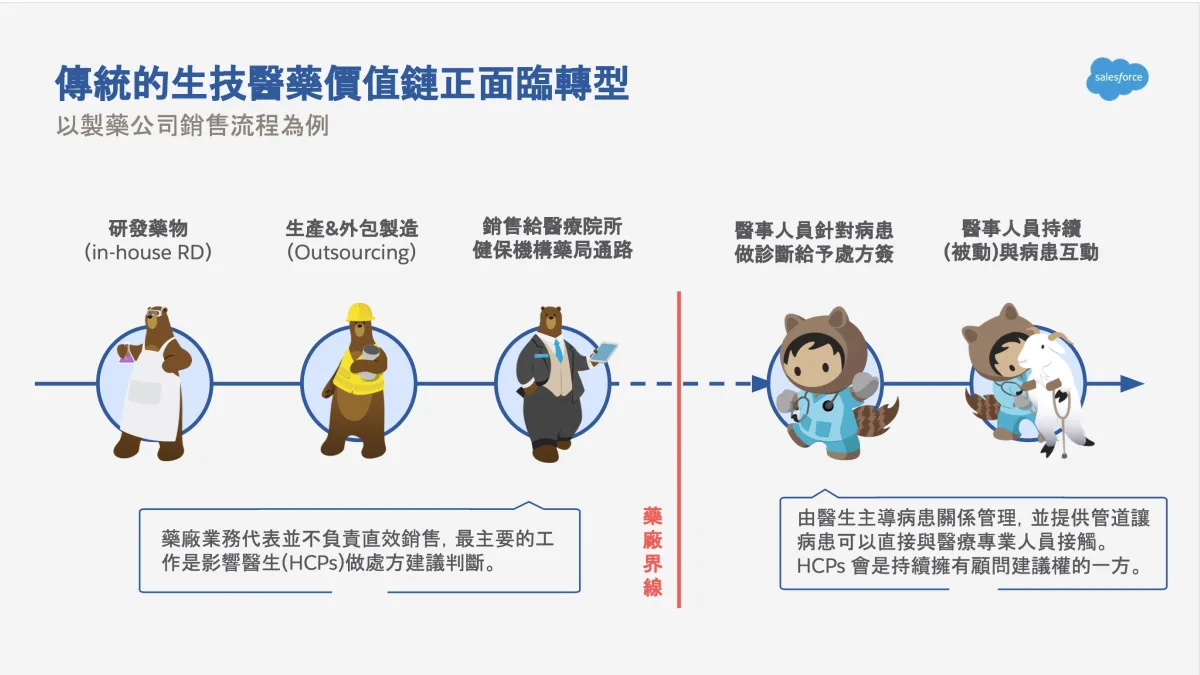
“The biggest challenge in biopharma is that frontline reps don’t sell directly. They can only keep influencing healthcare professionals (HCPs) in their prescribing decisions, and pharmacies and patients then use drugs based on those decisions, so sales figures are hard to track,” Kao explained.
Echoing the trends Tsai described in PART 1, Kao pointed out that complex customer channels, industry regulations, multiple stakeholders, and new customers (patients, pharmacy channels, and HCPs at hospitals and clinics) who expect precision medicine to improve their quality of life have opened a huge gap between biopharma companies and their customers, and even end users. Companies need CRM tools to influence HCPs more precisely.
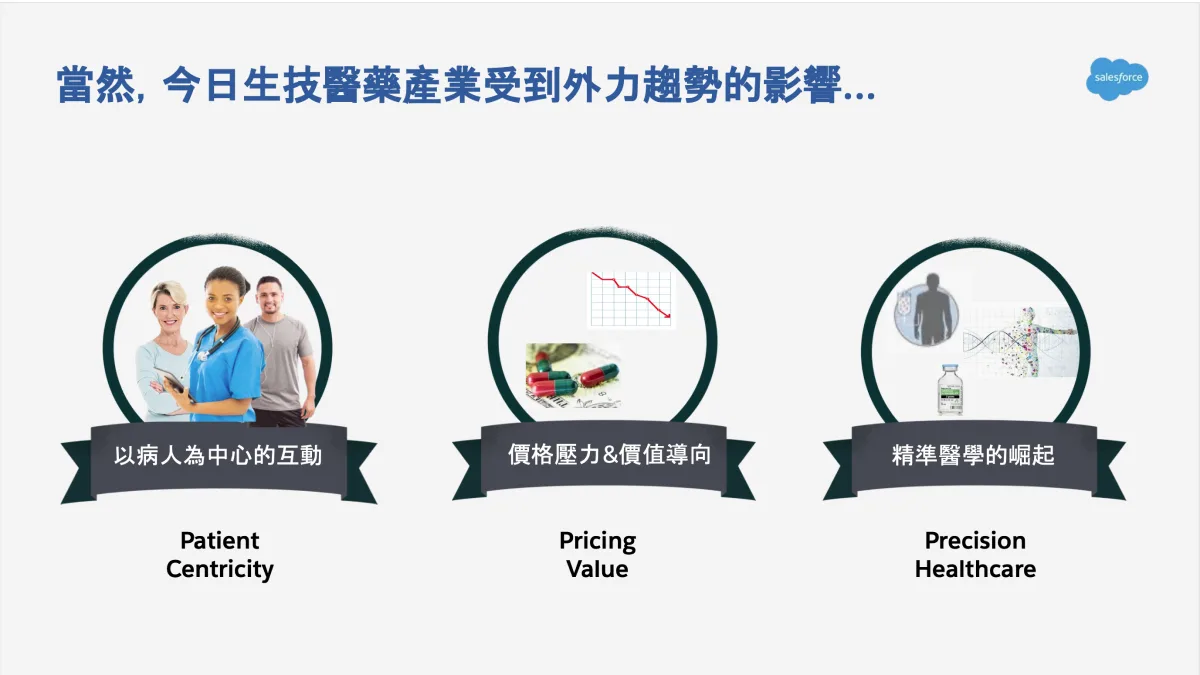
Three trends and four dilemmas are widening the gap
Three trends
- Patient-centered engagement (Patient Centricity)
- Pricing pressure intensifies competition in the drug market (Pricing Value)
- The rise of precision medicine makes new product development more data-driven (Precision Healthcare)
Four dilemmas
- Regulated advertising and sales
- An indirect supply chain
- Sales figures that are hard to track
- Intermediary education bodies
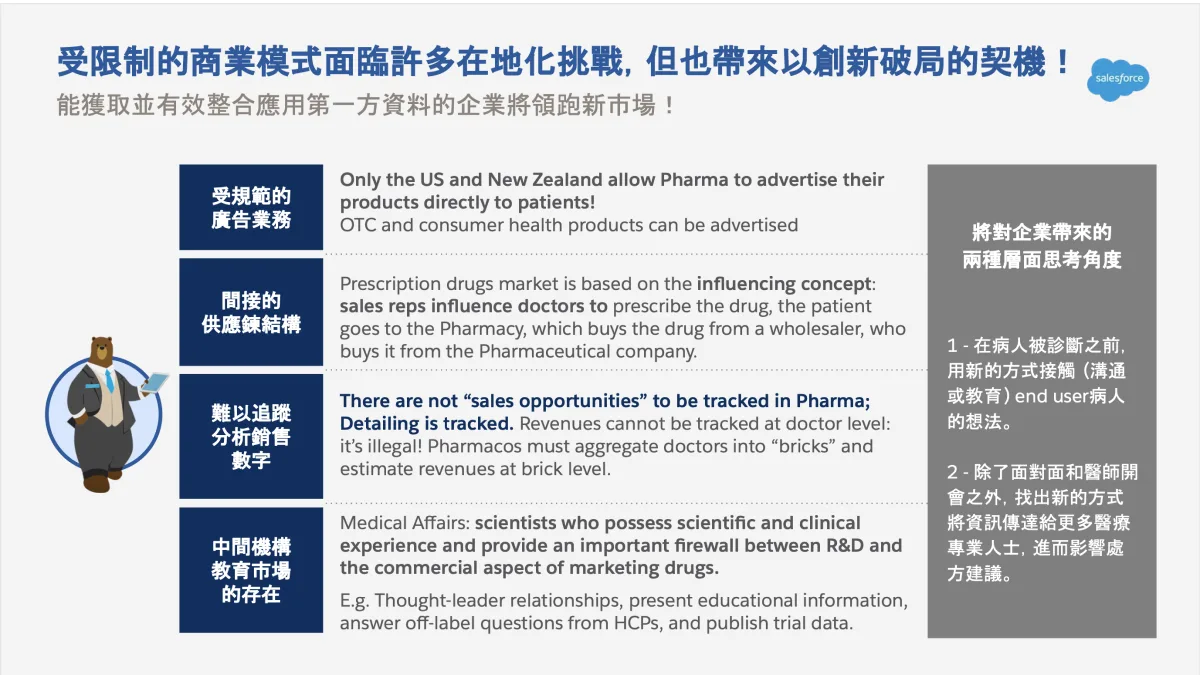
A data-driven sales process built on first-party data helps biopharma companies understand HCP preferences and market precisely
Using a pharma company’s sales process as an example, Kao noted that the journey from R&D and manufacturing to reps engaging HCPs is very long, and reps don’t sell directly. Using CRM and other digital transformation tools to consolidate all HCP data, then tailoring outreach to HCPs by region and specialty at each stage of the sales process, will be key to whether the industry can keep growing.
Key Takeaways:
Kao concluded that biopharma sales will transform in two directions. The first is digital channels: using CRM tools to consolidate all customers’ first-party data in a single platform for precise remarketing. The second is self-service, which aims to maximize market visibility and expand influence over prescribing decisions in a competitive industry. Both require more investment in digital transformation and in MarTech such as CRM and digital communication tools.
- With tighter healthcare regulations and new hybrid ways of engaging customers, sales will transform in two directions: digital channels and self-service (Marketing Automation)
- Invest more in digital transformation tools to maximize market visibility and expand influence over prescribing recommendations
- CRM is a solution built for digital transformation, creating first-party data for the business
Social CRM plus CRM: a strategy to fill the last-mile behavioral data gap
“As the most widely used messaging app in Taiwan, LINE is an excellent touchpoint for engaging customers, and it can also feed data back into your CRM,” said Lin Wei-cheng, Senior Account Executive at OakMega.
Why Social CRM?
Omni-channel communication really centers on CRM. Among all these channels, messaging apps are an excellent touchpoint with customers. Social CRM fills CRM’s inability to integrate data from messaging apps and completes the last mile of customer communication.
Build First-Party Data with Social CRM to Meet the New Digital Marketing Challenges of 2022The cookieless shift has made marketers’ jobs even harder, and 2022 is the year to find a way forward. Everyone is watching what Google and Facebook will offer. Google dropped FLoC for the Topics API, which is still in testing, and how it performs in practice remains to be seen. As the advantages of third-party cookies disappear, many brands are realizing that all their data sits in someone else’s hands: user data for FMCG and household goods belongs to retailers, advertising that long relied on cookies is becoming less and less accurate, and consumers are growing more aware of their privacy.https://oakmega.com/blog/social-crm-create-1st-party-data-solution
How to engage customers effectively through a LINE Official Account
Lin explained how Social CRM works using the example of a biopharma company that built a seminar registration flow on its LINE Official Account. He stressed that Social CRM’s tagging feature is the key to capturing different customers’ behavior. Whether it’s “clicked journals and latest news,” “contacted a sales rep five or more times,” “clicked interactive content once,” or “female,” any of this data can be used as a tag filter. By combining tags with unions and intersections, you can find active customers and re-engage them in real time.
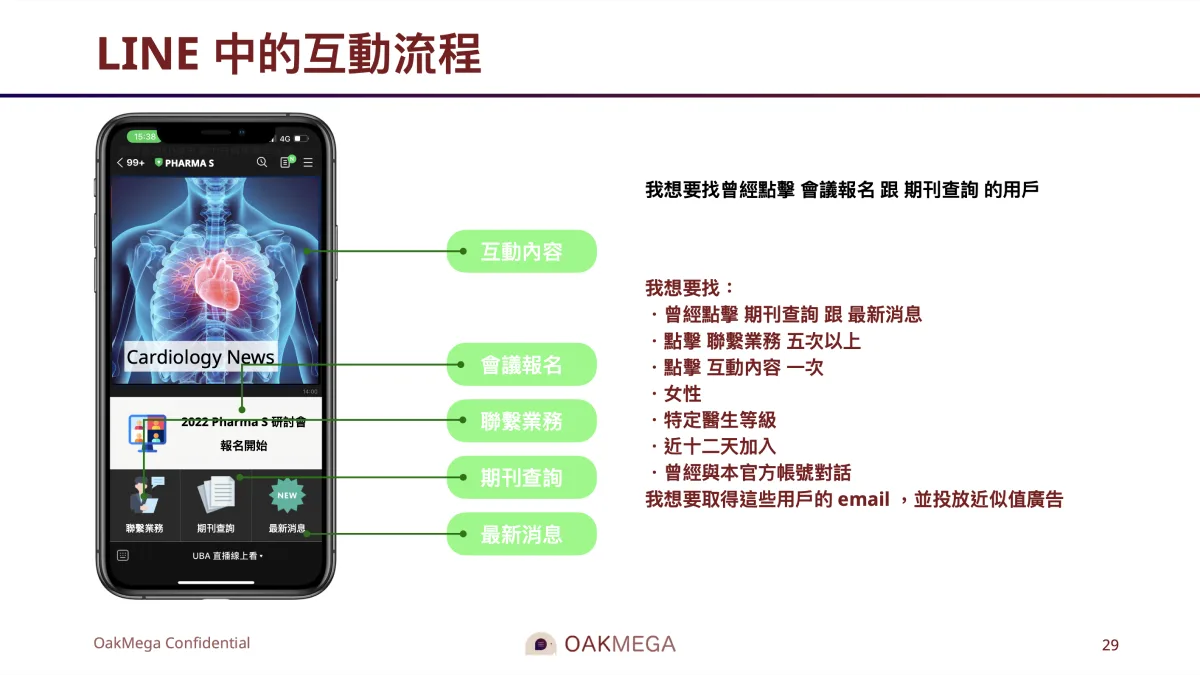
We can also break down each customer’s behavior by stage of the customer journey. Combined with Social CRM, data mining makes it possible to acquire new customers and retain existing ones.
Acquiring new customers
- HCPs add the LINE Official Account through a sales rep’s digital business card, then complete a form to verify their healthcare professional status
- An RTIM chatbot triggers exclusive healthcare messages
Retaining existing customers
- Digitize the seminar process and use tags to understand customer behavior and extend touchpoints
- Digitize gift redemption at offline drug launch events
- Offer an exclusive drug knowledge base through the LINE Official Account
Key Takeaways
Lin closed with two industry success stories. Both used LINE as the engagement entry point, with forms that automatically verify healthcare professional status so that every new friend is an HCP. They then kept engaging with soft content while collecting data, and digitized activities such as seminars. This solved the old problems of lacking channels and tools to engage HCPs and being unable to identify LINE users, keeping friend identification as high as 99% and the LINE Official Account block rate below 2%.
- LINE is an excellent touchpoint for engaging customers, and it can also feed data back into your CRM.
- Combining the customer journey with Social CRM lets you use data mining to acquire new customers and retain existing ones.
Conclusion
To learn more about Social CRM and CRM solutions for biopharma, or about the seminar content, fill out our inquiry form and a specialist will get in touch.