






Build First-Party Data with Social CRM to Meet the Digital Marketing Challenges of 2022
With third-party cookies losing their edge, many brands are realizing that their data sits in someone else's hands. For FMCG and household brands, customer data belongs to retail channels; ad targeting that has long relied on cookies keeps getting less accurate in a cookieless world; and consumers increasingly care about their privacy. Social CRM has become a key lever that helps brands own their customer data faster.
 ILING WuProduct Marketing Manager

Since the move to a cookieless web, marketers have had an even harder road. 2022 is shaping up as the year of searching for answers, and everyone is watching what Google and Facebook will offer. Google dropped FLoC in favor of the Topics API, but it is still in testing, and how it performs in practice remains to be seen.
With third-party cookies losing their edge, many brands are realizing that their data sits in someone else's hands. For FMCG and household brands, customer data belongs to retail channels. Ad targeting that has long relied on cookies keeps getting less accurate in a cookieless world, and consumers are becoming more aware of their own privacy.
How brands can keep their edge
Historically, brands have relied on a few key strengths:
- Strong brand awareness among consumers
- A large, established customer base
- A commitment to sustainability
- Iconic status
- Outstanding marketing teams
Beyond brand awareness, a large customer base means a large pool of member data, and that data is a brand's backbone. But as digital advertising grew more powerful, brand marketing came to depend on user tracking and personalized ads. Third-party cookies made it possible to pinpoint the right audiences and target ads precisely.
Once third-party cookies disappear, brands start to notice that their member data hasn't been updated in years. It is frozen at the moment a customer first filled out a form. Without third-party cookies, brands need to enrich member data with interests and keep it updated in real time, all to truly understand their customers.
Companies don't really own their data
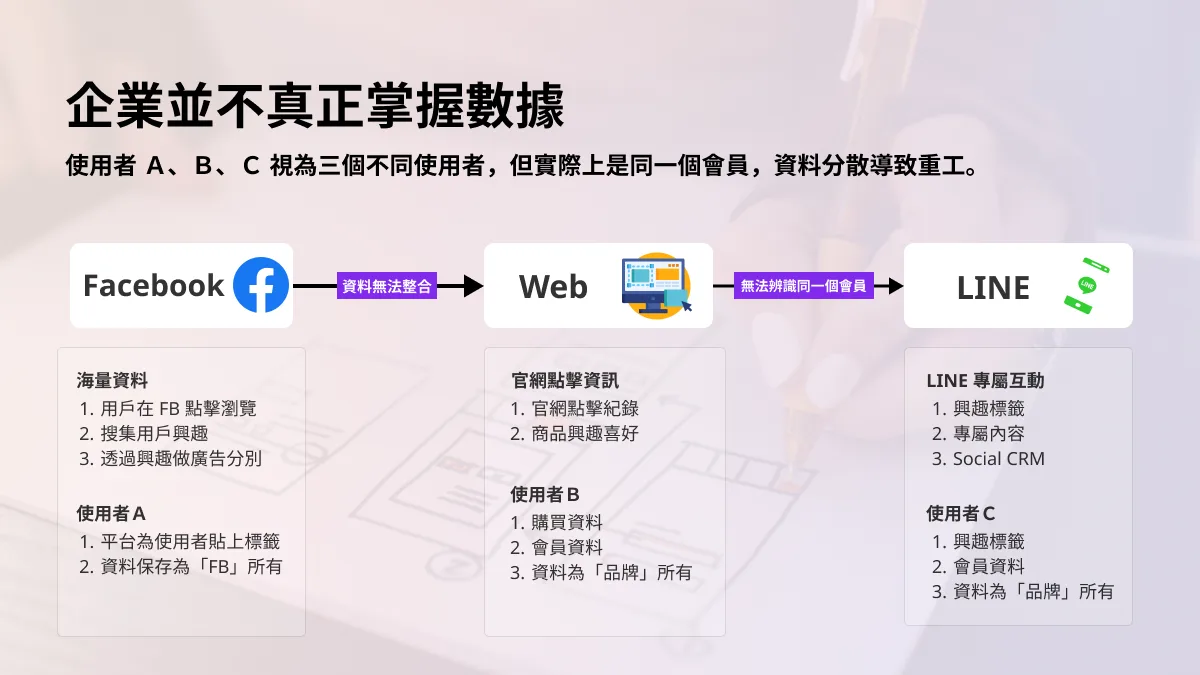
Social platforms are part of everyday life, and user data is scattered across all of them. A user sees an ad on Facebook, clicks through to a web page, and completes the purchase by logging in with LINE.
Each click along the way reveals something about the user's interests:
- Facebook: records what users click on and applies interest tags
- Brand website: records scrolling and clicks to analyze preferences and power recommendations
- LINE Login: connects consumer data and links user identities
Social CRM ties these touchpoints together. It stores Facebook interest tags in the brand's own database, uses tracking code to capture clicks on the brand website, and, once the user logs in with LINE, links their identities across platforms into a single profile.
Social CRM is both a channel and a database
Bringing data from many channels into one platform is every brand's dream, and it's exactly what a CRM helps with. Through integrations, brands take back ownership of their social platform data instead of relying on platforms' interest segments to target ads.
Owning your user data brings several benefits:
- Large brands can control massive datasets and analyze user behavior in finer detail
- Knowing user preferences lets you send customized, one-to-one messages
- You can package specific audiences for lookalike targeting on ad platforms
- You open your own communication channels and avoid being locked into a single platform
Data integration is the last mile in building the customer journey
"Everyone is competing to see who can collect more, more accurate, and faster user data." Brands, MarTech vendors, and agencies alike are all working to connect data across channels, because that is how you truly understand users and draw a clearer picture of your customers.
Say a company has 20,000 followers on LINE, 40,000 newsletter subscribers, and 30,000 member purchase records. That doesn't add up to 90,000 customers. Many of them overlap, and data integration is what identifies those overlapping users and merges them into a single record.
This member data will become a brand's strongest asset as it takes on the marketing challenges of 2022.