LINE’s 2020 Election Program Kicks Off: Why Segmentation and Group Mobilization Matter
During Taiwan’s 2018 local elections, LINE added a new “Election Zone” category to its LINE Today news channel, featuring the LINE accounts of candidates who bought the election package. With more than 70 million views, it proved how effective LINE is as an exposure point for candidates—not to mention LINE’s livestreaming, which has become a gateway to how people get news today.
 ILING WuProduct Marketing Manager
Taiwan’s 2020 presidential and legislative elections are just around the corner. So how much does running a LINE Official Account matter to these candidates’ campaigns? Let’s break it down with LINE’s own baseline numbers:
“21 million monthly active users”
“70 million+ views of the LINE Today Election Zone”
“20 times a day: how often each user opens LINE on average”
“450,000 unique viewers of the LINE Today ‘Future Mayors Speak’ livestreams”
During the 2018 local elections, LINE added a brand-new category to its LINE Today news channel, the “Election Zone,” featuring the LINE accounts of candidates who purchased the election package. Its more than 70 million views highlighted how effective LINE is as an exposure point for candidates—not to mention LINE’s livestreaming feature, which extends into the channels people now use to get news.
Reference links:
LINE TODAY reports Election Zone results: livestream viewers reach 5.8 million
Zero distance to voters! LINE officially launches its “2018 Election Program Verified Accounts”
LINE’s 21 million monthly active users already equal 89% of Taiwan’s population—far beyond the reach of traditional campaign tools like TV, radio, street billboards, flyers, and phone canvassing. In other words, LINE offers a gateway that lets anyone with information to share reach 21 million people directly through mobile, without being limited by algorithms.
Because LINE is so widely used and so sticky, a candidate today can effectively deliver their platform and ideas to voters by running just one LINE community.
Of course, a platform with lots of users is useless without real content that keeps drawing people into the channel.

Let’s start with the LINE Official Account of Taipei Mayor Ko Wen-je, which we helped run during the 2018 election, to see which tactics actually captured voters’ attention.
After connecting with Mayor Ko’s office last year, our team began by posting “good morning” images on their behalf and adjusting the posting schedule. From there, we used data to get to know the audience, observing the preferences, engagement, and activity of users across Ko Wen-je’s LINE account.
After a week of data collection, we set our top goal: increase user engagement.
Here’s why. In our experience, low engagement is a key negative indicator when running LINE. LINE doesn’t provide read-receipt data, so low engagement means the account owner has no way of knowing whether users are actually reading your platform, views, or any other messages.
With LINE Official Account 2.0 arriving, this becomes the straw that breaks the camel’s back: the less users engage, the harder it is to understand who they are—and the less effective segmentation becomes.
Once we had enough user data, our team worked closely with the Ko office’s marketing team and, in a short time, designed a chatbot module on LINE that dramatically boosted engagement.
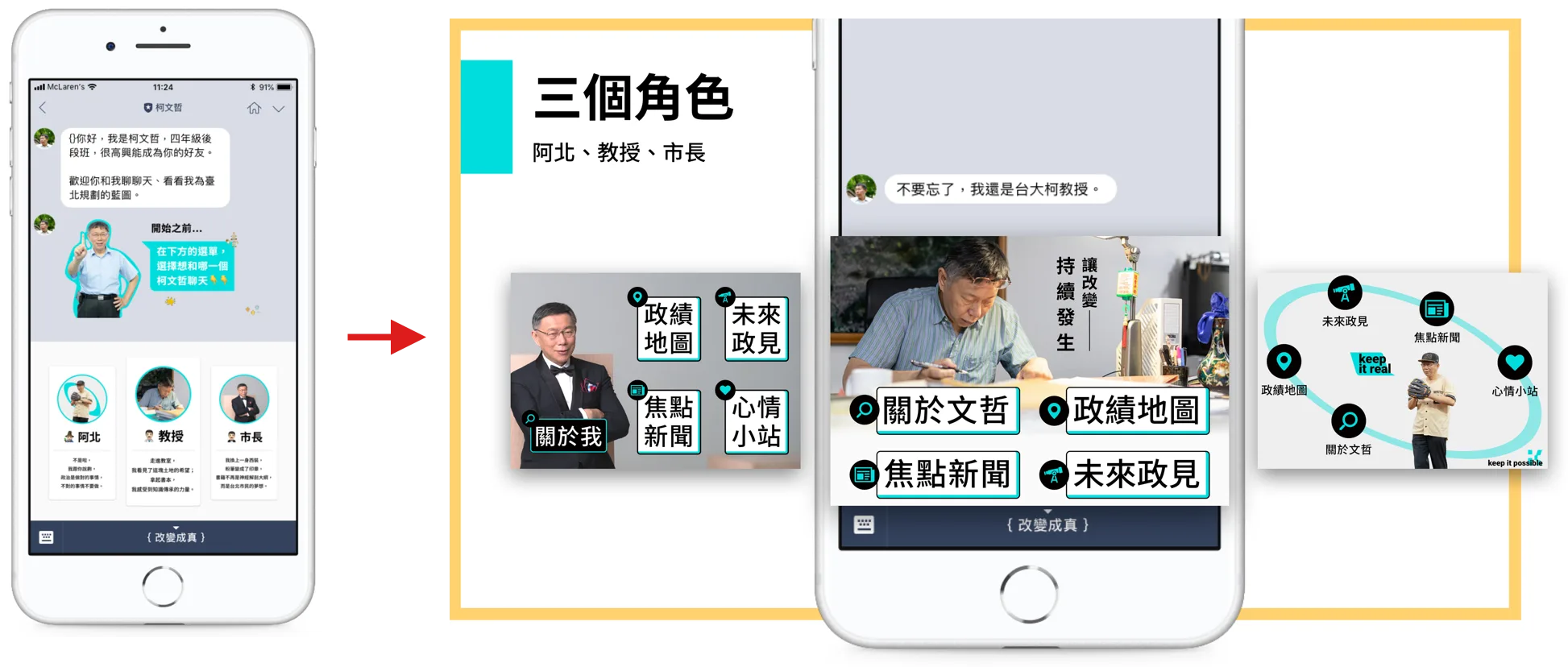
Rich menus are common by now, but they remain one of LINE’s most distinctive and hardest-to-replace features.
They clearly show users what basic information and services an account offers, and they can kick off chatbot conversations by typing on the user’s behalf.
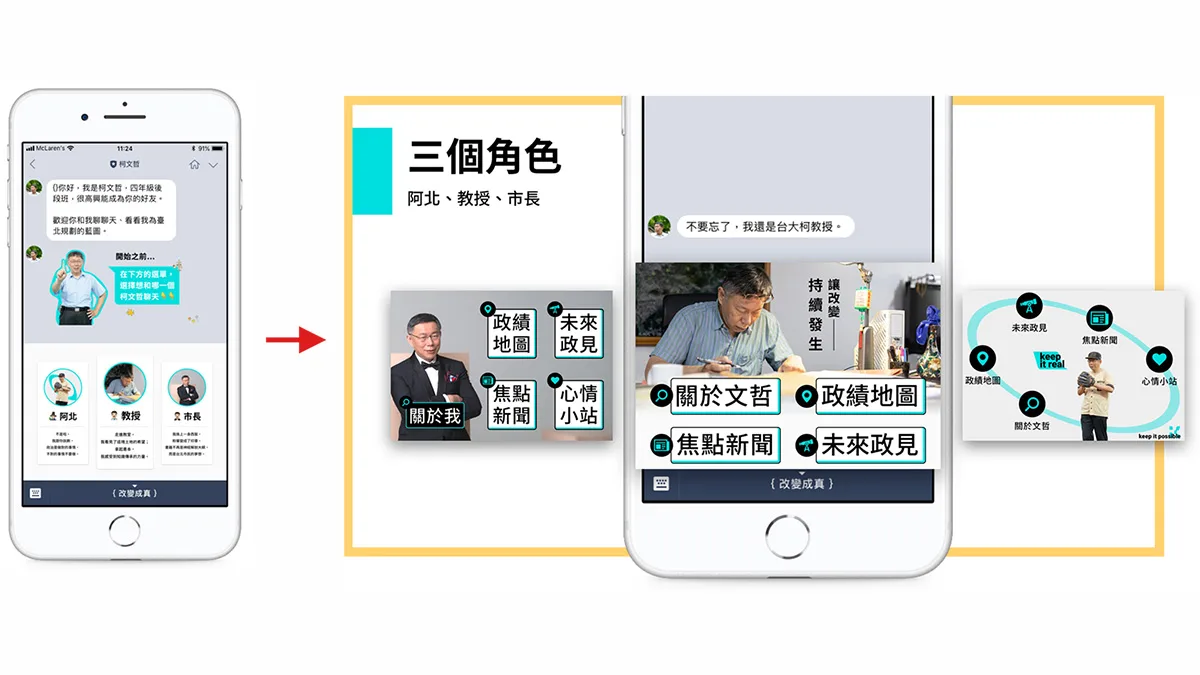
When users added Ko Wen-je’s LINE account, they could use the rich menu to choose which version of Mayor Ko they wanted to talk to.
We designed three chatbots representing different sides of Ko Wen-je: “A-Pei” (the folksy uncle), the “Professor,” and the “Mayor.” Once users picked their favorite persona, the system automatically switched them to the matching chatbot and showed a completely different rich menu.
Each of the three chatbots—A-Pei, the Professor, and the Mayor—had its own vocabulary. Their tone and answers differed based on each character’s script, so whether you wanted a witty, humorous, laid-back, or serious Mayor Ko, one of the three bots had you covered.
We used vector-matching semantic analysis to sharply cut chatbot training time, and we continuously analyzed the messages users sent to expand the dialogue library—instead of letting the system generate replies on its own. All these checks were in place to ensure there would be no gaffes, which is critical for a candidate’s community.
During the project, the chatbot replied to nearly 90% of all messages (on a matching score where 1 is perfect, it replied to anything scoring 0.5 or higher)
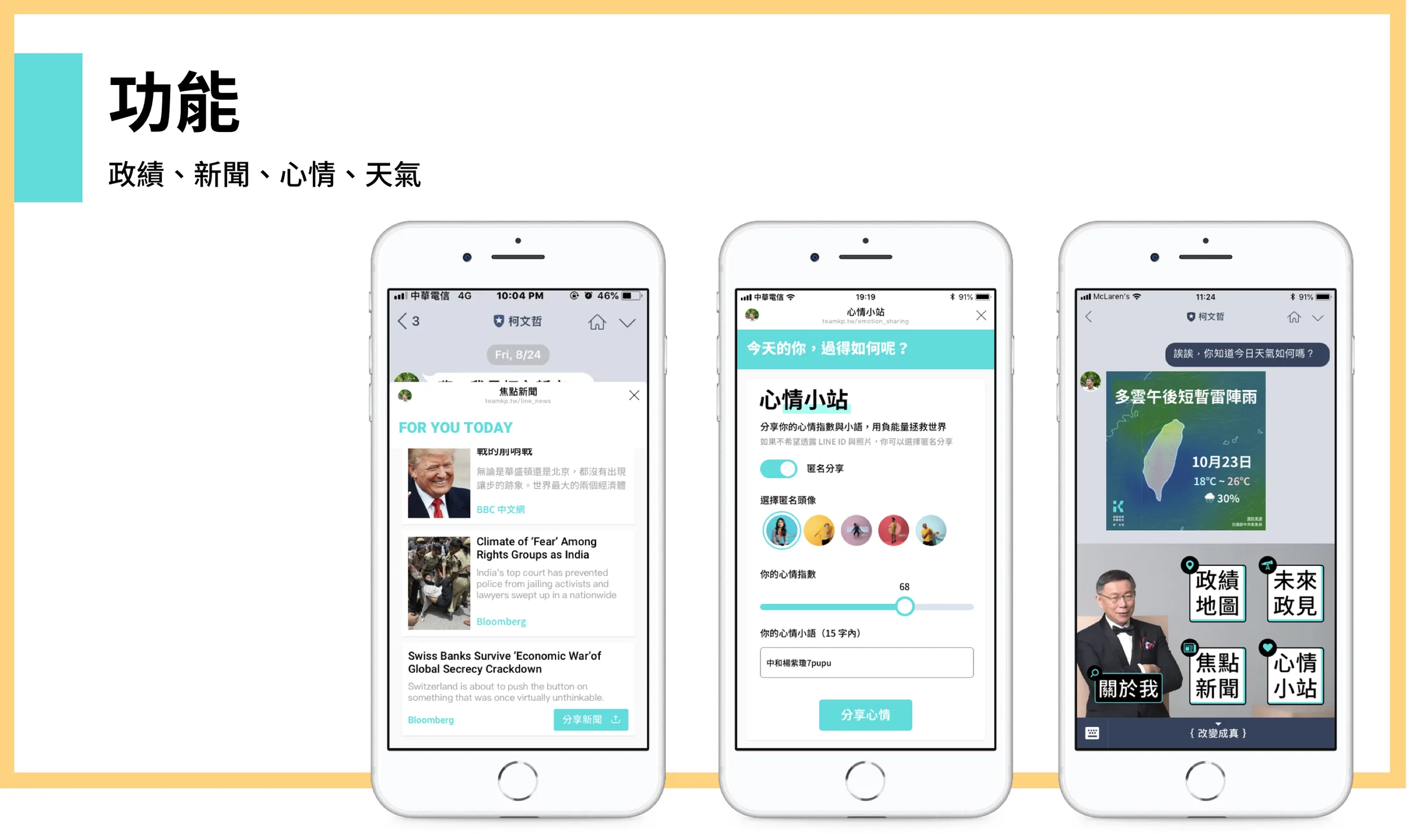
We also added many public services and interactive features to Ko Wen-je’s LINE account, such as “Top News,” “Mood Corner,” “Achievements Map,” and “Weather.” Just by following the account, users could easily access everyday services and see the candidate’s platform more transparently—strengthening stickiness and sparking engagement.
So what’s the point of constantly pushing engagement higher?
During the two-month project (9/24–11/25), Ko Wen-je’s LINE election account saw:
Its subsequent block rate cut in half,
Daily active users up 40x,
And total engagement reach the millions.
So what’s the point of constantly pushing engagement higher?
As mentioned earlier, LINE doesn’t provide read-receipt data. When engagement is low, you can’t measure how well your community management is working—that is, how many people actually read each post you publish.
A chatbot gets users to interact with the ideas in the account owner’s head in a fun, two-way format, so they come away with plenty of information while generating buzz along the way.
As engagement rises, the community comes alive and grows faster, and the block rate falls. And if users get enough information from the LINE community and stay because they’re engaged, you can gradually lead them to get to know the candidate in depth, embrace their ideas, grow the pool of potential supporters, and even motivate them to actually go out and vote.
Back to running Ko Wen-je’s LINE account.
Once engagement went up, every content-driven effort had a solid basis, and we could start reinforcing other campaign strategies. At the time, the social campaign had two strategies: “lock in young supporters” and “get out the vote.”
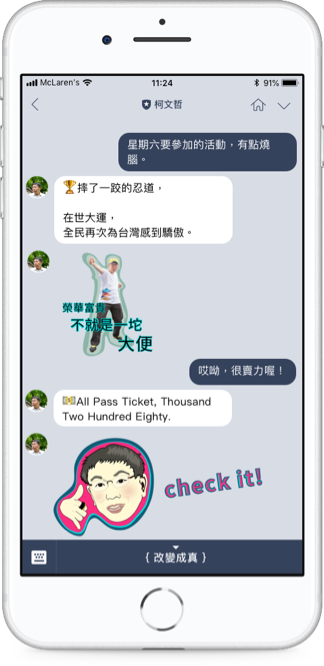
To lock in young supporters, the Ko office boldly tried two ideas: “policy rap” and “platform livestreams.”
Our team added plenty of creative touches here too—for example, late at night the chatbot automatically switched to rap mode.
Whenever users sent a message, in Chinese or English, the chatbot replied with policy content in matching rhymes.
We also created a series of Ko Wen-je character stickers for use in posts and chatbot replies, making the LINE account more memorable.
Many users messaged us asking how to get the sticker set. Unfortunately, we had designed and used the stickers as images, and they were never released for sale.
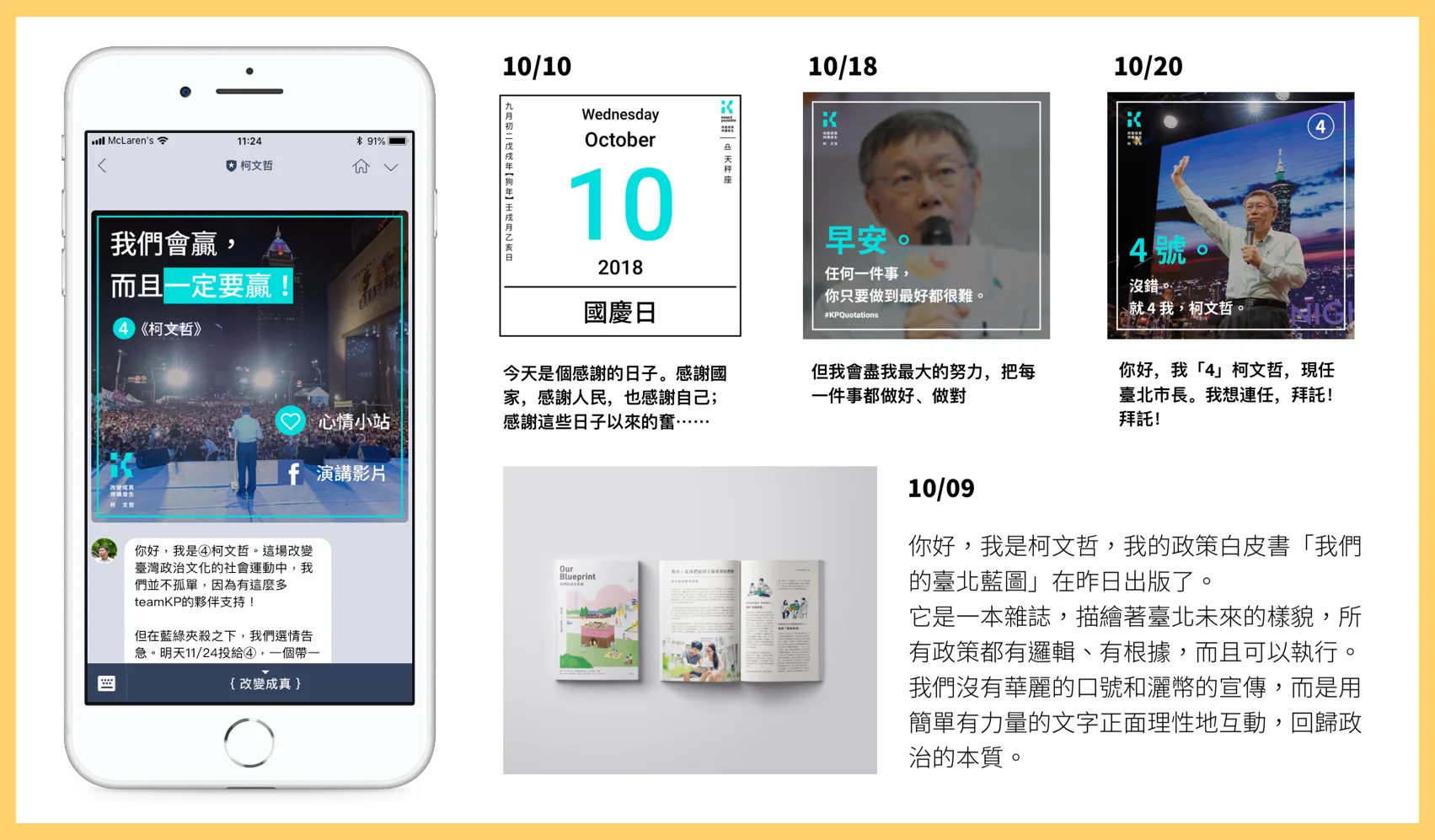
Beyond that, imagemap posters packed with calls to action, along with strong copy, were a mainstay. Unlike the cluttered visuals of traditional campaigns, they didn’t just provide a link—users could tap the poster itself to jump into a livestream or open a web page. All of this further boosted users’ willingness to engage.
We also kept adjusting posting frequency and timing to match users’ peak hours, and worked with the Ko office to use more videos, explainer graphics, and policy quiz giveaways—keeping key audiences’ attention and encouraging supporters to move from online to offline and actually go vote.
Further reading: You might also enjoy this lighter take on the Ko Wen-je chatbot.
That wraps up the Ko Wen-je case. With the 2020 election approaching, how can campaigns apply these lessons, spot opportunities early in their community data, and gain solid footing?
1. Segmentation
We expect this year’s election program to use LINE Official Account 2.0 pricing directly, so broadcasting to every follower will inevitably get expensive. The best way out is to send customized messages to segments based precisely on user preferences.
“The better you understand your potential supporters and meet their need for relevant content, the better your chances of turning online buzz into real votes.”
2. Group mobilization
Plenty of candidates have satellite supporter groups. If you can keep a close eye on these groups and post local, supportive, and mobilizing messages to them, you can strengthen your existing base (your grassroots organizers) while also reaching opinion leaders in those groups—growing your pool of potential supporters.
That’s on top of the obvious: user-friendly visual design, a variety of LINE message formats, chatbots, in-depth user messaging, and cross-platform behavioral data analysis.
LINE communities have already changed the traditional campaign landscape. Think of a LINE community as a platform that integrates GUI and CUI. (Note: graphical user interface and conversational user interface)
Beyond enabling “precise ad targeting” and “building the owner’s image,” it lets “AI customer service and human agents” work side by side, and makes it possible to offer more “constituent services.”
Want to see what OakMega can bring to your campaign? Feel free to leave a comment or contact us.