




LINE MINI App: The Last Moat for Taiwanese Brands Building Private Traffic
A LINE MINI App is a lightweight app that runs right inside LINE with no download, giving brands their own service entry point on the messaging platform where users spend the most time. In October 2025, LINE opened the platform to all, adding in-app payments and ad revenue sharing and kicking off a new phase of private traffic competition in Taiwan. For brands still relying on paid ads to buy traffic, this window is closing — and integrating a Social CRM is what turns a MINI App from an entry point into a flywheel.
 MarketingTeam
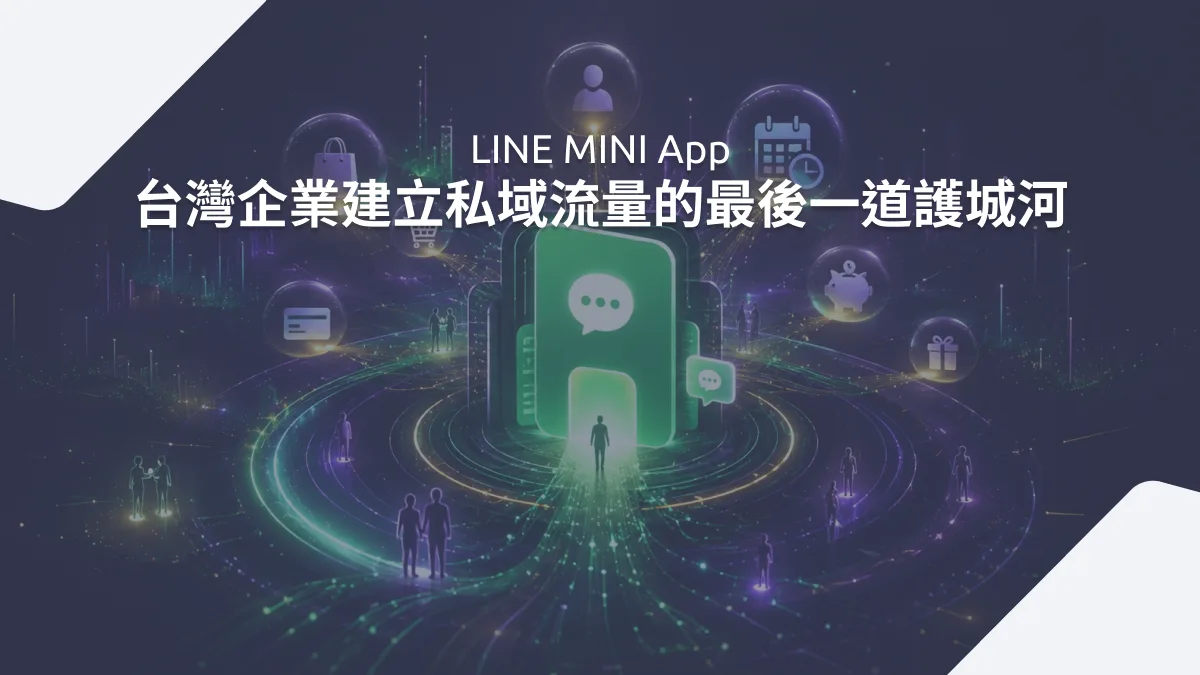
A LINE MINI App lets brands capture LINE User IDs on the platform that 22 million monthly active users in Taiwan open every day, build private traffic assets, and send personalized notifications for free through Service Messages. Since LINE fully opened the platform in October 2025, early movers have been building a moat of behavioral data that latecomers will struggle to replicate — and the most effective way to get started is to design a campaign that ignites traffic, rather than waiting passively for users to wander in.
Key Takeaways
- With 22 million monthly active users and 93% penetration in Taiwan, LINE is the only marketing platform where you never have to convince users to download anything
- A LINE MINI App gives brands access to LINE User IDs, building private traffic assets that don't depend on ads
- Service Messages let brands send triggered notifications for free, slashing communication costs
- Since the platform opened in October 2025, early movers have been building a data moat that latecomers will find hard to close
- Social CRM is the back-end engine that turns LINE MINI App data into a repeat-purchase flywheel
Contents
- Downloads Are Killing Your Conversion Rate
- What a LINE MINI App Is, and Why Now Is the Time to Move
- Free Notifications Are the Most Underrated Weapon
- Campaign Ignition: The Right Way to Open Up MINI App Traffic
- The Private Traffic Moat: First to Build, First to Win
- FAQ
Downloads Are Killing Your Conversion Rate
The marketing director of a Taiwanese restaurant chain once shared the story of the brand app they had just launched after three months and more than NT$2 million in spending. It passed 10,000 downloads in its first month. That sounds good, but she wasn't smiling. “Over 60% of people deleted it within a month,” she said. “Maybe fewer than a thousand are still using it. We basically paid NT$2 million for a thousand users.”
This isn't an outlier. It's a snapshot of the brand app ecosystem in Taiwan. According to AppsFlyer research, average 30-day retention for apps worldwide is below 30%, and Taiwanese consumers are even less tolerant of apps they don't truly need. Phone storage is limited, notifications feel intrusive, and brand apps are usually the first to get cleared out. The problem isn't the marketing budget. It's the medium itself.
The act of “downloading” is one of the highest-friction touchpoints between a brand and a consumer.
Asking consumers to install an app means asking them to pay up front in time, storage space, and trust before they get a single service experience. That logic may have worked a decade ago. But in a market where the number of apps installed on the average Taiwanese phone has plateaued, and people actively use no more than ten apps a day, there's almost no room left for newcomers.
So the real question is: if an app isn't the right vehicle, what is?
What a LINE MINI App Is, and Why Now Is the Time to Move
If you're looking for a platform in Taiwan that consumers open almost every day and that you never have to convince them to install, there's only one answer: LINE. It has 22 million monthly active users in Taiwan and 93% to 94% penetration, covering Taiwanese adults of nearly every age group. This isn't a “promising channel.” It's a reality where consumers are already there and brands haven't caught up.
Private traffic refers to customer communication channels that a brand owns directly and that aren't controlled by third-party platform algorithms, such as member lists, LINE User IDs, or email lists. Compared with “public traffic” that depends on paid ads, private traffic has two core advantages: communication costs approach zero, and the data belongs entirely to the brand. Social CRM (social customer relationship management) is a system that brings together social platform user data, behavioral journeys, and marketing automation, so brands can respond to individual users with precise, real-time communication.
The core idea of a LINE MINI App is to run a lightweight service interface directly inside LINE. Users don't download anything, don't switch apps, and don't log in separately. Brands can build ordering systems, member centers, booking tools, loyalty cards, and checkout flows on it. Almost anything a brand app can do, a LINE MINI App can do too — and it closes the loop entirely within the LINE ecosystem.
Even more important, brands get the LINE User ID of every user who opens their MINI App. It's an authentic identifier that can't be faked. It isn't an anonymous cookie or an email address someone might make up. It's a unique identifier tied directly to that person's LINE account, and it's the foundation for all downstream membership management, behavior tracking, and precision remarketing.
In the Taiwanese market, the LINE User ID is the digital identifier closest to a “real identity.” Once a brand has it, it can talk to customers directly without depending on ad platforms.
The 2025 Open Platform Shift: Not Just a Tech Upgrade, but a Ticket Into the Ecosystem
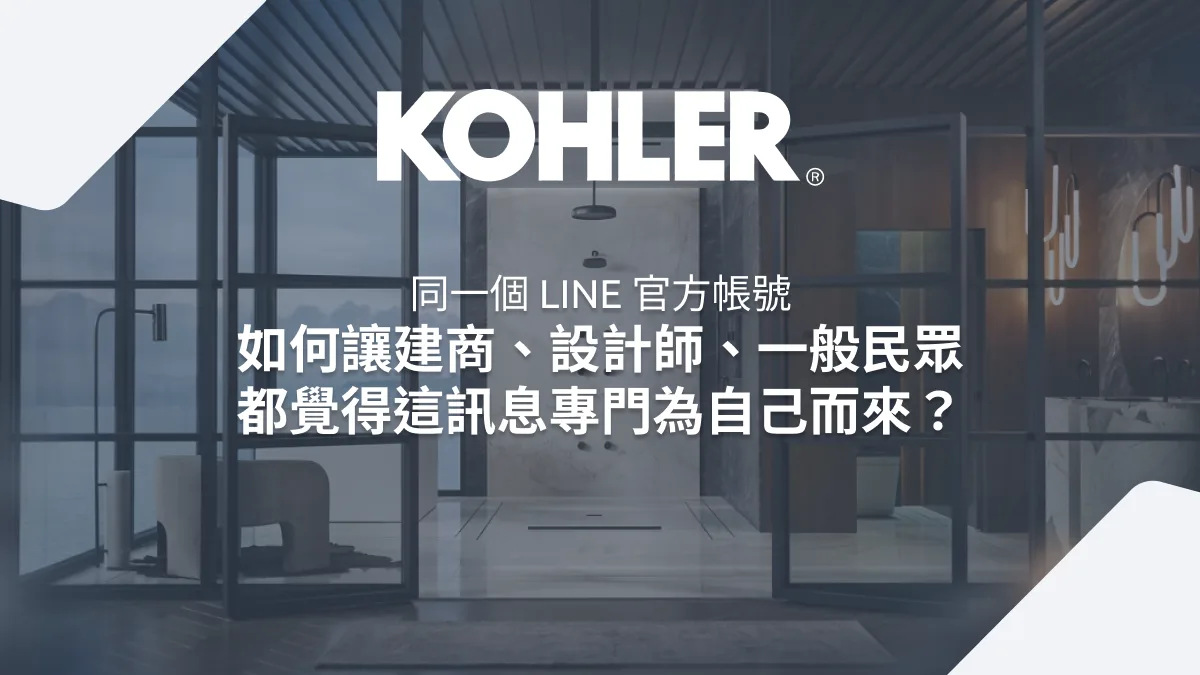
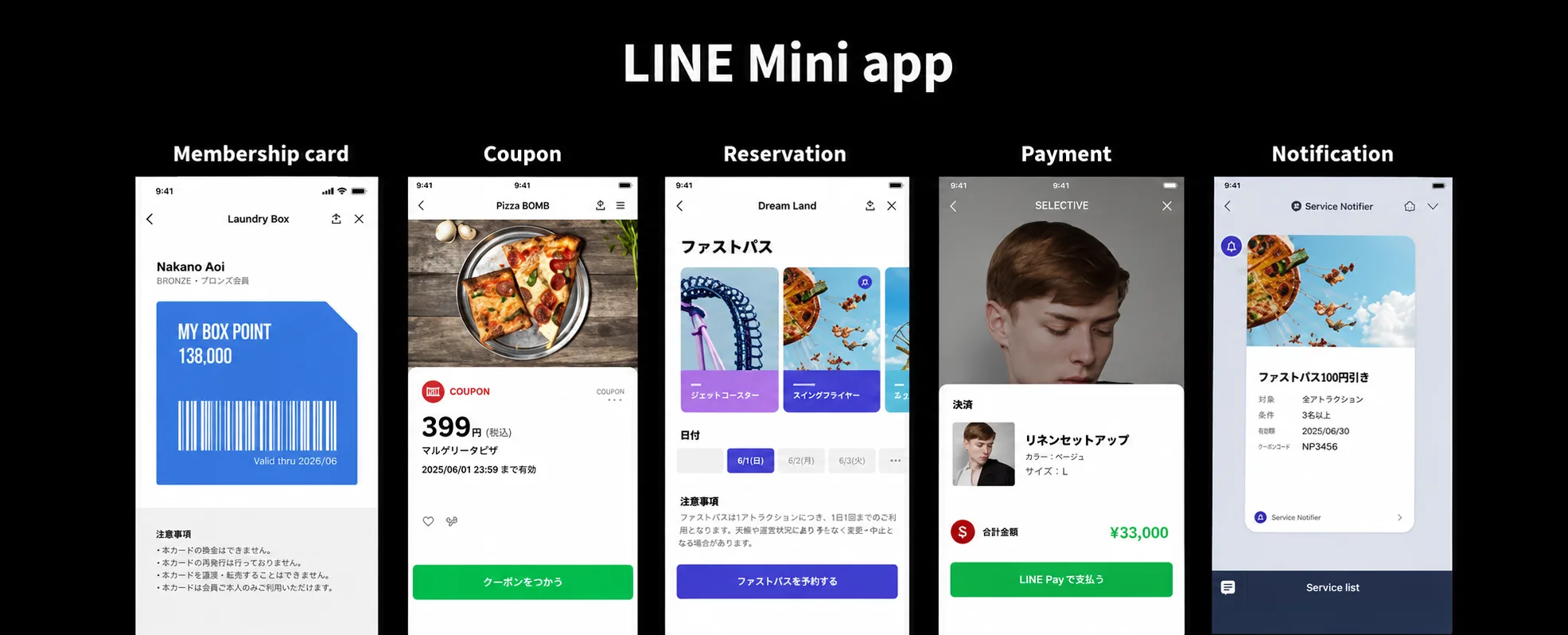 In a market with 93% LINE penetration, brands are building a private traffic moat inside the LINE ecosystem that will be hard to catch up with. Source
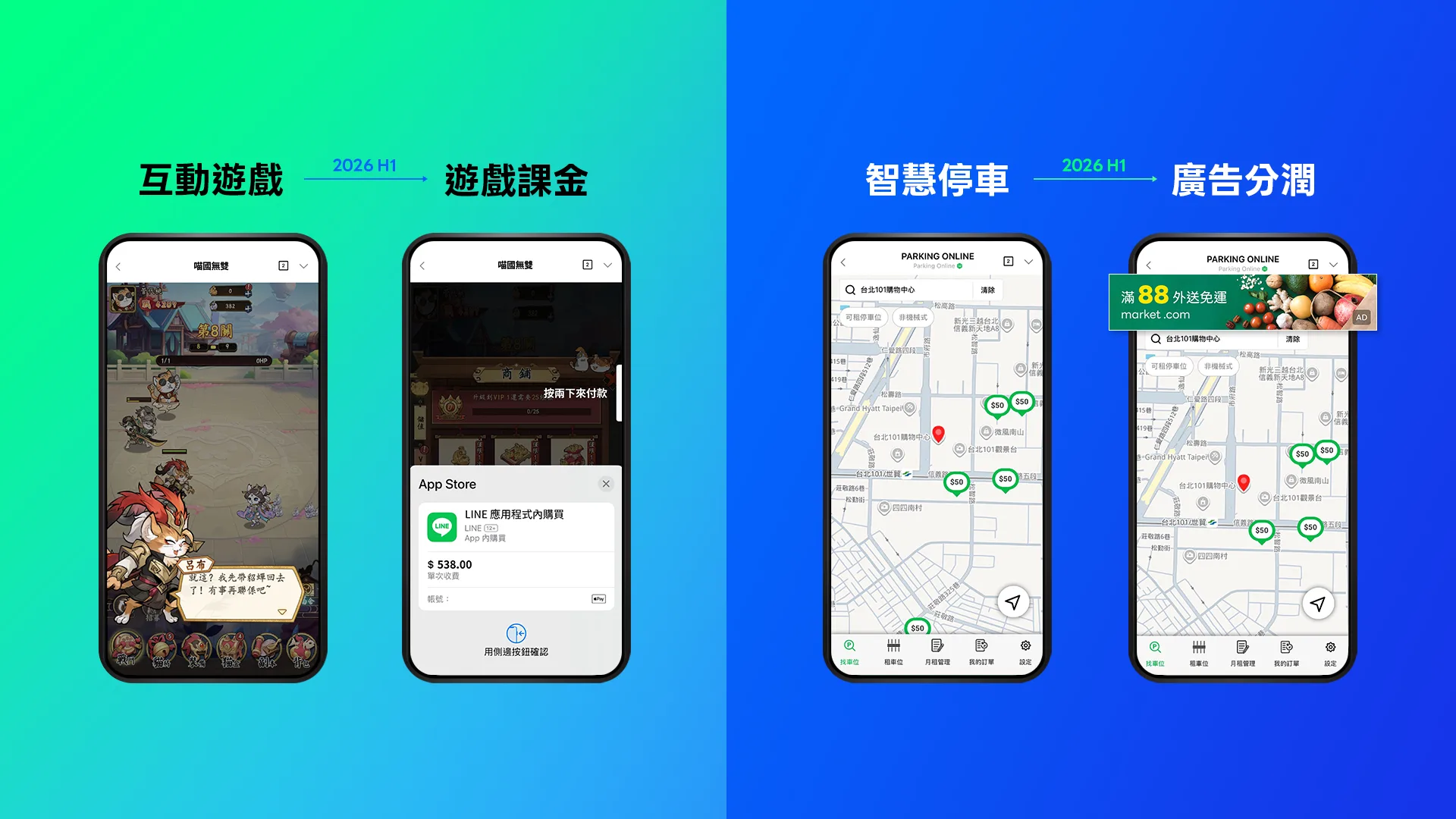
In October 2025, LINE officially announced that MINI App would become a fully open platform. Any brand can now apply to join without going through whitelist approval from an official LINE partner. Two key mechanisms launched alongside it: in-app payments (IAP), which let brands complete transactions directly inside their MINI App, and ad revenue sharing, which lets brands that hit traffic thresholds earn extra income from ad impressions.
The significance of this timing isn't just that the technology is now open. It's that early movers will accumulate data assets that latecomers will struggle to replicate. Every user who enters a brand's MINI App, every click, and every transaction adds to its behavioral data. Three or six months from now, that data will give early brands far more precise audience segmentation than competitors who are just getting started.
LINE Touch NFC: Turning Physical Locations Into Private Traffic Entry Points
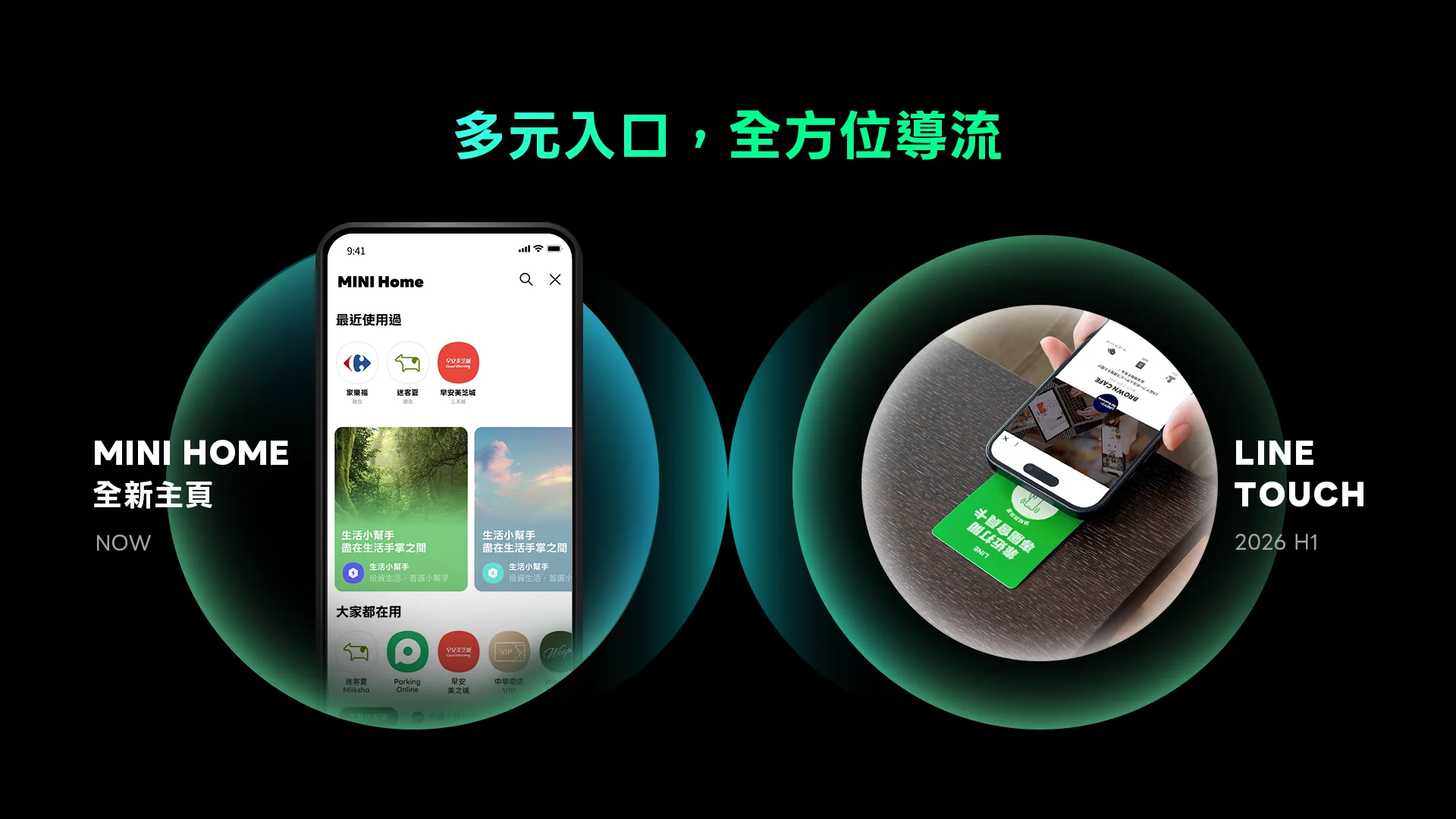
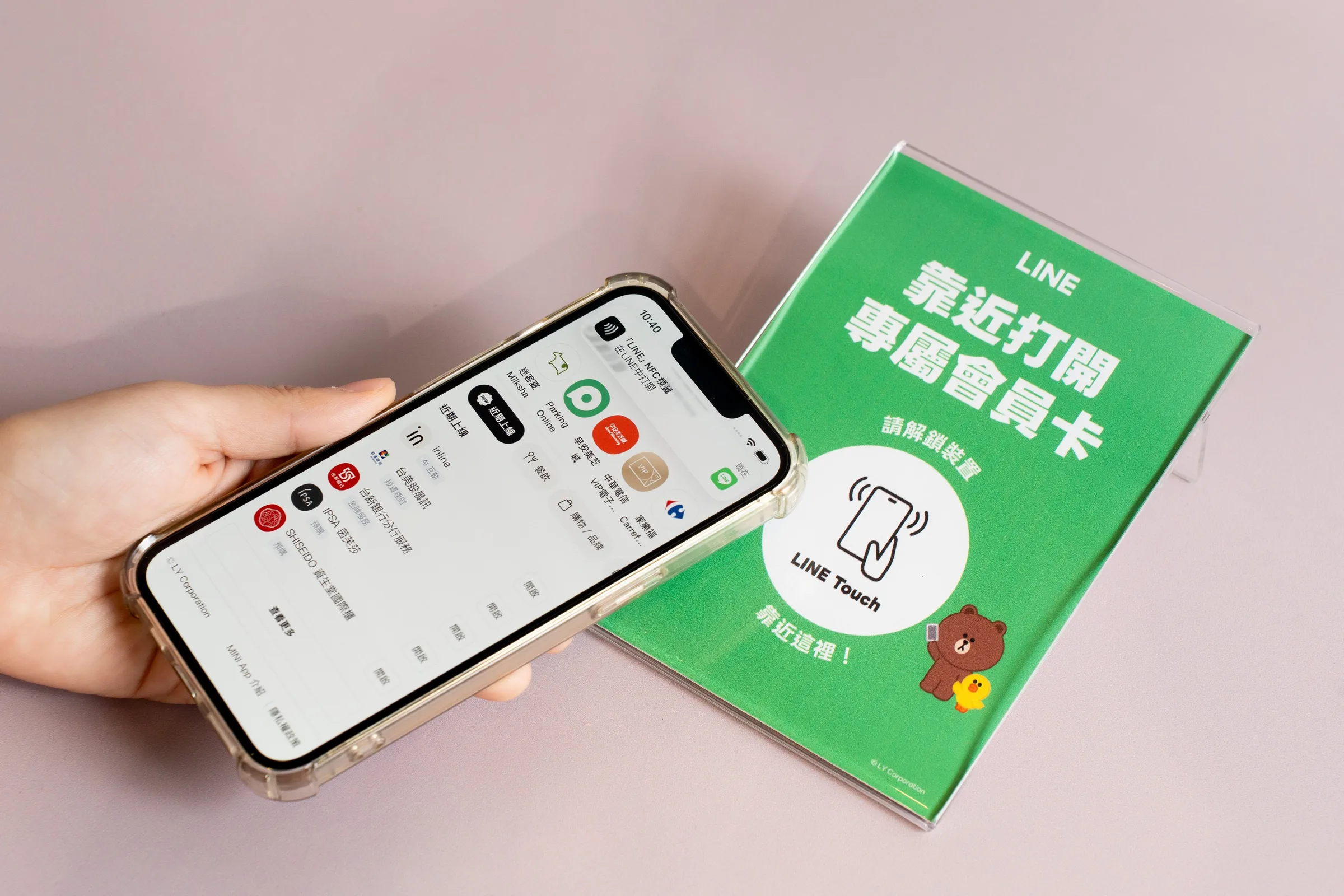
LINE Touch NFC hardware, expected to launch in the first half of 2026, is another signal worth preparing for early. Users simply tap their phone on an NFC device to launch a MINI App directly, with no QR code to scan and no brand account to search for. That means any physical touchpoint — a store checkout counter, a restaurant table, a gym entrance — can become a funnel into a brand's private traffic.
 Source
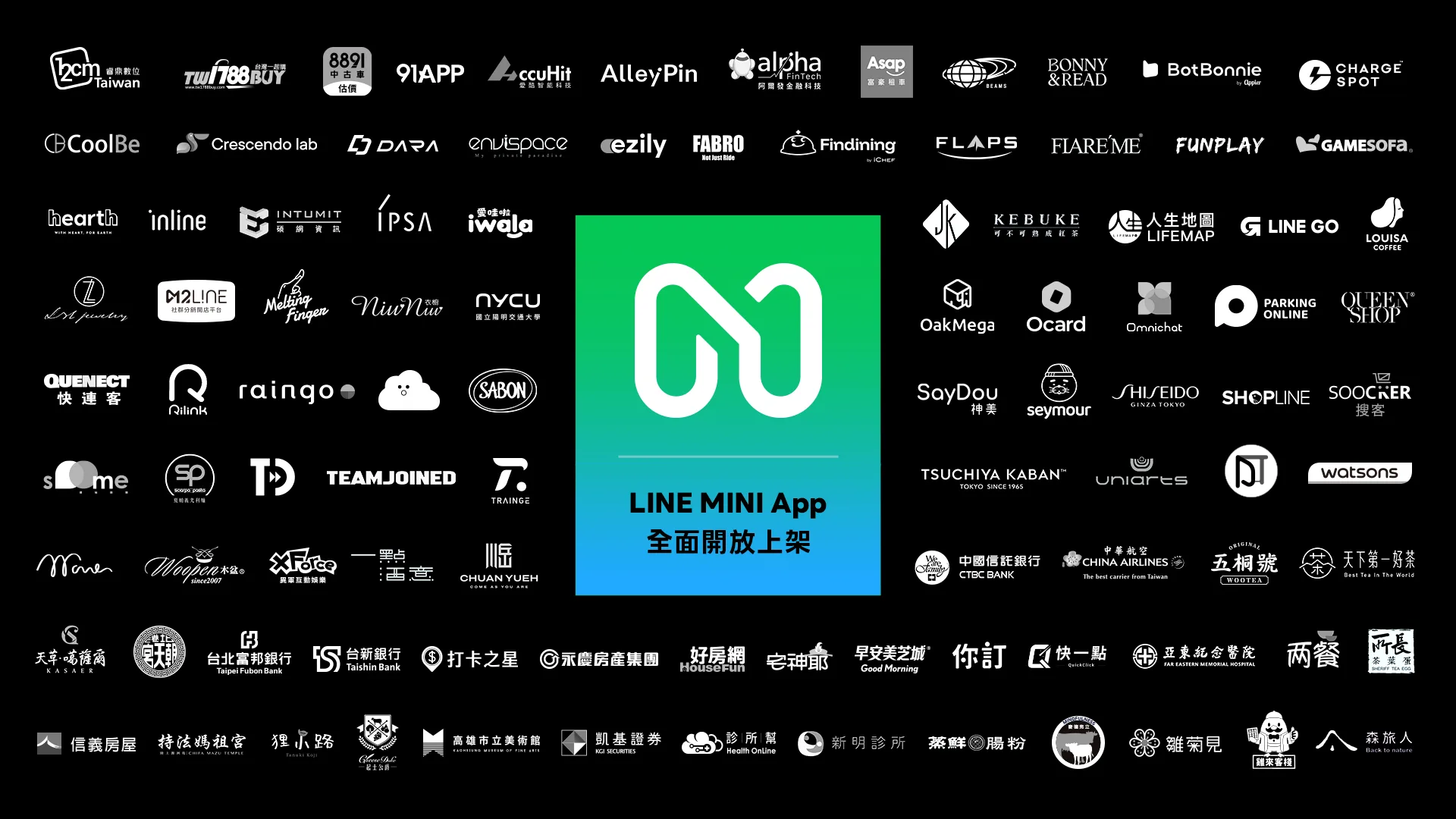
More than 100 Taiwanese brands have already deployed MINI Apps, and some nearly doubled their daily active users (DAU) in the first month after launch. Compared with the average retention of brand apps in Taiwan, that's almost an anomaly — and the reason for the anomaly is that it never asks users to do the high-friction work of downloading.
Three Steps to Launch Your LINE MINI App Private Traffic Strategy
- Apply for a MINI App developer account: Apply through the LINE Developers Console. You'll need an active LINE Official Account and completed business verification.
- Design a member authorization flow to capture LINE User IDs: When users first enter the MINI App, guide them through one-tap LINE account authorization so the brand obtains their unique LINE User ID.
- Connect a Social CRM and launch automated marketing: Feed User IDs and behavioral data into a Social CRM system, build audience segments and automated marketing journeys, and turn every data point into precise communication.
Free Notifications Are the Most Underrated Weapon
When brands evaluate the ROI of a LINE MINI App, most focus on “development cost” and “feature completeness.” That's a blind spot. What really belongs on the other side of the scale is the near-zero communication cost made possible by Service Messages.
Taiwanese brands marketing through LINE Official Accounts share a pain point almost everyone knows: pay-per-message pricing. Every broadcast costs money, and the more you send, the more you pay. Brands get stuck in a dilemma: send more and it hurts the budget, send less and you lose touch. This structural cost anxiety directly limits how often brands communicate and how personalized they can be.
Pay-per-message pricing has pushed Taiwanese brands' LINE strategies from “precise personalization” back to a defensive stance of “send as little as possible, and make every message count.”
 Source
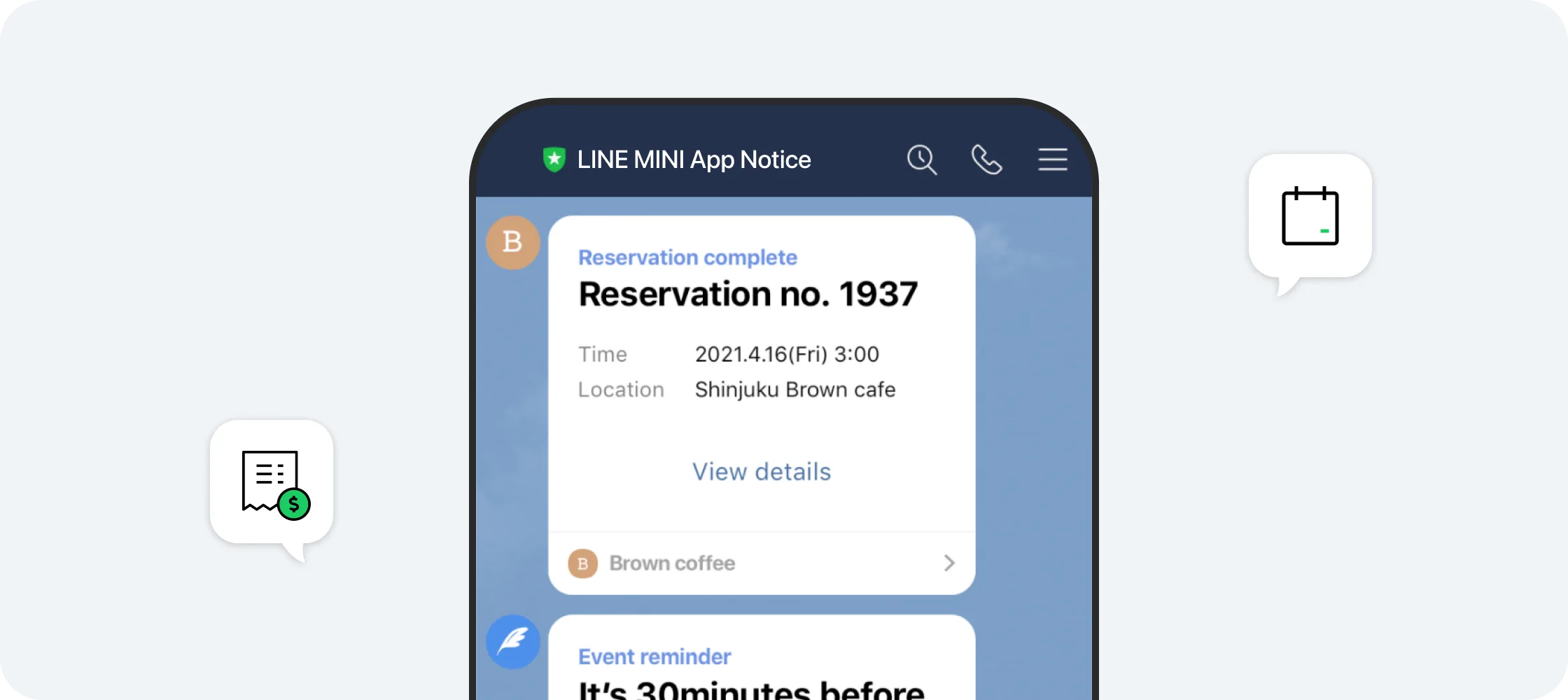
The MINI App Service Message mechanism breaks this logic. When a user takes a specific action inside a MINI App — completing an order, joining as a member, booking a service — the brand earns permission to send that user service notifications, and those notifications are free. Order confirmations, pickup reminders, points-expiry alerts, and personalized offers can all be sent for free, as long as the user has given permission.
This isn't a small change. It's a shift at the business-model level. Brands go from “buying usage of a messaging channel” to “building a private communication channel with high intent and high open rates.”
WeChat Mini Programs Already Offer a Cautionary Tale — But Read the Whole Story
WeChat Mini Programs officially launched in China in January 2017. It wasn't just a tech event. It was a historic moment when a platform completely reshaped the balance of power in a market. WeChat already covered messaging, payments (WeChat Pay), and content (Official Accounts). Mini Programs let it swallow “app discovery and usage” too, replacing Baidu as the gateway to services through social sharing and QR codes. Brands that built private traffic pools early, in 2017 and 2018 — Starbucks, McDonald's, and major retail chains — are still reaping the compounding returns today: precise user data, low-cost personalized communication, and repeat-purchase rates they can sustain without public ad spend.
But LINE isn't WeChat.
WeChat could build a Mini Program ecosystem because it became a super app covering every part of daily life. It now has more than 4.3 million Mini Programs, with games accounting for as much as 42% of users and lifestyle services 28% of traffic, so traffic flows in naturally. In Taiwan, LINE is still fundamentally a messaging platform. Google is the gateway to search, credit cards are still the main payment method, and LINE hasn't replaced any existing service layer, nor does it have a gaming ecosystem driving organic daily traffic.
Taiwan currently has about a hundred brands on MINI App, and none of them has built a habit of users opening it naturally every day. That means one thing: just building an entry point isn't enough.
Taiwan's LINE MINI App ecosystem is right where WeChat Mini Programs were at the starting line in 2017. The open platform has only just landed, early brands haven't built their data moats very high yet, and latecomers still have a shot. But to make a MINI App actually drive traffic instead of becoming a forgotten shell, brands need a mechanism that actively brings users in.
Campaign Ignition: The Right Way to Open Up MINI App Traffic
The most common way a brand Mini App dies isn't poor features. It's that nobody has a reason to open it.
Turn an ordering system, member card, or booking interface into a MINI App, and users might come in the first time for a discount. But then what? With nothing new and no reason to open it, it ends up just like a brand app: forgotten in a corner of the phone. Much of WeChat Mini Programs' high daily activity comes from games and high-frequency lifestyle services (ride-hailing, food delivery) — a foundation that service-oriented brand MINI Apps can't replicate.
The Taiwanese market has already proven a completely different approach: campaign-driven traffic.
 Source
Instead of building an “always-on service entry point,” use a shareable campaign to bring users into the MINI App, capture their LINE User IDs and segment tags along the way, and then let precise back-end messaging turn one-time participants into long-term members. Traffic doesn't come from waiting. It comes from using the right hook.
The right way to run a Mini App isn't to wait for users to find you. It's to bring them in with a campaign worth sharing, capture their IDs, and let Social CRM turn that single touchpoint into a long-term relationship.
Two case studies show how this works:
KKBOX Music Personality Quiz
KKBOX built a quiz around music listening behavior that sorts users into four music personalities, each with matching song recommendations and listening suggestions. It's more than a fun quiz: while collecting LINE User IDs, it also tags every user with their musical taste.
Follow-up messages are no longer broadcasts. Instead, they say something like, “You're the late-night jazz type. This playlist is for you.” From quiz result to play button, personalization shortens the entire conversion path — users don't feel like they're seeing an ad, but a recommendation from someone who really gets them.
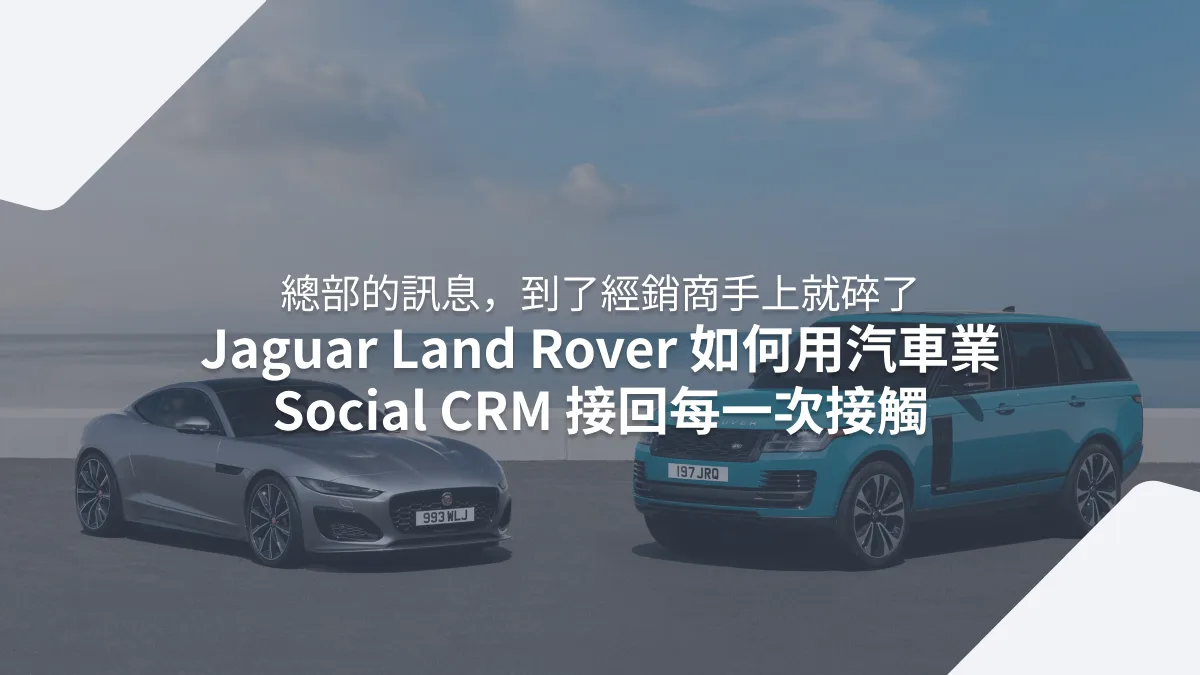
Pao Chia United: Routing Audiences Across Four Stellantis Brands
Pao Chia United distributes four brands in Taiwan — Jeep, Alfa Romeo, Peugeot, and Citroën. Its marketing challenge: when a potential buyer comes in, you don't know which brand's audience they belong to.
The solution was a personality quiz that routes users by brand. The questions surface preferences for “driving feel, design aesthetics, adventurous spirit, and urban style,” then direct each user to the matching brand, with all follow-up messaging segmented by brand from that point on. Audience pools for all four brands are built at once from a single campaign entry point, and the next message each person receives isn't a generic ad but the model that matches their own preferences.
The Essence of a Campaign: Using a One-Time Event to Earn Long-Term Communication Rights
Both cases share the same logic: treat the MINI App as an audience identification machine. Users come in to take part in a fun, shareable activity; the brand captures their IDs and segments them along the way; then Social CRM takes over, turning that single touchpoint into the starting point for all future precise communication.
The Mini App opens the door, the campaign brings people in, and Social CRM makes them stay.
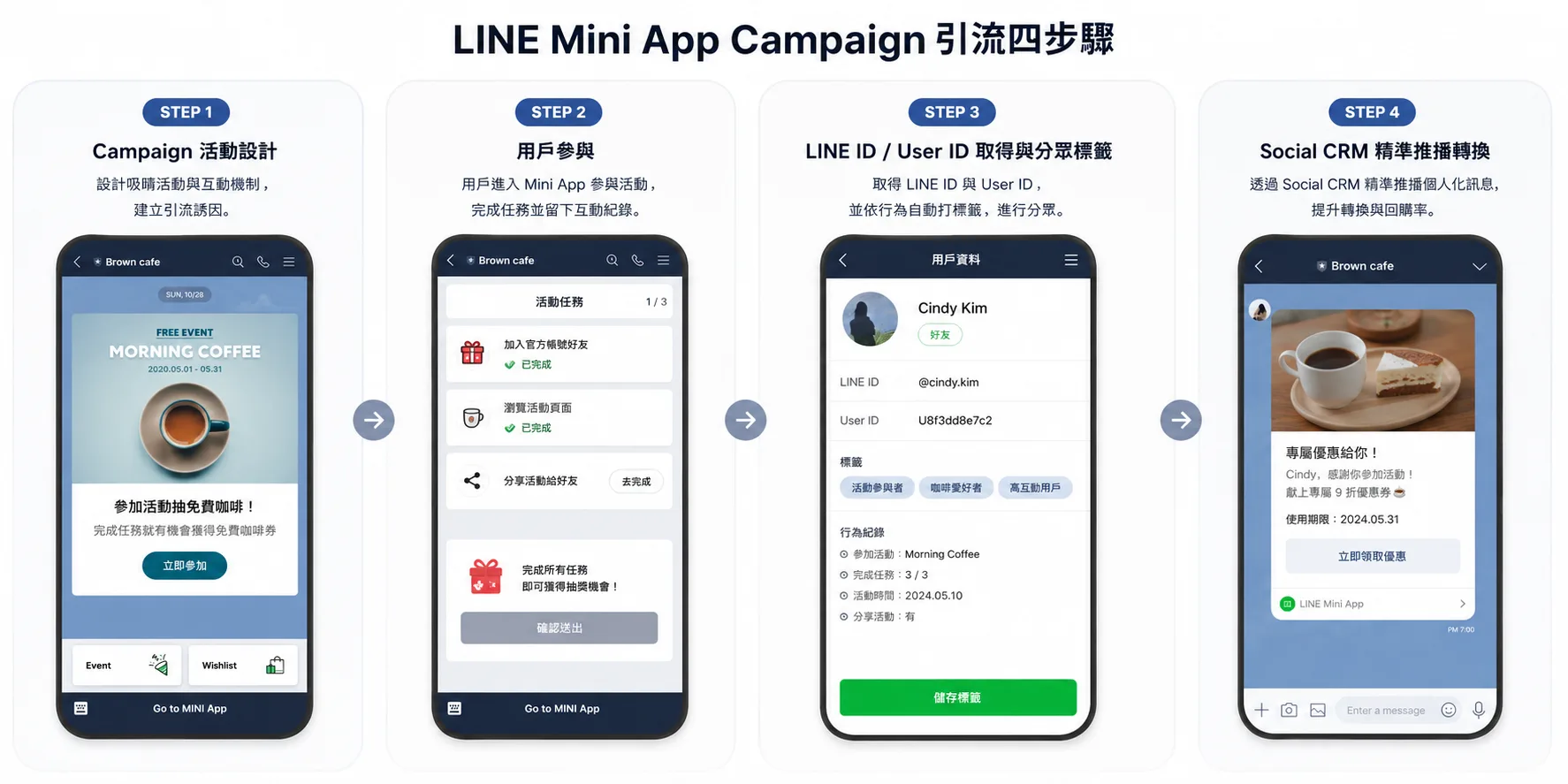
An effective MINI App campaign does three things at once: drives traffic into the MINI App, captures LINE User IDs, and applies audience segment tags, so Social CRM can take over all the precise communication that follows.
The Private Traffic Moat: First to Build, First to Win
 Source
People often ask me when the best time to get into LINE MINI Apps is. My answer: last year. The second-best answer: now.
I'm not trying to sell urgency. That's simply how private traffic works. The earlier and more data you collect, the more precisely you can act. The more precisely you act, the higher your repeat-purchase rate. The higher your repeat-purchase rate, the less you depend on ad platforms. It's a virtuous flywheel, but it takes time to get spinning — and once it does, the cost for latecomers to catch up grows exponentially.
A LINE MINI App can open the door for your brand, but how much value that door brings depends on how you treat every person who walks through it.
There's a link many brands overlook: the entry point and the flywheel are two different things.
A LINE MINI App is an excellent entry point. It solves the problem of “how to capture users' real identities on a high-penetration platform,” far more efficiently than a brand app and at far lower cost than buying ad traffic. But the entry point is only step one. LINE User IDs, click behavior, purchase history, membership tiers — once this data comes in, if it just sits in the back end, its value is zero.
 Source
To turn a MINI App from an entry point into a flywheel, you need a back-end system that converts data into action: automatically segmenting users by behavior, triggering different remarketing flows for different audiences, making sure high-value users get the right message at the right moment, and waking up dormant users without annoying them. This is nearly impossible to scale manually. It takes a Social CRM platform that truly understands the LINE ecosystem and can work with LINE User ID data.
The LINE User IDs a MINI App collects are raw ore; Social CRM is the smelter that turns that ore into competitive advantage. Without the smelter, the ore is just a backlog that keeps growing.
OakMega is a Social CRM platform built in Taiwan specifically for the LINE ecosystem, helping brands turn the user data collected by MINI Apps into actionable marketing. From data collection, audience segmentation, and personalized marketing journey design to automated triggers and remarketing, OakMega is currently the Social CRM solution with the deepest LINE ecosystem integration in the Taiwanese market. I'm not here to pitch my own product — I've genuinely seen too many brands deploy a MINI App, leave the asset idle for lack of back-end data integration, and end up right back on the old road of buying ads.
There's still time to build a private traffic moat in Taiwan. But a moat isn't dug deep by a single app entry point. It's built up bit by bit through every precise message, every effective remarketing touch, and every LINE User ID put to good use. Those who start first keep digging deeper; those who start late face a trench that gets harder and harder to cross.
Getting in now isn't about having no other choice. It's because first-mover advantage deserves to be taken more seriously in private traffic than almost anywhere else.
FAQ
**Q: How is a LINE MINI App different from a LINE Official Account?**
A LINE Official Account (LINE OA) is primarily a messaging tool, focused on broadcast messages, chatbots, and menu interactions, with a user experience close to a messaging platform. A LINE MINI App is a full application interface that can deliver ordering, booking, shopping, and membership services inside LINE, close the transaction loop, and capture richer behavioral data. The two don't replace each other; they're tools at different layers that work best together.
Q: Which is better for the Taiwanese market, a LINE MINI App or a brand's own app?
For most brands that aren't tech-native, a LINE MINI App reaches users in Taiwan far more efficiently than a standalone app, because it requires no download and runs inside LINE, which users already open every day, dramatically reducing friction. A standalone app offers the most flexibility and full brand control, but in Taiwan's LINE ecosystem with 93% penetration, building a private traffic foundation with a MINI App first is usually the higher-ROI starting point.
Q: Are Service Messages really completely free? What are the limits?
Service Messages are free under specific conditions: the user must first actively trigger a relevant action inside the MINI App, such as completing an order, joining as a member, or starting a service, before the brand is allowed to send them. The mechanism is designed to ensure messages are sent in contexts the user has authorized, which is why open and engagement rates are far higher than for regular broadcasts. Brands should note that Service Messages should focus on service notifications directly tied to user actions, not pure advertising.
Q: Is it too late to start building a LINE MINI App now?
100 brands are a tiny share of a market with 22 million monthly active LINE users in Taiwan, and most competitors in most verticals haven't moved seriously yet. Judging by the history of WeChat Mini Programs, it typically takes 18 to 24 months from platform opening for early brands to build up their data, and Taiwan is currently in the early part of that golden window. It's not too late, but every month you wait is another month of data assets for the competitors who got in first.
Q: I've already built a LINE MINI App, but almost nobody uses it. What's wrong?
This is the most common problem with brand MINI Apps. The root cause is usually that the MINI App was built as an “always-on service entry point,” but users have no reason to open it. Without games or high-frequency services (ride-hailing, food delivery) driving daily traffic, brand MINI Apps struggle to form natural usage habits. The fix isn't to optimize the MINI App's features. It's to design a traffic-driving campaign — a personality quiz, an interactive activity, a limited-time offer — that brings users in with something shareable, captures their LINE User IDs and segment tags, and then lets Social CRM handle the precise messaging that follows. The MINI App is the door; the campaign is the reason to walk through it.
Q: How do you design a personality quiz campaign for a LINE MINI App?
Personality quizzes are the MINI App campaign format with the strongest proven results in Taiwan, with completion rates above 90% and a built-in incentive for users to share. The design logic: write 6 to 12 questions tied to your brand's context, sort users into 3 to 5 types, give each type a personalized result and matching recommendations (products, playlists, car models, and so on), and trigger a LINE Service Message on completion to capture the ID and apply tags. KKBOX used music-behavior questions to identify listener personalities and push matching playlists, while Pao Chia United used driving-style preferences to sort audiences across Jeep, Alfa Romeo, Peugeot, and Citroën — both real-world applications of this logic.
Q: Which industries are best suited to LINE MINI App campaigns?
Industries with proven results in Taiwan include:
Retail and e-commerce — loyalty cards, member centers, and shopping recommendations, a low-cost alternative to a brand app with LINE Pay integration
Restaurant chains — ordering, reservations, and pickup notifications, using Service Messages instead of expensive push ads
Automotive brands — multi-brand routing (as in the Stellantis case), test-drive booking, and maintenance reminders, precisely reaching high-ticket car buyers
Music and entertainment — personalized content recommendations (as in the KKBOX case), concert notifications, and subscription onboarding
Beauty and personal care — booking systems, repurchase reminders, and personalized skincare recommendations
What they have in common: customers “research and compare” before buying, or have repeat-purchase potential afterward — exactly the scenarios where LINE User IDs combined with Social CRM behavior tracking deliver the most value.
Q: How should you measure LINE MINI App performance?
Core metrics should focus on the quality of private traffic rather than its scale, including: the number of LINE User IDs collected, MINI App monthly and daily active users (MAU/DAU), Service Message open and click-through rates, conversion rates and average order value driven by the MINI App, and changes in member repeat-purchase rates. Unlike ad-driven traffic, private traffic usually only starts to show compounding results after three to six months, so evaluate trends quarter by quarter rather than judging success by a single month's numbers.
Q: How can a business apply for a LINE MINI App?
What are the prerequisites? Since October 2025, LINE MINI App has been a fully open platform. Businesses can apply directly through the LINE Developers Console without whitelist approval. The basic requirements are an active LINE Official Account and completed business verification. Once development is complete, the app must pass LINE's review process, which typically takes 5 to 10 business days.
References
- LINE Taiwan (2025). “LINE MINI App Open Platform Announcement: IAP and Ad Revenue Sharing Explained.” LINE Developer News. Read more
- AppsFlyer (2024). “State of App Marketing Report 2024.” AppsFlyer. Read more
- LINE Taiwan (2025). “LINE Taiwan User Base and Market Penetration Data.” LINE Corporation official media kit. Read more
- LINE Taiwan (2025). “LINE Touch NFC Product Preview and Developer Notes.” LINE Developer Conference Taiwan 2025. Read more
- WalktheChat (2024). “WeChat Mini Programs: Stats, Categories & Ecosystem Overview.” WalktheChat. Read more
- AppInChina (2024). “WeChat Mini Program Statistics: 4.3 Million Programs.” AppInChina. Read more
- Carstuff (2025). “Pao Chia United Officially Announces It Will Distribute Alfa Romeo, Jeep, and RAM.” Carstuff. Read more