






Telegram the Chameleon: Is Cybersecurity National Security? Telegram's Love-Hate Relationship with Governments
Telegram promises the highest level of confidentiality for user data and has refused to hand chat records over to several governments. That promise fueled its rapid global growth: it reached 400 million monthly active users in just six years. Interestingly, in Taiwan, brands moved to Telegram before users did because LINE raised its prices, which had nothing to do with security or privacy. In Taiwan, Telegram has become one more option for running communities across platforms.
 AbbieCustomer Success Manager
 Inspired by: the Blue Shuilinglong series.
▍Taiwan: A timeline of the Presidential Office hack
May 15 |
In the evening, news broke of a data leak at the Presidential Office. Over the next few days, “Presidential Office hacked” became a trending phrase and caused an uproar. Was it a tangled love affair, a twist of fate, the lure of money, or a clash of interests? Stay tuned.
May 17 |
Enoch Wu outlined a three-point framework on the national security leak on Facebook. My favorite passage:
// [Rules decay through old habits, and people grow comfortable with the status quo. How many more unexploded cybersecurity bombs are waiting to be defused?]
To ensure “information security,” we must secure personnel, systems (network / ICT), and the physical environment. //
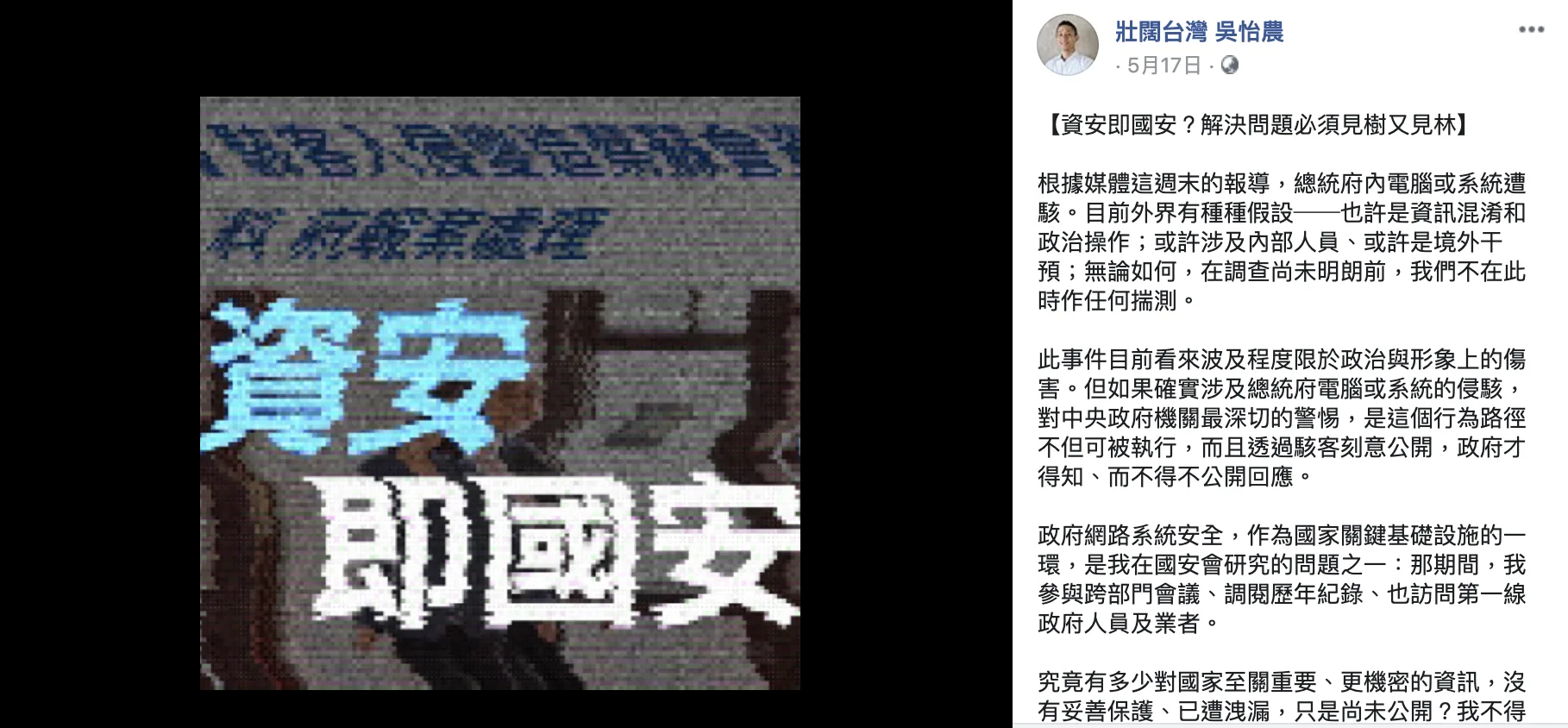 Image source / Facebook: Thrive Taiwan, Enoch Wu
Telegram promises the highest level of confidentiality for user data and has refused to hand chat records over to several governments. That promise fueled its rapid global growth: it reached 400 million monthly active users in just six years.
Interestingly, Telegram's user base surged in places like Hong Kong, South Korea and Iran because governments were monitoring speech. Taiwan is a completely different story: brands moved to Telegram before users did because LINE raised its prices, which had nothing to do with security or privacy.
President Tsai Ing-wen, for example, ran a Telegram channel for a while, again for reasons that had nothing to do with cybersecurity or national security. In Taiwan, Telegram has become one more option for running communities across platforms.
 So is it good or bad? / Image source: YouTube, Blue Shuilinglong
After reading other countries' stories, you might notice that Telegram's rise in Taiwan wasn't driven by national security. Here, privacy-first Telegram is just another community management option, and that's actually something to be very grateful for…

▍An umbrella for democracy and freedom…?
If Telegram offers so much privacy and protection, can it still run into “unexploded cybersecurity bombs”? It can. Let's look at the security bombs different countries have aimed at Telegram.
🇭🇰 Hong Kong
During the 2019 anti-extradition protests in Hong Kong, huge numbers of people started using Telegram, and it became a major tool for the movement. But on the eve of the June 12 protest, police arrested the admin of a Telegram group dedicated to help requests, discussion and information exchange for the June 11 second reading of the bill, and forced him to hand over his phone password. The data of that group's 20,000 members fell straight into police hands.
💥 Hong Kong police dropped a low-tech brute-force bomb and, overnight, solved what had stumped governments around the world: neither threats nor bribes could get at Telegram's content.
🇷🇺 Russia
In 2016, the Russian government passed an anti-terrorism law requiring messaging providers to give authorities user messages and data. Telegram argued that the demand violated the constitution, and on April 13, 2018, Russia ordered it blocked.
🇮🇷 Iran
In early 2018, Iranians protested inflation and economic recession. Local officials claimed Telegram channels encouraged armed uprising, throwing Molotov cocktails and other hateful acts that destabilized society. The Iranian government blocked Telegram in the name of “keeping the peace.”
💣 In both Iran and Russia, the founding team refused to hand over the keys and chose to be banned rather than let security blow up.
From Hong Kong to Iran, cybersecurity and national security are tightly linked. From a government's perspective, it's reasonable to see total privacy as a breeding ground for crime. From the user's perspective, Telegram is an umbrella: a shelter from the storm in a corner the government can't reach.
🇰🇷 A side note on South Korea
A story that's somewhat related, and somewhat not
On April 26, 2014, the Sewol ferry sank in South Korea, killing more than 300 people. The government came under public criticism, and in September President Park Geun-hye told her cabinet that online speech was dividing the country.
South Korean prosecutors then announced round-the-clock monitoring of online speech and obtained the chat records of tens of millions of users from companies such as Kakao and LINE. When the news broke, users flocked to Telegram: 1.5 million new users signed up within a week, and Telegram became an umbrella of democracy against the government.
▍Conclusion
Cybersecurity and national security are closely intertwined. South Korea's recent Nth Room case and ISIS's use of Telegram to communicate have drawn plenty of criticism. Still, among today's messaging apps, Telegram remains the relatively safer, more private choice.
Compared with the origin stories of other messaging apps, Telegram is probably the only platform on the market born because its founder got a visit from the police. It was conceived on the night police raided the founder's home: he wanted to make a phone call but feared being monitored, which strengthened his resolve to put privacy first no matter what.
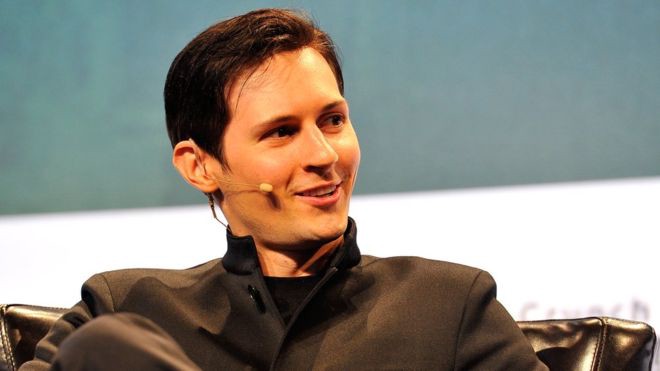 Image source / BBC: Russia’s Telegram block hits web users
“Privacy is not for sale, and human rights should not be compromised out of fear or greed.” That is why Telegram founder Pavel Durov refuses to compromise. Personally, I've always felt there's a gap between this quote and what Telegram actually brings about. Telegram protects people standing up to authoritarian, corrupt governments, but it also protects organizations that disregard human rights and spread fear. What do you think?
📣 Join the Telegram Taiwan Marketing Lab and join the discussion 🚀 Give your eyes a rest,
and learn about Telegram through our podcast 📟 Spotify 🍎 Apple 🖲 TuneIn