






Start Nurturing Your VIP Customers! 5 Free, Practical Tools for Managing Customer Data
With Apple's recent iOS updates adding “user-first” privacy protections, third-party cookies on their way out, and the EU's GDPR long in force, brands face huge challenges both in acquiring new customers and in maintaining existing relationships. With so much uncertainty around third-party data, brands need to actively build their own first-party databases. So how do you choose the right customer management tool?
 Howard HuangMarketing Specialist

With Apple's iOS updates this year (2021) adding “user-first” privacy protections, Google announcing it will phase out third-party cookies by 2023 and replace them with its new Privacy Sandbox initiative, and the EU's GDPR privacy rules in force for years, brands face huge challenges both in acquiring new customers and in maintaining existing relationships.
With so much uncertainty around third-party data, brands need to actively build their own first-party databases. A customer management tool not only helps you manage customers more effectively and improve customer retention—over time, it can also drive revenue growth.
So how do you choose the right customer management tool?
Why Does Actively Managing Customer Data Matter?

Every brand has a customer journey for its target audience, showing how customers interact with the brand—for example, how using the brand's services helps achieve the goals the brand has set. Managing customer data can be seen as focusing on improving customer acquisition and customer retention.
If your short-term marketing strategies and ad campaigns stay the same, the number of customers you acquire should stay the same, too. At that point, delivering services that precisely match customer needs can raise order conversion rates and improve retention.
Looking at it through the 80/20 rule, 80% of a company's revenue comes from 20% of its users—usually repeat buyers. That shows why it's so important to focus on retaining existing customers, and doing that effectively requires the right customer management tool. (Further reading: Why is customer retention so important for loyalty, operational ROI, and company growth?)
Why Do Customer Acquisition Costs Keep Rising? How Can Brands Stay Profitable?Imagine your company added nearly 100 new customers this month—60% more than the average of the past few months. Your sales, marketing, and even product and engineering teams are thrilled: it means your service is resonating with users and is more likely to attract investors. But do you know your current customer acquisition cost? In other words, how much did you spend on marketing to win those nearly 100 customers?https://oakmega.com/blog/why-cac-is-important-for-business
How Do You Choose the Right Customer Management Tool?
A good customer management tool doesn't just store customer data. It lets marketers and salespeople apply a digital marketing strategy to understand each customer's member profile and member history, optimize existing customer processes and marketing and sales strategies, and improve the service and satisfaction delivered by customer success specialists—ultimately raising retention.
Below, we introduce five customer data management tools that work for small and medium-sized enterprises (SMEs) across industries and can effectively strengthen customer relationships. They help brands apply CRM thinking to build their own first-hand member data, so marketing, sales, and customer service teams can hit their goals and improve retention.
Five Customer Management Tools for SMEs
1. HubSpot
HubSpot is a software company that brings marketing, sales, and customer service together on a single platform. Sales reps' inbound leads, follow-ups, and order flows—as well as team performance—can be viewed across different dimensions and charts. All data on the platform updates in real time and can be exported in one click, so marketing teams can use it for retargeting and truly own their first-hand data.
HubSpot also coined the term inbound marketing. Its view is that only brands that cultivate a rich online “ecosystem” and focus on building owned traffic, rather than relying on one-off ad traffic, can effectively attract their target audiences and build a competitive edge online.
2. Mixpanel
Mixpanel is a software platform for data-driven marketing analytics. It makes it easy to observe and analyze how users interact with your product, without tying up engineering time writing SQL or waiting on vendor support.
For metrics, everything from basic data to common ones like DAU, MAU, and retention can be queried in real time. It also supports cross-device tracking, so you can understand each customer's behavior profile, make strategies more concrete, and engage customers in the moment. You can also run A/B tests on website redesigns or new features and see results over a set time period.
3. Pipedrive
Pipedrive is a CRM platform focused on the sales process. Automated messages eliminate large amounts of repetitive appointment scheduling, and a clear interface shows customers' inbound pipeline at each stage. Its analytics automatically forecast each rep's future sales so you can adjust your sales strategy in real time.
Compared with Salesforce, Pipedrive has a lower barrier to entry: its basic plan meets most businesses' needs at a more competitive price. It also supports a full Chinese interface and Chinese-language customer support, shortening the adjustment period when rolling it out.
4. 91 App
91 App is an e-commerce storefront platform. As online shopping surges and customer journeys become increasingly fragmented, understanding the behavior of existing and potential customers is harder than ever—which makes marketing automation all the more important.
Beyond e-commerce storefronts, 91 App puts members at the core and drives online-merge-offline (OMO) integration, building a new retail model powered by omnichannel data marketing.
Its OMO CRM solution integrates different channels, records customer click behavior, and uses AI to predict products customers are likely to be interested in—helping you understand your members and easily create seamless online-offline experiences.
5. OakMega Social CRM
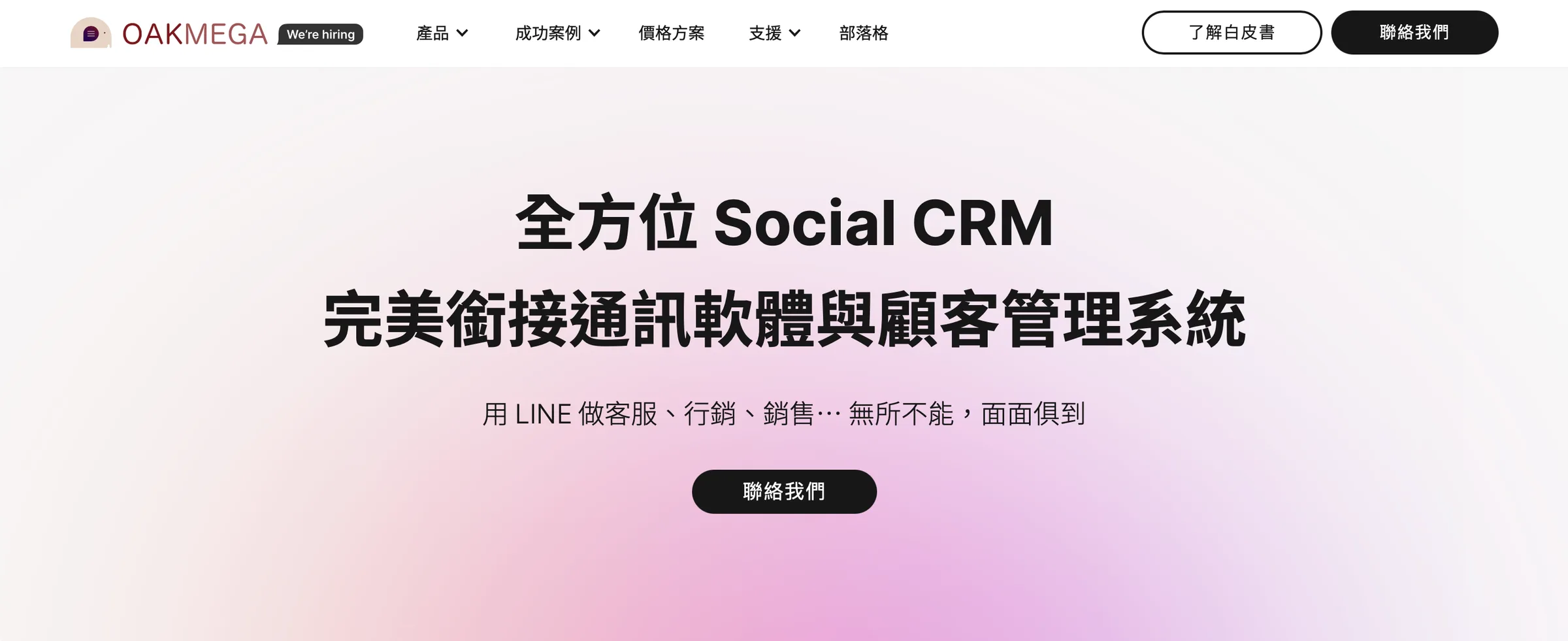
OakMega is a Social CRM software company focused on building customer relationship management systems on messaging apps, helping brands capture real-time first-party data and build VIP relationships with customers.
Running brands on messaging apps has become an unstoppable trend. Brands want to take advantage of how apps like LINE let them interact with customers directly, as well as how heavily people in Taiwan use them every day. OakMega Social CRM offers the most intuitive, easy-to-use admin interface in the industry, freeing you from the clunky native back end so you can easily manage LINE and other messaging apps. And because it brings CRM thinking into the mix, tag tracking lets you send segmented broadcasts for true one-to-one engagement, while building a member database and nurturing a loyal base of VIP customers to improve retention.
LINE OA vs. OakMega Social CRM: Which One Wins?LINE has become a space many marketers want to break into. Marketers have a lot on their plates every day—this article helps you evaluate which interface and features best fit your team.https://oakmega.com/blog/line-oa-vs-oakmega-social-crm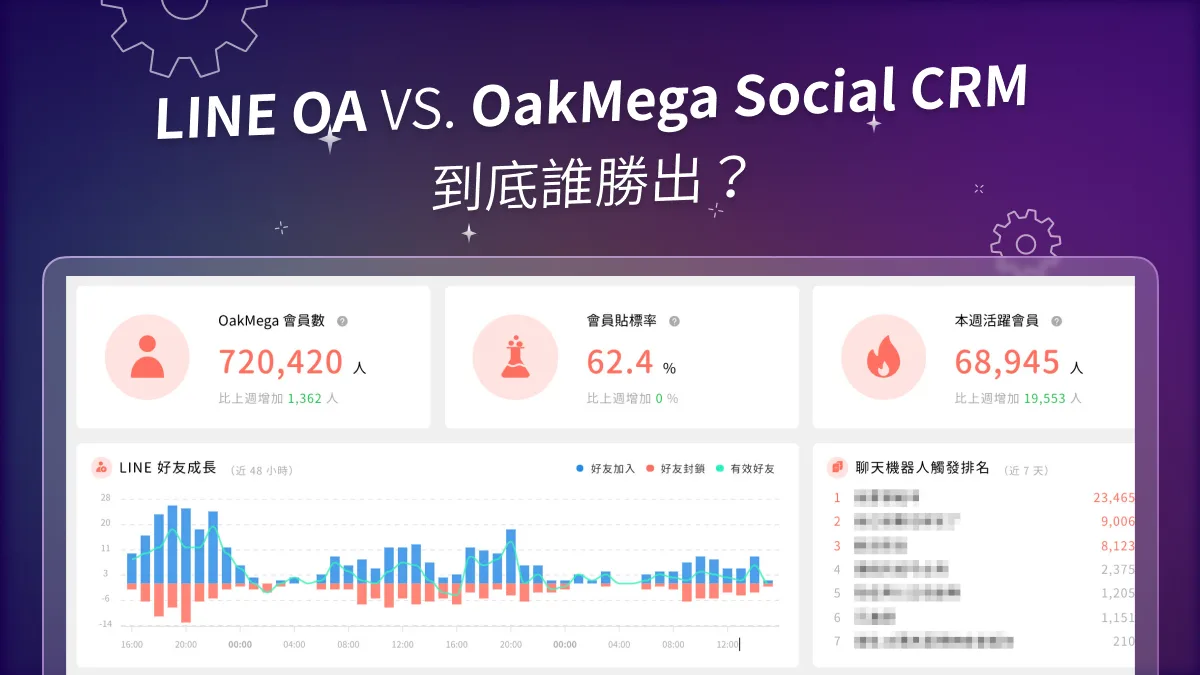
Conclusion
Building and managing a customer database to improve retention is key to a brand's continued growth. Only by taking a data-driven approach and consistently giving existing customers the content they need can you raise retention—and, across the customer engagement cycle of Acquire, Engage, Retain, and Grow, keep drawing potential users into interactions with your brand, creating a virtuous cycle.